... A FORUM TO STIMULATE DEBATE ... ... JUST ADD A COMMENT AT ANY ENTRY BELOW... ... FOR THE SUSTAINABLE DEVELOPMENT OF TOWN AND VALLEY ...
Showing posts with label dartington. Show all posts

Friday, 29 March 2019

Forestry Commission: centenary event "Evolving the Forest": Wednesday 19th - Friday 21st June at Dartington Hall

The Forestry Commission is celebrating 100 years: 

In September 1919 the Forestry Commission was founded to restore the nation’s woods and forests following the First World War, and the passing of the Forestry Act.

We are now England’s largest landowner and look after over 1,500 forests. We deliver internationally renowned research in sustainable forestry and help other landowners make their woodlands more productive, better for wildlife, and prepared for the challenges of a changing climate.


Celebrating 100 years of forestry | Forestry Commission England

And there's a very interesting-looking seminar at Dartington Hall later on: 

Evolving The Forest

Wednesday 19 June - Friday 21 June 2019
Dartington Hall, Devon

Book now

This symposium will draw together a wide variety of voices to explore a heritage of woodland and forest and look to their future. In celebration of the Forestry Commission’s centenary it looks back at the last 100 years and looks forward to the next.

The event will draw on the wisdom of foresters, environmental managers, policy-makers, scientists and other experts; it will hear the voices of artists, designers, writers and philosophers; and learn from others around the world about their own cultural connections to trees, and the wood that produces some of the world’s most beautiful objects.

Forest Research's contrbutions include a presentation by Chris Reynolds on 'Alternative species for resilient forests' in which he will explain how Forest Research are reviewing and testing new tree species for forestry in the UK. This will include some early results from recent field trials.

Also, with Karen Price from from Westonbirt Arboretum, Liz O'Brien will be holding an interactive workshop on 'How to Hygge a Tree' in which they will be exploring techniques for using trees and woodland for positive wellbeing.


Evolving The Forest - Forest Research
.
.
.

Saturday, 29 December 2018

The myth of meritocracy: who really gets what they deserve?

'Meritocracy' has been very much in the news of late, especially in the States - and from very different sources:
Quotas and the Lie of Meritocracy - Forbes
Meritocracy Is A Chimera - Forbes
Opinion | The Case Against Meritocracy - The New York Times
T.M. Landry and the Myth of Meritocracy in Education - The Atlantic
Douthat: The Case Against Meritocracy - Opinion - The Register-Guard - Eugene, OR

In the final look at 'meritocracy' on this blog, here is a piece from the Guardian from October this year which considers the author of the ironic concept - and how he started his thoughtful journey at Dartington:

The long read

The myth of meritocracy: who really gets what they deserve? 


Illustration: Getty / Guardian Design

By Kwame Anthony Appiah

Fri 19 Oct 2018 06.00 BST
Last modified on Mon 29 Oct 2018 13.32 GMT

Michael Young was an inconvenient child. His father, an Australian, was a musician and music critic, and his mother, who grew up in Ireland, was a painter of a bohemian bent. They were hard-up, distractible and frequently on the outs with each other. Michael, born in 1915 in Manchester, soon found that neither had much time for him. Once when his parents had seemingly forgotten his birthday, he imagined that he was in for a big end-of-day surprise. But no, they really had forgotten his birthday, which was no surprise at all. He overheard his parents talk about putting him up for adoption and, by his own account, never fully shed his fear of abandonment.

Everything changed for him when, at the age of 14, he was sent to an experimental boarding school at Dartington Hall in Devon. It was the creation of the great progressive philanthropists Leonard and Dorothy Elmhirst, and it sought to change society by changing souls. There it was as if he had been put up for adoption, because the Elmhirsts treated him as a son, encouraging and supporting him for the rest of their lives. Suddenly he was a member of the transnational elite: dining with President Roosevelt, listening in on a conversation between Leonard and Henry Ford.

Young, who has been called the greatest practical sociologist of the past century, pioneered the modern scientific exploration of the social lives of the English working class. He did not just aim to study class, though; he aimed to ameliorate the damage he believed it could do. The Dartington ideal was about the cultivation of personality and aptitudes whatever form they took, and the British class structure plainly impeded this ideal. What would supplant the old, caste-like system of social hierarchy? For many today, the answer is “meritocracy” – a term that Young himself coined 60 years ago. Meritocracy represents a vision in which power and privilege would be allocated by individual merit, not by social origins.

Inspired by the meritocratic ideal, many people these days are committed to a view of how the hierarchies of money and status in our world should be organised. We think that jobs should go not to people who have connections or pedigree, but to those best qualified for them, regardless of their background. Occasionally, we will allow for exceptions – for positive discrimination, say, to help undo the effects of previous discrimination. But such exceptions are provisional: when the bigotries of sex, race, class and caste are gone, the exceptions will cease to be warranted. We have rejected the old class society. In moving toward the meritocratic ideal, we have imagined that we have retired the old encrustations of inherited hierarchies. As Young knew, that is not the real story.

Young hated the term “welfare state” – he said that it smelled of carbolic – but before he turned 30 he had helped create one. As the director of the British Labour party’s research office, he drafted large parts of the manifesto on which the party won the 1945 election. The manifesto, “Let Us Face the Future”, called for “the establishment of the Socialist Commonwealth of Great Britain – free, democratic, efficient, progressive, public-spirited, its material resources organised in the service of the British people”. Soon the party, as it promised, raised the school-leaving age to 15, increased adult education, improved public housing, made public secondary school education free, created a national health service and provided social security for all.

As a result, the lives of the English working class were beginning to change radically for the better. Unions and labour laws reduced the hours worked by manual labourers, increasing their possibilities of leisure. Rising incomes made it possible for them to buy televisions and refrigerators. And changes, partly driven by new estate taxes, were going on at the top of the income hierarchy, too. In 1949, the Labour chancellor of the exchequer, Stafford Cripps, introduced a tax that rose to 80% on estates of £1m and above, or about £32m in contemporary inflation-adjusted terms. (Disclosure: I’m a grandson of his.) For a couple of generations afterward, these efforts at social reform both protected members of the working classes and allowed more of their children to make the move up the hierarchy of occupations and of income, and so, to some degree, of status. Young was acutely conscious of these accomplishments; he was acutely conscious, too, of their limitations.

Just as happened in the US, college attendance shot up in Britain after the second world war, and one of the main indicators of class was increasingly whether you had been to university. The middle-class status of meagerly compensated librarians reflected a vocational requirement for an education beyond secondary school; that the better-paid assembly-line workers were working-class reflected the absence of such a requirement. Working-class consciousness – legible in the very name of the Labour party, founded in 1900 – spoke of class mobilisation, of workers securing their interests. The emerging era of education, by contrast, spoke of class mobility – blue collars giving way to white. Would mobility undermine class consciousness?

These questions preyed on Young. Operating out of a community studies institute he set up in Bethnal Green, he helped create and nurture dozens and dozens of programmes and organisations, all attending to social needs he had identified. The Consumers’ Association was his brainchild, along with its magazine, Which?. So was the Open University, which has taught more than 2 million students since Young founded it in 1969, making it the largest academic institution in the UK by enrolment. Yet education mattered to him not just as a means of mobility, but as a way to make people more forceful as citizens, whatever their station – less easily bulldozed by commercial developers or the government planners of Whitehall. Late in life, he even set up the School for Social Entrepreneurs. Over the decades, he wanted to strengthen the social networks – the “social capital”, as social scientists say these days – of communities that get pushed around by those who were increasingly claiming a lion’s share of society’s power and wealth.

What drove him was his sense that class hierarchies would resist the reforms he helped implement. He explained how it would happen in a 1958 satire, his second best-seller, entitled The Rise of the Meritocracy. Like so many phenomena, meritocracy was named by an enemy. Young’s book was ostensibly an analysis written in 2033 by a historian looking back at the development over the decades of a new British society. In that distant future, riches and rule were earned, not inherited. The new ruling class was determined, the author wrote, by the formula “IQ + effort = merit”. Democracy would give way to rule by the cleverest – “not an aristocracy of birth, not a plutocracy of wealth, but a true meritocracy of talent.” This is the first published appearance of the word “meritocracy”, and the book aimed to show what a society governed on this principle would look like.


‘Education mattered to Young not just as a means of mobility, but as a way to make people more forceful as citizens, whatever their station.’ Photograph: Getty

Young’s vision was decidedly dystopian. As wealth increasingly reflects the innate distribution of natural talent, and the wealthy increasingly marry one another, society sorts into two main classes, in which everyone accepts that they have more or less what they deserve. He imagined a country in which “the eminent know that success is a just reward for their own capacity, their own efforts”, and in which the lower orders know that they have failed every chance they were given. “They are tested again and again … If they have been labelled ‘dunce’ repeatedly they cannot any longer pretend; their image of themselves is more nearly a true, unflattering reflection.”

But one immediate difficulty was that, as Young’s narrator concedes, “nearly all parents are going to try to gain unfair advantages for their offspring”. And when you have inequalities of income, one thing people can do with extra money is to pursue that goal. If the financial status of your parents helped determine your economic rewards, you would no longer be living by the formula that “IQ + effort = merit”.

Those cautions have, of course, proved well founded. In the US, the top fifth of households enjoyed a $4tn increase in pretax income between 1979 and 2013 – $1tn more than came to all the rest. When increased access to higher education was introduced in the US and Britain, it was seen as a great equaliser. But a couple of generations later, researchers tell us that higher education is now a great stratifier. Economists have found that many elite US universities – including Brown, Dartmouth, Penn, Princeton, and Yale – take more students from the top 1% of the income distribution than from the bottom 60%. To achieve a position in the top tier of wealth, power and privilege, in short, it helps enormously to start there. “American meritocracy,” the Yale law professor Daniel Markovits argues, has “become precisely what it was invented to combat: a mechanism for the dynastic transmission of wealth and privilege across generations.”

Young, who died in 2002 at the age of 86, saw what was happening. “Education has put its seal of approval on a minority,” he wrote, “and its seal of disapproval on the many who fail to shine from the time they are relegated to the bottom streams at the age of seven or before.” What should have been mechanisms of mobility had become fortresses of privilege. He saw an emerging cohort of mercantile meritocrats who can be insufferably smug, much more so than the people who knew they had achieved advancement not on their own merit but because they were, as somebody’s son or daughter, the beneficiaries of nepotism. The newcomers can actually believe they have morality on their side. So assured have the elite become that there is almost no block on the rewards they arrogate to themselves.

The carapace of “merit”, Young argued, had only inoculated the winners from shame and reproach.

Americans, unlike the British, don’t talk much about working-class consciousness; it is sometimes said that all Americans are, by self-conception, middle class. But this, it turns out, is not currently what Americans themselves think. In a 2014 National Opinion Research Center survey, more Americans identified as working-class than as middle-class. One (but only one) strand of the populism that tipped Donald Trump into power expressed resentment toward a class defined by its education and its values: the cosmopolitan, degree-laden people who dominate the media, the public culture and the professions in the US. Clinton swept the 50 most educated counties, as Nate Silver noted shortly after the 2016 election; Trump swept the 50 least. Populists think that liberal elites look down on ordinary Americans, ignore their concerns and use their power to their own advantage. They may not call them an upper class, but the indices that populists use to define them – money, education, connections, power – would have picked out the old upper and upper-middle classes of the last century.

And many white working-class voters feel a sense of subordination, derived from a lack of formal education, and that can play a part in their politics. Back in the early 1970s, the sociologists Richard Sennett and Jonathan Cobb recorded these attitudes in a study memorably titled The Hidden Injuries of Class. This sense of vulnerability is perfectly consistent with feeling superior in other ways. Working-class men often think that middle-class and upper-class men are unmanly or undeserving. Still, a significant portion of what we call the American white working class has been persuaded that, in some sense, they do not deserve the opportunities that have been denied to them.

They may complain that minorities have unfair advantages in the competition for work and the distribution of government benefits. Nevertheless, they do not think it is wrong either that they do not get jobs for which they believe they are not qualified, or that the jobs for which they are qualified are typically less well paid. They think minorities are getting “handouts” – and men may feel that women are getting unfair advantages, too – but they don’t think the solution is to demand handouts for themselves. They are likely to regard the treatment of racial minorities as an exception to the right general rule: they think the US mostly is and certainly should be a society in which opportunities belong to those who have earned them.


A still from an Open University maths lecture, first broadcast in January 1971. Photograph: Open University/PA

If a new dynastic system is nonetheless taking shape, you might conclude that meritocracy has faltered because, as many complain, it isn’t meritocratic enough. If talent is capitalised efficiently only in high tax brackets, you could conclude that we have simply failed to achieve the meritocratic ideal. Maybe it is not possible to give everyone equally good parenting, but you could push more rigorously for merit, making sure every child has the educational advantages and is taught the social tricks that successful families now hoard for their children. Why isn’t that the right response?

Because, Young believed, the problem was not just with how the prizes of social life were distributed; it was with the prizes themselves. A system of class filtered by meritocracy would, in his view, still be a system of class: it would involve a hierarchy of social respect, granting dignity to those at the top, but denying respect and self-respect to those who did not inherit the talents and the capacity for effort that, combined with proper education, would give them access to the most highly remunerated occupations. This is why the authors of his fictional Chelsea Manifesto – which, in The Rise of the Meritocracy, is supposed to serve as the last sign of resistance to the new order – ask for a society that “both possessed and acted upon plural values”, including kindliness, courage and sensitivity, so all had a chance to “develop his own special capacities for leading a rich life”. Even if you were somehow upholding “IQ + effort = merit”, then your equation was sponsoring a larger inequality.

This alternative vision, in which each of us takes our allotment of talents and pursues a distinctive set of achievements and the self-respect they bring, was one that Young had learned from his schooling at Dartington Hall. And his profound commitment to social equality can seem, in the mode of schoolhouse utopias, quixotic. Yet it draws on a deeper philosophical picture. The central task of ethics is to ask what it is for a human life to go well. A plausible answer is that living well means meeting the challenge set by three things: your capacities, the circumstances into which you were born, and the projects that you yourself decide are important. Because each of us comes equipped with different talents and is born into different circumstances, and because people choose their own projects, each of us faces his or her own challenge. There is no comparative measure that would enable an assessment of whether your life or my life is better; Young was right to protest the idea that “people could be put into rank order of worth”. What matters in the end is not how we rank against others. We do not need to find something that we do better than anyone else; what matters, to the Dartingtonians, is simply that we do our best.

The ideal of meritocracy, Young understood, confuses two different concerns. One is a matter of efficiency; the other is a question of human worth. If we want people to do difficult jobs that require talent, education, effort, training and practice, we need to be able to identify candidates with the right combination of aptitude and willingness and provide them incentives to train and practice.

Michael Young in 1949. Photograph: Getty

Because there will be a limited supply of educational and occupational opportunities, we will have to have ways of allocating them – some principles of selection to match people to positions, along with appropriate incentives to ensure the necessary work gets done. If these principles of selection have been reasonably designed, we can say, if we like, that the people who meet the criteria for entering the schools or getting the jobs “merit” those positions. This is, to enlist some useful philosophers’ jargon, a matter of “institutional desert”. People deserve these positions in the sense in which people who buy winning lottery tickets deserve their winnings: they got them by a proper application of the rules.

Institutional desert, however, has nothing to do with the intrinsic worthiness of the people who get into college or who get the jobs, any more than lottery winners are people of special merit and losers are somehow less worthy. Even on the highest levels of achievement, there is enormous contingency at play. If Einstein had been born a century earlier, he might have made no momentous contributions to his field; a Mozart who came of age in the early 20th century and trained on 12-tone rows might not have done so either. Neither might have made much use of their aptitudes had they grown up among the Amazonian Nukak.

And, of course, the capacity for hard work is itself the result of natural endowments and upbringing. So neither talent nor effort, the two things that would determine rewards in the world of the meritocracy, is itself something earned. People who have, as The Rise of the Meritocracy bluntly put it, been repeatedly “labelled ‘dunce’” still have capacities and the challenge of making a meaningful life. The lives of the less successful are not less worthy than those of others, but not because they are as worthy or more worthy. There is simply no sensible way of comparing the worth of human lives.

Put aside the vexed notion of “merit”, and a simpler picture emerges. Money and status are rewards that can encourage people to do the things that need doing. A well-designed society will elicit and deploy developed talent efficiently. The social rewards of wealth and honour are inevitably going to be unequally shared, because that is the only way they can serve their function as incentives for human behaviour. But we go wrong when we deny not only the merit but the dignity of those whose luck in the genetic lottery and in the historical contingencies of their situation has left them less rewarded.

Yes, people will inevitably want to share both money and status with those they love, seeking to get their children financial and social rewards. But we should not secure our children’s advantages in a way that denies a decent life to the children of others. Each child should have access to a decent education, suitable to her talents and her choices; each should be able to regard him- or herself with self-respect. Further democratising the opportunities for advancement is something we know how to do, even if the state of current politics in Britain and the US has made it increasingly unlikely that it will be done anytime soon. But such measures were envisaged in Young’s meritocratic dystopia, where inheritance was to hold little sway. His deeper point was that we also need to apply ourselves to something we do not yet quite know how to do: to eradicate contempt for those who are disfavoured by the ethic of effortful competition.

“It is good sense to appoint individual people to jobs on their merit,” Young wrote. “It is the opposite when those who are judged to have merit of a particular kind harden into a new social class without room in it for others.” The goal is not to eradicate hierarchy and to turn every mountain into a salt flat; we live in a plenitude of incommensurable hierarchies, and the circulation of social esteem will always benefit the better novelist, the more important mathematician, the savvier businessman, the faster runner, the more effective social entrepreneur. We cannot fully control the distribution of economic, social and human capital, or eradicate the intricate patterns that emerge from these overlaid grids. But class identities do not have to internalise those injuries of class. It remains an urgent collective endeavour to revise the ways we think about human worth in the service of moral equality.

This can sound utopian, and, in its fullest conception, it undoubtedly is. Yet nobody was more practical-minded than Young, institution-builder par excellence. It is true that the stirrings of Young’s conscience responded to the personal as well as the systemic; dying of cancer in a hospital ward, he worried whether the contractor-supplied African immigrants who wheeled around the food trolleys were getting minimum wage. But his compassion was welded to a sturdy sense of the possible. He did not merely dream of reducing inherited privilege; he devised concrete measures to see that it happened, in the hope that all citizens could have the chance to develop their “own special capacities for leading a rich life”. He had certainly done exactly that himself. In the imaginary future of The Rise of the Meritocracy, there was still a House of Lords, but it was occupied solely by people who had earned their places there through distinguished public service. If anyone had merited a place in that imaginary legislature, it would have been him.

That was far from true of the House of Lords he grew up with, which was probably one reason why his patron Leonard Elmhirst declined a peerage when offered one in the 1940s; in the circles he moved in, he made clear, “acceptance would neither be easy for me to explain nor easy for my friends to comprehend”. So it is more than a little ironic that when Young, the great egalitarian, was offered a peerage in 1978, he took it. Naturally, he chose for himself the title Baron Young of Dartington, honouring the institution he had served as a trustee since the age of 27. As you would expect, he used the opportunity to speak about the issues that moved him in the upper house of the British parliament. But there is a further, final irony. A major reason he had accepted the title (“guardedly”, as he told his friends) was that he was having difficulties meeting the expense of travelling up to London from his home in the country. Members of the Lords not only got a daily allowance if they attended the house; they got a pass to travel free on the railways. Michael Young entered the aristocracy because he needed the money.

Friday, 9 November 2018

Agroforestry: where trees, farming and biodiversity get together

Ten years ago, the Vision Group paid a visit to an inspiring project looking at 'agroforestry':
Futures Forum: The Agroforestry Research Trust @ Dartington

Writer on sustainability issues Samuel Smith looks at the latest - including from Dartington:

AGROFORESTRY: WHERE TREES, FARMING AND BIODIVERSITY GET TOGETHER

OCTOBER 10, 2018 / BLOG

This summer I’ve taken the opportunity to learn more about agroforestry. In August I spent a day at Wakelyns Agroforestry Farm in Suffolk with the UK Agroforestry Network, hearing from a variety of UK projects. Then in September, an agroforestry weekend course with Professor Martin Wolfe, hosted by Huxhams Cross Farm in Dartington.

Over the years I’ve become increasingly convinced of the important role agroforestry can play in helping our farming systems become more resilient to environmental pressures such as climate change. Therefore it’s been a pleasure to visit these sites, hearing first-hand the experiences from agroforestry experts. In this piece, I’m sharing some of the insights and learnings that stuck with me, as well as some resources.

First off, what is agroforestry? It’s the deliberate integration of trees and shrubs into crop or pastureland. This may be done for a variety of reasons. For example, providing shelterbelts for crops, valuable shade for animals, habitats to increase biodiversity, improvements to soil structure and health, and crop diversification. As such, agroforestry is not new. Humans have always been dependent on, or closely associated, with trees. Agroforestry practices stretch back thousands of years. You could even say that we evolved as agroforesters.

While many farmers are conscious of the value trees bring to their landscapes, industrial farming systems have created ever-increasing field-sizes, devoid of trees and shrubs, and dominated by single-variety mono-cultures. To provide reliable, predictable and cheap outputs, these systems are co-dependent on chemical inputs and large, expensive machinery. The result is cheap food. But at what cost?


Vast monocultures dominate many farming landscapes

The UK Environment Secretary, Michael Gove recently said that our soils have 30-40 harvests left. A fundamental destruction of soil fertility is underway. Alongside this, we’re witnessing other escalating environmental pressures such as climate change and an unprecedented loss of biodiversity, while being tasked with a quest for sustainable intensification as available land declines. So naturally, there’s increasing attention towards regenerative agricultural practices (methods of farming that increase ecosystem services, rather than deplete them) and in particular, agroforestry.


Professor Martin Wolfe and Wakelyns

It’s fitting to begin by introducing Professor Martin Wolfe, a pioneer of agroforestry in the UK. A plant pathologist by trade, Martin spent his early career as a scientist, particularly interested in the co-evolution of pests and wheat diseases. In 1984, while working at the Plant Breeding Institute in Cambridge, Martin was introduced to the term “agroforestry”. This was a key moment that started to shape his ideas and research. The idea of integrating the diversity of annual and perennial crops into a farm system led Martin and his wife Anne, to establish Wakelyns, a 22.5 hectare organic agroforestry system in 1994. The aim was to understand and compare different types of agroforestry systems. In particular, Martin has been fascinated with the diversity at every level of farming, from the soil microbia, to crop varieties and populations and the species of flora and fauna across the farm.


Professor Martin Wolfe, with Marina O’Connell at Huxhams Cross Farm

In agroforestry, there are some broad categories of systems:
> riparian buffers: trees lining the edges of a watercourse: offering shade protection, as well as slowing down and filtering the water entering into the watercourse.
> shelterbelts: usually wind protection. One of the largest examples of a shelterbelt is the Great Green Wall in China – still being planted, it is designed to protect from the dust storms of the Gobi Desert. It’s estimated to be completed in 2050, at which point it will be 2,800 miles long!
> wood pasture: a mosaic habitat of trees, such as can be found in national parks.
> silvopasture: combining trees and the grazing of animals in a mutually beneficial way.
> parkland: such as you might find on estates.
> forest gardens: designed to emulate natural woodland, very intensive, multi-layered planting of crops, typically small-scale.
> alley cropping: described below:

At Wakelyns, the dominant approach is alley cropping whereby rows of trees are planted and a crop is grown in the alleyways between these rows. There is quite a different feel to a farm landscape that uses alley-cropping. It’s not possible to gaze across an expansive landscape. Instead, the feel is of intimacy. Secluded, quiet lanes that buzz with wildlife. The alley cropping system at Wakelyns, I understand, is the most mature in the UK.

The alleys at Wakelyns are orientated North-South, this is typical for minimizing shading in the crop lanes. Martin’s alleys are 12m width, which he selected to support a range of farm machinery (divisible by 3 or 4m). The tree rows are 3m wide. The site features three sets of tree system: a) hardwoods (e.g. ash, hornbeam, oak, hornbean), b) a hazel and willow coppiced system c) fruit and nut system.


The hazel is planted as a double hedge and coppiced alternately every five years, previously for weaving and thatch roofs and currently for on-site heating fuel. This rate of growth is considered fast – a standard coppice cycle is typically every seven years.


The willow is a five-component mixture of species, also planted as pairs, with 75cm between rows and 90cm spacing.


Land Equivalent Value (LER)

Some farmers may fear that trees compete for valuable space and water on a farm – thereby decreasing the yield of the primary crop. This is where the Land Equivalent Ratio (LER) becomes an important concept to help compare the yields of an agroforestry system that have multiple outputs (e.g. the yield from the tree crops such as fruit or timber) against a monoculture system.

The LER indicates the area of monocultures needed to produce as much as one intercropped hectare. Anything above one is a gain. So for example, if the LER is 1.4, the agroforestry system yields 40% more than if the crops are grown separately on two plots. How might this happen? There can be multiple reasons that support a positive interaction between trees and crops. For example, increased crop shelter (the trees help reduce wind speeds), improved soil and water quality protection, and reduced evaporation and water loss from crops. At Wakelyns, Martin has calculated an LER of 1.4 but he is mindful to note that there is nothing to accurately compare this against, as he doesn’t have a nearby monoculture of the same crop varieties grown under the same conditions. Martin believes that LER is helpful but we also need to develop Biodiversity, Carbon and Water Equivalent Ratios, helping understand better the other benefits happening in an agroforestry system. To this end, there is huge potential for further research.


Graphic from from Briggs, S. (2015). A farmers perspective on Agroforestry (presentation).

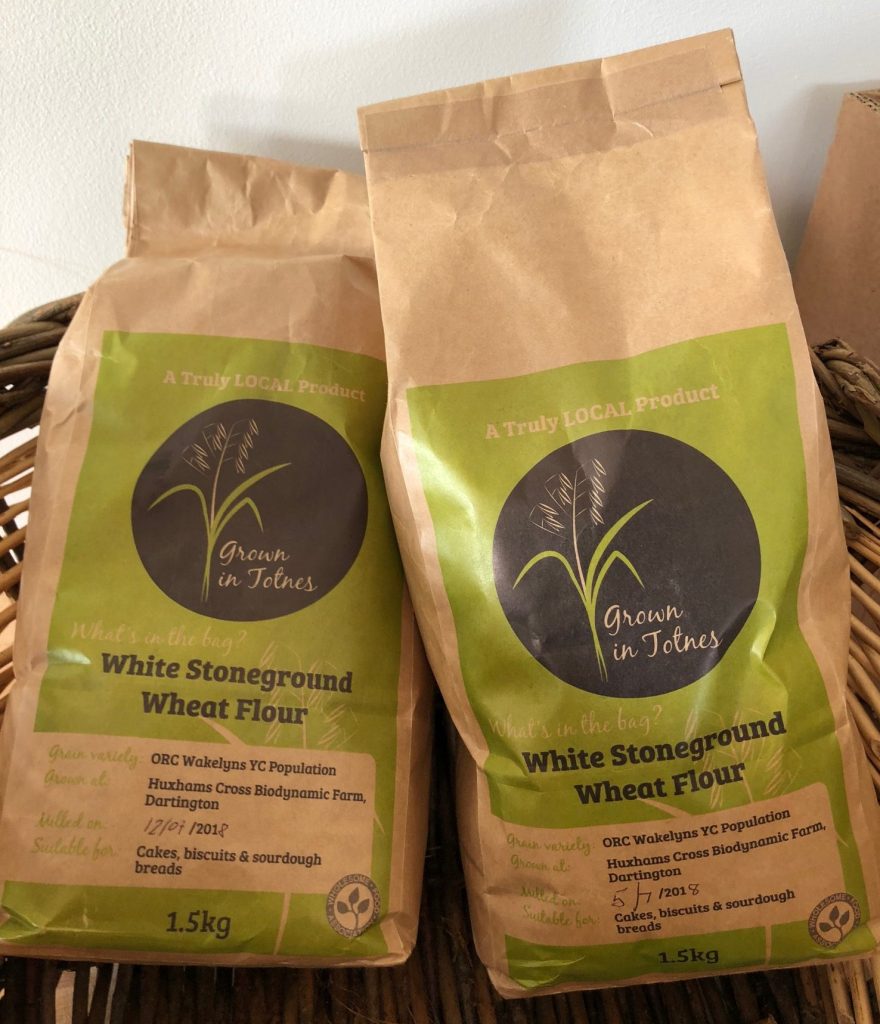
Population Wheat

One aspect of the visit that was particularly interesting was Martin’s work on Composite Cross Populations of wheat. Starting in 2001/02 and in partnership with the Organic Research Centre, an evolutionary breeding programme has produced a hugely diverse population of wheat suitable for organic and low-input farming systems. Known as “Population Wheat”, it was bred by making 190 crosses among 20 different parent varieties (some high yielding, and some highly resilient) and mixing all the resulting seed. This has now been through eleven generations of natural field selection, including at Wakelyns.

The diversity in the “populations” approach, both genetic and physical, means the crop has a better capacity to cope with a more variable climate, pests and diseases. This means that it’s also better suited for organic, low-input approaches. In a conventional monocultural system, identical varieties of the same crop are typically planted across a field. While this approach has convenience for marketing and manufacturers, the crop is less adaptable to environmental stresses. The Population Wheat demonstrates Martin’s pursuit for species diversity, not just at a macro-scale through alley-cropping, but within arable crop species.


A local food system

While many arable farmers have little control or knowledge of where their crop ends up, Martin has been able to link his farm products into a traceable local food system. This includes supplying into the award-winning Hodmedod’s – that specialise in beans and pulses from British farms (particularly focusing on less well-known and neglected crops) and Kimberley Bell’s Small Food Bakery in Nottingham. Both these enterprises have won BBC’s Food and Farming Awards in recent years. Establishing such a local food system is something Martin is passionate about and it demonstrates a replicable model for others.

Truly Traceable are also known to visit Martin’s farm – a rather unique enterprise that produces venison and game pies. Customers receive a certificate with their order, providing the location and a photo of the animal shortly after it’s been shot!


Huxham’s Cross Farm

The agroforestry course with Martin Wolfe took place at The Apricot Centre, Huxhams Cross Farm in Dartington. This is a 34 acre biodynamic, mixed farm that provides therapeutic support for families and children, as well as food production that includes the Population Wheat mentioned above, and mixed fruits, vegetables, and eggs, available through a local box scheme and markets.

This was my second visit to Huxham’s Cross this year and I’m incredibly impressed with how quickly this enterprise is transforming the land into a thriving, diverse and productive farm. It was only acquired in 2015 by the Biodynamic Land Trust and previously had been conventional barley for the last 40 years. An inspiring sign of how quickly landscapes and soils can start to be transformed. Not to mention, how farms can be designed as valuable places for people.

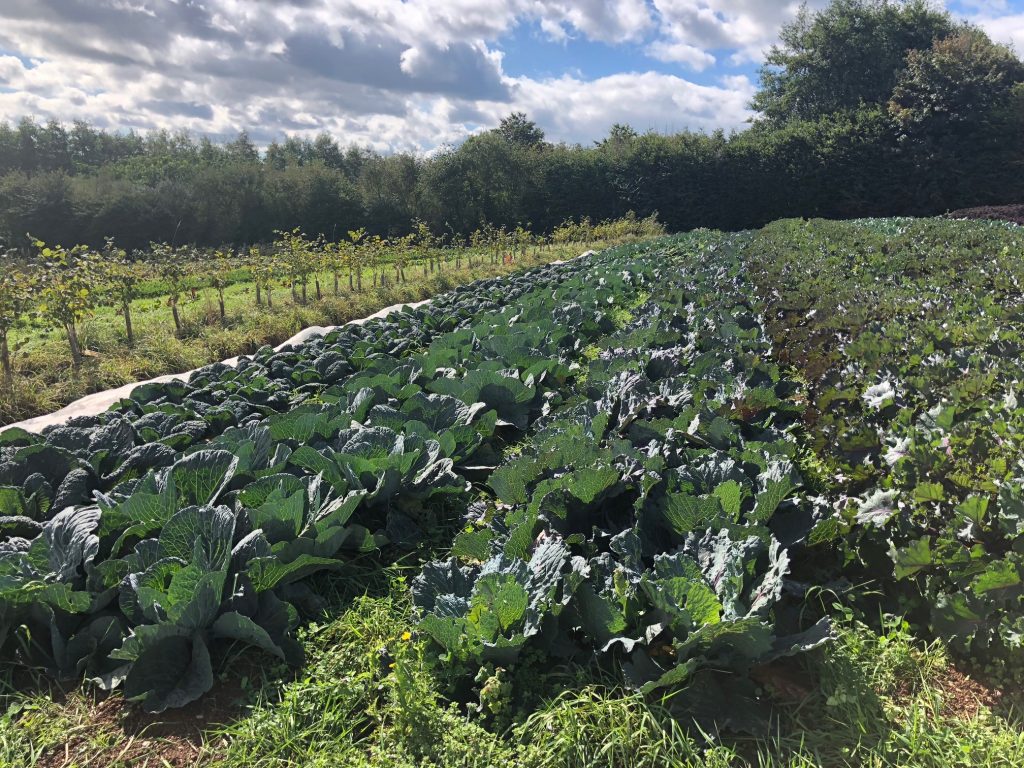
In terms of their application of agroforestry, vegetables are growing in an alley cropping system, with rows of hazel planted at 28m spacings. The hazel provides wind shelter, functional biodiversity and slows down the movement of water (and topsoil) down the field which slopes towards a brook. There’s a little more about the design process for the farm here, which was inspired by permaculture principles.


Broadlear’s Agroforestry Project

Just down the road is another new agroforestry project which Huxham’s Cross Farm is also involved with. What’s unique about this 48-acre field is the collaboration between multiple people and organisations: considered a “UK first” and therefore a valuable model to learn from. The different Parties include:

> The landowners – Dartington Hall Trust
> The farm tenant (Jon and Lynne Perkin, Dartington Dairy) – who are growing forage crops in the alleys for their goat herd.


Agroforestry tree license holders including:
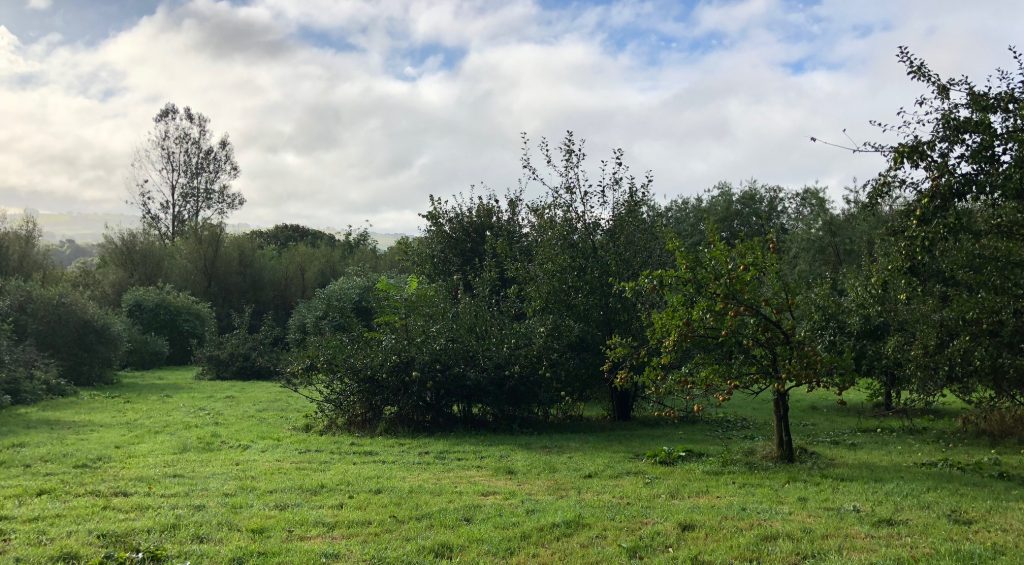
> Huxham’s Cross Farm – who have planted 600 fruit trees on 20m spacing
Salthouse & Peppermongers – who are growing the UK’s first ever commercial table crop of Sichuan pepper.
Luscombe Drinks – who have planted elderflower for their drinks.

There are some excellent, detailed blogs written by Harriet Bell that cover the design of this project, so I won’t even attempt to go into any detail here.


Agroforestry design at Broadlears


Broadlears Agroforestry site

I’ve had the pleasure of visiting Martin Crawford’s two-acre Forest Garden several times over the years and went on a course with him in 2014 (some notes of which are here). Martin Crawford is one of the most recognised practitioners of forest gardening and has written some excellent reference guides to support others.

In terms of agroforestry approaches, forest gardening is the most intensive and diverse, often showcasing an enormous diversity of species. Because of this, forest gardens are typically more suited to smaller scale systems and are unlikely to be commercial operations. Martin’s two-acre forest garden was planted in 1994, interestingly, the same time Martin Wolfe was planting his trees at Wakelyns. As such, it’s a fantastic example of a mature forest garden. Each time I visit it’s like being in a wonderland of edible curiosities. Inspiring, peaceful and a place from which there is a lot to learn.

Martin also has two other sites where agroforestry is demonstrated at a different scale. An 11-acre site nearby in Littlehempston and a Fruit and Nut forest. On this occasion, we were also able to visit his Fruit and Nut forest, which is more of a commercial enterprise. Compared to his 2-acre site, the trees here are given wider spacings, allowing them to spread out and enabling much better access for harvesting. The way trees are planted is more like a parkland, but very well sheltered by strips of willow and hazel.


Martin Crawford's Fruit and Nut Forest


How might we scale agroforestry?

Agroforestry is becoming more recognised and growing in popularity. As the urgency of climate change intensifies and increasing calls for carbon drawdown unfold, there will be an increasing number of voices that call us to plant more trees, transform our landscapes and our agriculture systems. This is right. However, as it stands, integrating agroforestry into food production systems, as seen in alley cropping, remains a niche, counter-cultural idea. For many farmers, I suspect it feels a risky, uncertain and long-term investment. It’s easy to understand why. In the UK there aren’t enough examples of mature, productive farms thriving from their investment into agroforestry. For many conventional farmers, exploring agroforestry will require a shift in thinking about their approach to food production; moving from mono-cropping systems to a more complex, diverse system, besides an investment into new or different machinery.

When thinking about how agroforestry can scale, we need to take a hard look at the existing lock-ins of our industrial agricultural systems. IPES-FOOD’s Uniformity to Diversityreport did a fantastic job at identifying these. For example, conventional farmers who have invested in large-scale, expensive machinery that lock them into industrial-scale cropping systems. Other lock-in examples might include farm business tenancies that don’t lend themselves to a patient, long-term investment into alley-cropping systems; or a policy environment that doesn’t support or understand farming agroforestry systems.

I like to think that all these challenges are surmountable. We urgently need many more agroforestry demonstration sites, knowledge sharing and support for farmers to test it. We should look globally at examples of best practice of where agroforestry is working in other countries. Examining the policies that will support it and the innovative ways in which farmers might integrate it – such as the multi-tiered tenancy approach at Broadlears. Right now in the UK, there’s a big opportunity with the new Agricultural Bill, to put in place measures to support agroforestry.

Agroforestry won’t happen automatically in response to environmental pressures. It needs advocating. Fortunately, we have some fantastic organisations promoting it (see the resources below) that need more support. Furthermore, we need to support the farming pioneers who are already practicing agroforestry. They have so much to teach us.


Useful resources


AFINET has been set up to share good practice, latest news and scientific achievements.
World Agroforestry Centre: based in Nairobi, a centre acts as a repository of agroforestry science and information, developing knowledge practices to ensure food security and environmental sustainability.
AGFORWARD: an EU four-year research project into agroforestry.
Agroforestry Research Trust: non-profit set up by Martin Crawford to research temperate agroforestry and all aspects of plant cropping and uses, with a focus on tree, shrub and perennial crops.
The Woodland Trust – UK charity, that can provide advisory support and free trees for farmers
2018 article in the Guardian on agroforestry: The latest cutting-edge technology changing our landscapes? Trees
Stephen Briggs’: a key practitioner and advocate of agroforestry in the UK. His system is based on 24m alleys, with a mix of perennials (apple trees) and annuals (cereals). He also runs Abacus Agriculture can provide advice on design.
Jonathan Smith, from Scilly Organics and the Farm Carbon Cutting Toolkit also wrote up his visit from the day at Wakelyns here.
More information on Composite Cross Populations from the Organic Research Centre


Agroforestry: where trees, farming and biodiversity get together – Samuel Smith

See also:
Futures Forum: The Water, Energy and Food Nexus
Futures Forum: Gender and the environment @ Radio 4's Costing the Earth
.
.
.

Saturday, 29 April 2017

Stretching the boundaries of zero-carbon building

It looks good and it ticked all the boxes for 'sustainable design':


Dartington Primary School | Have Your Say

However, it had to be demolished only seven years after it was built:
'Visionary' £7m eco-school to be demolished because of leaky roof - Telegraph
Demolition of leaky primary school at middle of £7m law suit is set to begin | Plymouth Herald

The Architect's Journal has looked into it a little more:

Exclusive: Demolished eco-school’s design ‘fell below expected level of competence’


12 APRIL, 2017 BY ELLA BRAIDWOOD


A zero-carbon school by White Design, demolished last year, was damaged by water ingress ‘largely due to defects in the design’, a damning report has found

The 2012 report by the Building Research Establishment (BRE), obtained by the AJ under the Freedom of Information Act, sheds light into the demolition of Dartington Primary School in Devon just seven years after its completion. The school, built for £6.5 million, had previously been lauded for its groundbreaking use of sustainable architecture.


Exclusive: Demolished eco-school’s design ‘fell below expected level of competence’ | News | Architects Journal

However, whilst there are plenty of other fiascoes
Masdar's zero-carbon dream could become world’s first green ghost town | Environment | The Guardian

... there are many successful exciting projects out there:
London's cleanest, greenest homes - The great Grosvenor experiment


Including in the West Country:
The Emerald wins special mention at South West Tourism Awards | The Emerald Cornwall

And more local authorities are recognising the benefits of encouraging such architecture and design principles:
New design and conservation awards – Shropshire Council
.
.
.

Tuesday, 19 April 2016

A solution to our housing problems: community land trusts

In the cities of the United States, communities are turning to the land trust model to generate affordable housing:


Report Release: Community + Land + Trust: Tools for Development without Displacement | NESRI | National Economic & Social Rights Initiative
Can Community Land Trusts Solve Baltimore’s Homelessness Problem? | The Nation
Can Neighborhoods Be Revitalized Without Gentrifying Them? | The Nation

It's also happening in UK cities:


Turner Prize 2015: Liverpool housing estate shortlisted for prestigious art gong - Mirror Online
Granby Four Streets CLT - Granby 4 Streets Community Land Trust
Futures Forum: Toxteth and Turner: "Turner Prize winners show how the soul can be put back into regeneration schemes"
Futures Forum: Toxteth and Turner: "It has taken the Turner prize to highlight that there is an alternative to replacing low-income housing with expensive flats."


Bristol Community Land Trust | Developing affordable housing and community assets around Bristol
Futures Forum: Housing: Made in Bristol
Futures Forum: Abolish Empty Office Blocks (AEOB: House People) buys its first property in Bristol

Things are happening in the South West:
Cornwall Community Land Trust | Affordable Homes
Community Land Trusts | WessexCA

In Totnes:

Introduction

Transition Homes Community Land Trust has submitted a planning application for a development of 27 affordable, eco-homes on a site near Dartington village.
This page provides information on the application, registering your interest as a potential resident of the site, and our contact details.This page will be updated with relevant news and information about the CLT and the proposed development, including volunteer opportunities when we get to the construction stage.

February 2016 - view and comment on our planning application

Our planning application was submitted in December and  has now been validated by South Hams District Council, who began their formal consultation on 2nd February. The application is available for viewing and comment on their website*, which contains the site and house plans.
There are many documents on their website which were submitted with the planning application. The planning statement is the key document for an overview of all aspects of the project. You can read it on the SHDC or read it here.
* If you are using a smart phone, the link will not work. Please search South Hams planning via Google, and in their search facility enter '2927/15' under application number.
We encourage anyone living locally to comment on the application during the consultation period, which ends March 2nd.
The main aim of the project is to provide affordable, sustainable housing for local people in housing need. The application includes plans for 19 affordable houses, with 8 market houses which are required to generate income to help pay for the affordable homes.
The plans


Transition Homes site plan, Clay Park
The key features of the development include:
  • 27 terraced homes: 1, 2, 3 and 4 bedroom
  • a community building, and plant room for a wood-fuelled boiler
  • highly sustainable development using low-carbon materials and technologies to minimise environmental impact
  • highly energy efficient homes resulting in low energy costs for residents
  • 19 affordable homes for local people in housing need, with 8 market homes
  • high quality construction – not ‘cheap’ housing – using local, natural building materials, and local tradespeople and suppliers
  • not 'just' a housing development: the site includes food growing areas; renewable energy; community orchard and coppice; shared facilities including a village green, community hub, and laundry; training & education opportunities for locals, building a new community
  • improved biodiversity of the site: hedgerow management and new hedges, native tree planting, orchard, wetland areas, wildflower meadow, nesting for birds and bats
  • community led, not-for-profit. Transition Homes CLT is a registered charity, and the project is run by local volunteers.
Transition Homes - Transition Town Totnes

And in East Devon:

Community Land Trusts

Content

A Community Land Trust (CLT) is a community-led, not-for-profit, organisation that provides land and buildings to meet the long term needs of it's community.  It offers a way to provide permanently affordable housing, and holds these assets in trust, so the community benefits forever.  
The National CLT Network provides resources and advice on getting started.

Start up loan

A loan of up to £5,000 per CLT can be made available from the council to qualifying CLT's to cover the initial start up costs. The loan is available to emerging or established CLTs. The loan is intended to help with legal fees, surveys and employing architects.
If you would like to apply for a CLT start up loan please contact our housing development and enabling officer for an application form.

When this content has been updated

Community Land Trusts - East Devon

And in particular, in Beer:


BEER COMMUNITYLAND TRUSTNorthcott Building Contractors | East Devon
Futures Forum: Beer Community Land Trust
Futures Forum: Community Land Trusts and affordable housing
Futures Forum: Community Land Trusts and affordable housing: part two: taking control

See also:
National CLT Network
.
.
.