... A FORUM TO STIMULATE DEBATE ... ... JUST ADD A COMMENT AT ANY ENTRY BELOW... ... FOR THE SUSTAINABLE DEVELOPMENT OF TOWN AND VALLEY ...
Showing posts with label family. Show all posts

Sunday, 24 March 2019

Rural poverty, rural immobility > "opportunities in rural areas are not as abundant for young people as they are in cities"

It's a very difficult thing to work out which areas of the country are rich or poor:
These maps show how hard it is to measure inequality in English council areas | CityMetric

The government keeps statistics of sorts:
Rural poverty statistics - GOV.UK

However, we do know that 25% of farming families live on or below the poverty line:
#KeepBritainFarming: Country Living campaign to save the UK's small family farms

Research shows that many living in the countryside cannot afford to keep warm:


The Sunday Times today warns about the realities of life in the country:

What young people quitting the city for the countryside need to know

India Knight 
The Sunday Times, March 24 2019

Sweet cottages aren't all inhabited by adorable, apple-cheeked people. Nature is violent. Rural poverty is shocking. Winters are long...

The Huffington Post looks at the issues: 

When Will Britain Acknowledge Our Countryside Poverty?

Has social mobility stopped? Certainly not, but if you live in a rural area your chances are being constrained


THE BLOG

22/03/2019 

Dan Boatright 

As a teacher I always find myself saying phrases like ‘if you work hard, you will reap the rewards’, ‘all those hours of studying will pay off’ and ‘keep your nose to the grindstone and you will achieve your goals’.

But in truth I know that there is still a huge barrier in front of my students – not what you know, but who you know. It pays to be connected – If social mobility worked effectively we would see the 7% of people who attended private schools being 7% of the leaders in their respective professions. Instead 50% of the leading people in such professions as politics, media and film, law, the arts, music and elite sports attended a private schools. While I do not begrudge them their success, this clearly demonstrates social mobility is not working in the UK.

If you live in a rural environment your chances of being successful in life are very much linked to your early years. I live in rural Worcestershire, and went to college from rural North Yorkshire. I remain the only degree educated person in my family and the reasons are clear – opportunities in rural areas are not as abundant for young people as they are in cities. As a result, our countryside has become a social mobility coldspot, with my local council of Wychavon rated 310th out of 324 councils in a recent government report. If your parents are plumbers or cleaners, bakers or builders, the chances are you will follow in their footsteps. For some, through choice, but for others, it is because options are limited.

It is easy to hide social mobility in the countryside. My town of Pershore is generally a well-off and affluent area. House prices and wages are above the national average, the town is a great place to raise children and the schools are generally good. But if you are from a working-class background and work in the service industry the average house prices of £300,000 quickly make the experience of living in the area unsustainable. And the recent revelation that house prices have been forced upwards by the government’s Help to Buy scheme, just adds to the issues people face. With housing unaffordable, people are struggling to help their children access opportunities to increase their chances in life.

Education is the key to success. Education opens doors to all, regardless of backgrounds. But in a rural area, education opportunities can be very limited. Schools have the added pressures of large catchment areas, with children travelling from a wide area. Class sizes can also be small and, in the current educational climate, unsustainable. So schools have to focus on traditional GCSE and A level subjects, limiting their students’ knowledge of other, potentially inspiring minority subjects. Similarly colleges focus on qualifications aimed at the local economy. In Pershore, our local college is an agricultural centre so, if a young person wants to study ancient history or geology, electrical engineering or photography, they must travel to neighbouring towns. This commute requires time and the money, and is also restricted further by the continued reduction of bus services in the area.

But it is an even bigger issue for the local economy if young people decide to go to university. As young men and women move into cities to study at university, they create a rural brain drain. This results in a drop in the 18-30 year old population, which further limits the opportunities of those who remain as it keeps job opportunities in traditional low paid professions. New industries rarely emerge and there are few incentives for young locals to return after graduation. With limited public transport and sluggish roll-out of high speed broadband graduates find no drive to return to their childhood homes.

The situation is more optimistic in inner cities. London occupies 17 of the top 20 most socially mobile councils. Young people have access to more post-16 education institutions, more teachers for specialist A-level subjects, more universities, and more employers with better-quality jobs.

As a teacher of geography and geology, I experience the impact that smaller subjects can have on young people who have not yet found their chosen career path. Studying a minority subject like geology (where jobs are abundant but awareness is limited), gives many students a sense of direction that they would have lacked if they did not know about Earth sciences and the careers available. But it is only in large colleges, or private institutions, that such subjects are sustainable. Furthermore, larger colleges in urban areas can access opportunities for their students. Working at an inner city college with many students from a deprived area, it is clear what we have to do to help them succeed. In areas like Pershore, poorer students are less visible and it is harder to identify individual needs; opportunities remain limited, especially for those without the finances or confidence to travel to neighbouring areas.

Of course not everything is perfect in major cities, but it is clear that opportunities are more accessible and education is the driving force that helps students from more deprived environments succeed in life. Wychavon, however, is struggling to keep up with the pace, with education opportunities limited and access to transport becoming ever more a problem. Has social mobility stopped? Certainly not. But if you live in a rural area, your chances are being constrained, and maybe we need to seek alternative approaches to help our rural young people succeed.


When Will Britain Acknowledge Our Countryside Poverty? | HuffPost UK
.
.
.

Friday, 23 November 2018

Tree-dressing at Sidmouth Parish Church > decorating a veteran yew > Saturday 24th November

Tomorrow is 'Tree Charter Day' - and Sidmouth is making a contribution:
Futures Forum: Tree-dressing at Sidmouth Parish Church > on Tree Charter Day > Saturday 24th November

The Herald is heading the event as one of its 'five things to do in Sidmouth this weekend':


Tree Dressing in the churchyard 

Become one with nature at a celebration of the life of a yew tree. The new event by Sidmouth Arboretum has been granted permission from the parish church to decorate one of the veteran yew trees that resides in the church yard.

The organisers are asking for people to bring their own decorations including colourful ribbons, strips of material, coloured paper, fir cones and dried fruit that will be hung on the tree. 

It is the Arboretum’s way of showing its appreciation of the tree and to give thanks for its evergreen foliage and habitat in the churchyard. 

The celebration is from 4 - 5pm on Saturday (November 24) and will take place in the churchyard of St Giles and St Nicholas. 

Email info@sidmoutharboretum.org.uk for more information.


Five things to do in Sidmouth this weekend | Latest Sidmouth and Ottery News - Sidmouth Herald
.
.
.

Sunday, 18 November 2018

Tree-dressing at Sidmouth Parish Church > on Tree Charter Day > Saturday 24th November

Next Saturday is Tree Charter Day:
Tree Charter Day - Vision Group for Sidmouth

Organised  by the Woodland Trust:

The 24th November 2018 is Tree Charter Day. It's an opportunity to reinforce our relationship with trees and woods, and reflect on last year when we launched the Charter for Trees, Woods, and People on the 800th anniversary of the 1217 Charter of the Forest.

We believe the people of the UK have a right to the benefits brought by trees and woods. The Charter recognises, celebrates, and protects this right. Tree Charter Day is the perfect time to enjoy and celebrate all things trees!

There will be a wide variety of activities taking place across the UK to get involved in - or why not set something up yourself? Whatever you do, we hope you have a tree-mendous Tree Charter Day!


And a local event in these parts is a tree-dressing at the Sidmouth Parish Church:

With a press release from the Sidmouth Arboretum:

This SATURDAY 24 NOVEMBER is annual Tree Charter Day and falls within National Tree Week

You are invited to a tree dressing 4pm-5pm at Sidmouth Parish Church.

The yew trees in the churchyard of St Giles and St Nicholas are young by some standards, though one has a girth of 13 foot or more. This Saturday Sidmouth Arboretum will celebrate the resilience and value of these trees by decorating the lower branches with colourful ribbons, and lights.

This is an opportunity for people to celebrate trees in the public domain, courtesy of the Church Warden – and hence to begin to value and care more for them.

All are welcome to join us in tree dressing, which is a way of saying thank you to the trees for their contribution throughout the year to the community as well as for wildlife. Bring your own decorations and join in the fun!


Sidmouth Arboretum
.
.
.

Saturday, 3 November 2018

Neo-localism

The think-tanks Localis considers how the issues around 'globalisation' effect us locally:
Futures Forum: Devolution and social mobility > "Rural areas such as Devon, Kent, Cumbria and Durham, as well as coastal towns like Dorset and Norfolk, are all in the bottom 10 on the social mobility index."

This is from their home page: 


NEO-LOCALISM

Our research and policy programme is guided by the concept of neo-localism. Neo-localism is about giving places and people more control over the effects of globalisation. It is concerned by economic prosperity, but also enhancing other aspects of people’s lives such as family and culture. It is not anti-globalisation, but wants to bend the mainstream of social and economic policy so that place is put at the centre of political thinking.
In particular our work is focused on four areas:
  • Reshaping our economy. How places can take control of their economies and drive local growth.
  • Culture, tradition and beauty. Crafting policy to help our heritage, physical environment and cultural life continue to enrich our lives.
  • Reforming public services. Ideas to help save the public services and institutions upon which many in society depend.
  • Improving family life. Fresh thinking to ensure the UK remains one of the most family friendly places in the world.
Each of these themes, and neo-localism as a concept, is explored further in our essay collection on Neo-localism: Rediscovering the nation. Contributors include Rt Hon Sajid Javid MP, Rafael Behr, Philip Collins and Claire Fox. Each essay takes on a question central to the future of localism and the broader political changes happening in the UK. Taken as a whole the collection is where Localis is heading intellectually, becoming a think tank which focuses on the idea of ‘place’ and why it matters to politics and policy.

And this is their essay collection:
Neo-localism: Rediscovering the nation
Neo-localism isn’t a neologism. It has been in use for some time in human geography circles. A quick google search tells you it was coined by Wes Flack and refers to the idea of promoting and preserving community identities and cultures. Wanting to place it into a UK political context, we have what you might describe as ‘culturally appropriated’ the term. The only similarities between our definition and the original is the sense of ‘the local’ being acutely important to communities.
This collection is really a statement of where Localis is heading intellectually. We’ll certainly continue to produce precise policy research on the economy and public services, but we can’t be blind to the wider political breakdown the UK is experiencing. To not have a view on the nature of what is happening to our politics, to not be brave enough to take the risk of having an opinion and making it known, would be wasteful.

Neo-localism: Rediscovering the nation - Localis

See also:
Localis - Wikipedia
New localism - Wikipedia
.
.
.

Tuesday, 23 October 2018

Apple pressing > The Knapp, Sidmouth > Wednesday 24th October

It's that time of year:
Futures Forum: Apple pressing > Salcombe Regis > Sunday 14th October


The District Council's Countryside team will be down at the Knapp tomorrow for more fun:


Apple pressing


Apple pressing

Enjoy your own delicious apple juice!

Enjoy delicious apple juice picked and pressed at The Knapp - as fresh as it gets!
Bring a flask and join the Wild East Devon rangers at Knapp Local Nature Reserve for a morning of harvesting in the orchard.

How much

Free.
No booking necessary.

When

 - 

Where

The Knapp Local Nature Reserve 
Station Road
Sidmouth
NEAREST POSTCODE EX10 8NZ

Directions

Get directions to this event with Google Maps.

Parking

Roadside parking on Station Road.

Who

Event aimed at everyone.
Limited access for wheelchairs. Please contact the team to discuss.
Well behaved dogs on leads welcomed.

Further info

Call Countryside on 01395 517557 or email countryside@eastdevon.gov.uk


Apple pressing - East Devon
.
.
.

Friday, 12 October 2018

Sidmouth Science Festival >>> big weekend > Saturday 13th and Sunday 14th October

It's the final couple of days - and the biggest -at the Science Festival:
Sidmouth Science Festival: Thursday 27 September to Sunday 14 October 2018 inclusive | Sidmouth Science Festival

The Herald reports: 

Last chance to enjoy Sidmouth Science Festival

PUBLISHED: 14:57 11 October 2018 | UPDATED: 14:57 11 October 2018
The Unkindest Cut dance performance at Sidmouth Science Festival. Picture:  Brian Hartley

The Unkindest Cut dance performance at Sidmouth Science Festival. Picture: Brian Hartley


Explorations of the mind, seaside science and fungus forays were amongst the events at this year’s Sidmouth Science Festival.


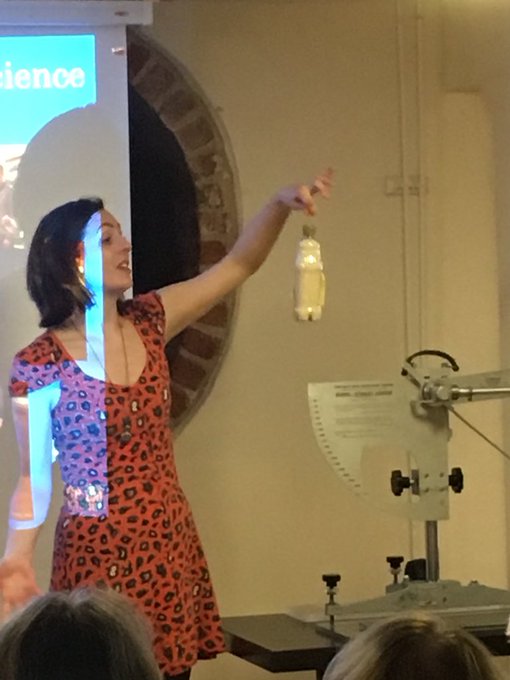
Informative and humorous talk from Julia Carrell for @FindingAda day @SidmouthScience Thanks to @IMechE and @ExIST_Exeter who would have thought would involve a pencil in a bottle of rice!!

This weekend with be the final chance for people to make the most of the event.
One of the potential highlights will be the drone racing on Saturday (tomorrow) - some of the country’s finest drone pilots will be heading to Sidmouth Cricket Club and, weather permitting, spectators can watch exciting races from 11am until 5pm.
Sunday will see a visit from the BBC’s The One Show science correspondent Dr Marty Jopson. His Invisible Worlds show delves into the realm of microscopical wonders. It will run from 2pm until 2.45pm at the Norman Lockyer Observatory. Marty will also be doing a Q&A from 3.30pm until 4pm. Visit sidmouthsciencefestival.org for more information.
Be sure to pick up a copy of next week’s Herald to catch a glimpse of the festival pictures.

Last chance to enjoy Sidmouth Science Festival | Latest Sidmouth and Ottery News - Sidmouth Herald
.
.
.

Apple pressing > Salcombe Regis > Sunday 14th October

Orchards are making a come-back:
Home - Orchards Live

And a regular orchard event is happening again this Sunday: 

Sidmouth Apple Celebration & Pressing Day

14-10-2018

2pm- early eve

The free event will be held at Thorn Park Golf Centre near Sidmouth on Sunday 14 October.

Previously we have offered just a pressing service for local’s garden apples but this year we have decided to expand the event to make it more of a family day to include live music, cider and apple drinks, hot food, apple products,demonstrations, exhibits, children activities etc. The event will run from 2.00pm until early evening.

Events and Courses - Orchard Link

The Herald gives a little more:

Entertainment for all the family at Thorn Park apple pressing day

08 October 2018

Philippa Davies


Making apple juice at Thorn Park. Picture: Contributed

Event includes food and drink, live music, children’s activities, vintage tractors and alpacas

An Apple Celebration and Pressing Day is to be held at the Thorn Park Golf Centre at Salcombe Regis.

This year’s event, on Sunday, October 14, will be much bigger than usual, with live music, cider and apple juice drinks, hot food, children’s activities and other entertainment.

There will also be the usual apple pressing service, using both a traditional screw press and a modern hydropress, for people to make juice from their own apples.

The food available will include pork and apple burgers, home-made apple cakes and fritters, and baked goods.

Mulled cider, apple cocktails and smoothies will be on offer.

Among the attractions will be vintage tractors, the Gliddon’s steam traction engine, alpacas and music from the indie-folk band Velvet and Stone. Children can try apple bobbing, and make a bird feeder from an apple and sesame seeds.

People can go along in Victorian dress if they want to.

Entry is free and the event begins at 2pm.


Apple Celebration and Pressing at Thorn Park, Salcombe Regis | Latest Sidmouth and Ottery News - Sidmouth Herald
.
.
.

Saturday, 22 September 2018

The four-day week on full pay

The idea of a 'four-day week' is being put into practice:
Futures Forum: New Zealand firm's four-day week an 'unmitigated success' > Reduced hours for same pay increased successful work-life balance management, cutting stress levels and boosting commitment

And in the UK too, as reported in today's i-newspaper:


‘We work a four day week, with no drop in our pay’: Meet the workers and firms proving the benefits of a shorter working week


Sound too good to be true? The fact is a growing number of UK companies are seeing the economic benefits of giving their staff an extra day


Friday September 21st 2018


David Rutherford, who works at Advice Direct Scotland, spends his day off with his wife and child.

What would you do with a three-day weekend – assuming, that is, there was no reduction in your salary? All those household chores could be taken care of on Friday (or Monday perhaps) leaving you free to enjoy two days of uninterrupted leisure.

Sound too good to be true? The fact is a growing number of UK companies are seeing the economic benefits of giving their staff an extra day off.

Bosses are realising it’s important to measure people on what they actually achieve at work, not how many hours they sit behind their desk. By chopping the working week down to four days, staff are likely to be more engaged in their work, less stressed and in some cases able to maintain the same level of productivity.

The four-day week may sound radical, but it really isn’t. The economist John Maynard Keynes predicted in 1930 that at some point in the future we’d all be on a working week of just 15 hours. Keynes was one of the leading economists of the 20th century, but in this case his prediction was spectacularly wrong.

A five-day week is not efficient

The fact is, little has changed since the idea of a two-day weekend was first established. The earliest recorded use of the word “weekend” was in 1879 in an English magazine called Notes and Queries. It referred to the idea of a worker taking a half-day on Saturday and all of Sunday to recuperate. It wasn’t until the turn of the century that the half-day became a full one.

Fast forward to 2018 and most full-time workers still do a five-day week and their hours are still generally fixed to eight or nine hours a day.

There is plenty of evidence to suggest the five-day week is not efficient. A growing body of research indicates that a shorter week could boost productivity and health and help companies retain their employees.

A few bold companies are challenging the status quo by slashing working hours.

At Advice Direct Scotland, for example, the introduction of a four-day week at the beginning of this month is already having positive results according to the consumer firm’s compliance officer, David Rutherford. “We wanted to boost staff morale and benefit from increasing productivity and reduced absenteeism,” he says. “Everyone’s aware they need to be more productive on the four days they are in.”

Employees at the firm don’t work the same four days, meaning Advice Direct Scotland can continue offering the same service as before. All 68 staff are on the same pay as when they were doing a five-day week and the holiday entitlement is the same.

However, the working hours have changed from 9-5 to 9-6. “The change has been unanimously approved of. People are very accepting of the fact they have to work a wee bit harder when they’re in. But they have the reward of an extra day off.”

Rutherford, who takes every Tuesday off and spends the day with his seven-month-old son, says the change is likely to boost staff loyalty. “I personally feel it’s a benefit that would keep me here longer. Before I’d barely see my son in the week. Now I get to spend a whole extra day with him and my wife.”

The pressure to be ‘on call’

The idea that technology would reduce our working hours and unchain us from our desks has, in most cases, proved false. The minute we step out of the office, many feel the pressure to check emails and answer queries.

While the concept of a four-day week may seem an unachievable dream to some, all employees should take heart from the fact they have a legal right to request flexible working.

To have the highest chance of success, workers should make a practical case and show how both they and the business would benefit. Employers can reject the request if they can make a reasonable business case, but workers can make a fresh claim every 12 months.

“It all comes down to the relationship between the employer and employee,” says Stefan Stern, a visiting professor at Cass Business School. “You can go to a tribunal ultimately if you think the firm is being unfair, although this is time-consuming and stressful. But workers should take comfort in the fact that in a tighter labour market, employers ought to be keener to hang on to good people – there aren’t millions of unemployed people waiting to take your job.”

Cries to adopt a new pattern of working have become more vocal in recent weeks. The TUC called for a four-day working week to be adopted by the end of this century.

The union group’s argument is that it will make work more satisfying, boost productivity and get more people into work.

‘A happy team means happy clients’

Rich Leigh, the founder of Gloucester-based consumer PR agency Radioactive, recently introduced a four-day working week without reducing staff pay.

Leigh, who founded Radioactive PR in 2015, trialled a four-day working week for his 10 staff for six weeks over the summer. After gathering feedback from both employees and the agency’s clients, he decided the trial had been a success and the agency now permanently has a four-day week.

“Reducing the working week to four days has meant a hit to our profit margins, but it’s only in the low single digits,” says Leigh. “We can absorb it as the fact we are based in Gloucester means we have cheaper running costs and we have a higher profit margin than those based in London. We are in a creative industry and I’d hate for my staff to come to work and dread the day ahead. A happy team can only do great work and create happy clients.”

He says staff were initially bemused by the idea. Most of the team are in their 20s and hadn’t considered the need to have a more flexible working week. Now they are enjoying the freedom to bake, do DIY, see friends and “take long naps”.


The team at Radioactive PR work Monday to Thursday

All staff work Monday to Thursday 9-5:30, taking Friday off. The holiday allowance has been reduced from 33 days a year to 28. But Leigh says the staff get an extra 40 days off under the current structure than they did previously. There is a Whatsapp group where staff can be contacted if there is a work emergency on a Friday or weekend.

Leigh, 30, is using the extra day off to write, take bike rides and spend more time with his wife and three children. “I didn’t want to be an absent dad and I wanted my business to reflect that,” he adds.
A dream rather than a reality?

Critics of the UK adopting a four-day week will point to the case of France, who adopted a shorter working week in the 1990s under a socialist government. The idea was to get more people into work, but the country has an unemployment rate close to 10 per cent (compared to the UK’s 4 per cent).

Then there’s the fact that some careers are less suited to a shorter working week than others. In these cases, companies would have to hire more staff in order to sustain the current level of service.

“In some sectors a move to a four-day week may prove all but impossible: it is difficult to see how the NHS, GP surgeries and healthcare providers for example, could accommodate a four-day week when they are already stretched. The same could be said of retail and hospitality, where the demand for 24-7 service is unlikely to diminish,” says Richard Woodman, an employment lawyer at Royds Withy King.

But the fact remains that something needs to change if the gender pay gap is to close. Many women with children find it difficult to juggle a fulfilling career and childcare. If more men also worked flexibly, or reduced their hours, it would open up more job shares in senior roles.

“The challenge we face is to design modern jobs with hours that also allow people to have a home life – whether that involves caring for children or pursuing things important to them. The important thing is that businesses try different ways to make it work. Many people would want to change jobs for the chance of a four-day week as long as it didn’t mean being paid for four days and working five,” says Christine Armstrong, a business consultant and author of The Mother of All Jobs.

Working a 15-hour week on full-time pay is sadly never going to be achievable. But a four-day week is within the realms of possibility – and more companies will give it serious consideration.

The working week: Key turning points in UK employment law

Trade Union Act 1871: Trade Unions legalised

Factory Act 1878: Children under 10 prohibited from working

The Old Age Pension Act 1908: State pension introduced for retirees over 70

Shops Act 1911: Shop staff entitled to a weekly half day

Contracts of Employment Act 1963: Contracts introduced and reasonable notice of dismissal

Race Relations Act 1965: Illegal to discriminate on grounds of race

Working Time Regulations 1998: Workers given the right to 20 paid holidays a year and breaks from work. Increased to 28 days holiday in 2007

Maternity and Parental Leave Regulations 1999: 52-week maternity leave guaranteed

Pensions Act 2008: Auto-enrolment introduced


Meet the firms that have gone down to a four day week on the same pay
.
.
.

Wednesday, 22 August 2018

Sidmouth Regatta > Friday 24th - Sunday 26th August

It all starts on Friday night from the air:
All you need to know about the Red Arrows in Sidmouth - and how to avoid the gridlock - Devon Live

But the actual show at sea begins on Saturday:

Sidmouth Regatta

August 25th and 26th 2018

29 years ago Sidmouth Sailing Club formed a committee to revive Sidmouth 
Regatta.

The idea is to provide some fun events for local families and visitors who wish to join in and a more serious side for those who wish to take part in the sailing races. Over the years the event has enabled the local branch of the RNLI to profit from collections during the Saturday evening events. These collections over the years have amounted to a substantial sum.

Traditional sea based activities take place on Saturday culminating with live music and a spectacular firework display. Earlier on the popular raft race takes place followed by a courtesy visit from the Exmouth Lifeboat, weather/operational duties permitting.

Sundays events are for the children and their families. The events are all free to enter with generous prizes.

Wet weather contingencies are in place for the drawing competition and the fancy dress should the weather become inclement.

Why not enter the ‘Shop Window Competition’ and try to win a generous cash prize. Have fun looking in our local shops trying to find the numbered discs. Shops taking part will be displaying a competition poster.

ENJOY THE WEEKEND STARTING WITH A DISPLAY BY THE RAF RED ARROWS ON FRIDAY 24TH AUGUST (subject to confirmation and weather conditions)

_ _ _ _ _ _ _ _ _ _ _ _ _ _ _ _ _ _ _ _ _ _

ALL EVENTS WEATHER PERMITTING. TIMES ARE APPROXIMATE.

THE SAILING AND ANGLING CLUB IS OPEN TO ALL ON SATURDAY 25TH

Entries on the day.

All prizes presented at the club after Lifeboat Display.

All events start at Port Royal.

PROGRAMMES WILL BE AVAILABLE FROM SIDMOUTH SAILING CLUB, SIDMOUTH INFORMATION CENTRE AND HUMBUG.


Sidmouth Regatta - Visit Sidmouth 


Sidmouth Regatta in hosted by Sidmouth Sailing Club.

An annual event with Sea based activities and shore based activies for the youngsters 

Sailing Races 
Raft Race 
Grand Firework Display 
Childrens Drawing Competition 
Childrens Fancy Dress 
Family Treasure Hunt 
Bouncy Castle 
Tombolla 
Punch and Judy 
Cake and Sweet Stall
Real Ale Tent.

Sidmouth Town Website - Gallery - Category: Sidmouth Regatta
Sidmouth Regatta 2018
Sidmouth Regatta & Boxing Day Swim | Facebook
.
.
.

Sunday, 12 August 2018

Rockpool Ramble > Discover the wonders of Sidmouth's rockpools > Tuesday 14th August

Sidmouth has some of the best places for rock-pooling in the West Country:
Good rock pools - Jacobs Ladder Beach, Sidmouth Traveller Reviews - TripAdvisor
Top 10 Beaches to go Rockpooling in South Devon - Visit South Devon


Sidmouth : Beach & Rock Pools (C) Lewis Clarke :: Geograph Britain and Ireland

And every year, the District Council's Countryside team take us rock-pooling at Jacob's Ladder:
Rockpool ramble- Sidmouth - East Devon

This year it's happening again, as reported in the Herald:


Rockpool Ramble in Sidmouth | Latest Sidmouth and Ottery News - Sidmouth Herald

And as reported on the District Council's pages: 


Rockpool Ramble Sidmouth


Rockpool Ramble Sidmouth

Discover the wonders of Sidmouth's rockpools

Explore the mysterious world of Sidmouth's rockpools with the Countryside team.
Learn where to look and what to look out for.

Some buckets and nets available to borrow - please bring your own if you have them.

How much

£3.00 suggested donation per child.
No booking necessary.

When

 - 

Where

The beach by Jacob's Ladder 
Peak Hill Road
Sidmouth
EX10 8RZ


© Crown copyright and database rights 2018 100023746
+

Directions

Get directions to this event with Google Maps.

Parking

Pay and display car parking available in Sidmouth

Who

Event aimed at everyone.

Further info

Call Countryside on 01395 517557 or email countryside@eastdevon.gov.uk


Rockpool Ramble Sidmouth - East Devon
.
.
.