Andrew MooseHead of Retail, Consumer Goods and Lifestyle Industries, World Economic Forum
Dana MarquardtCommunity Lead - Retail, Consumer Goods & Lifestyle Industries, World Economic Forum
In our overpopulated world, stuffed with an ever-growing stockpile of products, offline experiences have become key to personal fulfilment. While 78% of millennials choose to spend money on a desirable experience over something material, the trend extends beyond just young people, to every age bracket and socioeconomic class.
This tidal wave is already having extreme effects on the global economy and traditional business models. It requires a fundamental shift in how we look at everything, from revenue growth to personal happiness. Ultimately, the shift to an experience economy has the power not only to change how we spend our time and money, but also to promote inclusion and democratize happiness.
The commoditization of things
Products from every corner of the globe are easier to acquire than ever before - and many of them are even shipped for free. This ubiquity leads to commoditization, which drives down the perceived value of these objects.
One company that has continued to thrive is Lego, even as many households have reached saturation point, stuffed with toy building blocks. The company has launched in-store experiences and conventions accessible to all socioeconomic groups, designed to encourage collaboration and help build children’s cognitive skills. While many commoditized toy companies have faded in the digital age, Lego has doubled down on creating offline experiences that create connection and brand affinity.
When diamonds are no longer rare, and the world’s increasing number of urban residents are no longer interested in owning a car, rare experiences become the new social capital. Nowadays, the world’s biggest celebrities tend to post far more Instagram “humble brags” in exotic destinations than photos of new fur coats. The means and time to create unique experiences are this era’s luxury goods.
Human psychology
Many would argue that this trend toward an experiential economy is not a trend at all, but rather a realization of the longevity of human happiness. Professors Thomas Gilovich and Amit Kumar of Cornell University study the relationship between wealth and happiness, and conclude that “experiential purchases, such as vacations, concerts and meals out, tend to bring consumers more enduring happiness than material purchases, such as high-end clothing, jewellery and electronic gadgets”.
According to the researchers, experiences create more lasting happiness because they are more open to positive reinterpretation; they tend to become more meaningful parts of one’s identity; and they do more to foster social relationships. Experiences help us learn, grow and connect with each other, so it’s no surprise we choose to spend our money and time on them.
Since 1987, the share of consumer spending on live experiences and events has increased by 70%, relative to total US consumer spending. The importance of human experience is not new, but this massive shift has been waiting for the perfect moment - rampant overconsumption and the social platforms to amplify it.
The death of retail
Physical retail is dead. Its extinction is accelerating as malls close, chains go bankrupt and next-day delivery makes a trip to the store seem pointless. Many of the brands that we grew up with - Toys ‘R’ Us, RadioShack, Rite Aid, Sears, Sports Authority and Claire’s - are closing their shutters. The stores that kept malls expanding through the 1990s have turned into business school case studies about the impact of digital disruption. Why take hours to visit a toy store when Amazon gives better customer service, cheaper prices, informative reviews and fast delivery, with no need to wait in line?
The only companies that will exist in 10 years’ time are those that create and nurture human experiences. This learning and growth will come from maximizing opportunities, including the reinvention of retail spaces, new models of engagement, and an understanding of experiences as perhaps the most important form of marketing.
Red Bull built its global empire on allowing people to experience the personality of its brand. Lululemon builds community by offering free yoga classes in its stores. Patagonia and REI both focus on experiences - trips, hikes, and classes - as core parts of their business.
These experiential initiatives create emotional bonds between consumers and brands, frequently having ten times the return on investment compared to digital marketing and building measurable loyalty. The brands that embrace the experience economy - and the data that powers it - are the only ones who will thrive.
Inclusion
As the forces of the Fourth Industrial Revolution accelerate, consumers are enjoying the benefits of rapid innovation and new models of consumption, but also struggling to maintain a sense of connection and understanding our rapidly changing world. In that context, it should be no surprise that experiences, especially transformative ones that educate, inspire and bring people together, are growing in popularity.
Crossroads Foundation, a nonprofit organization based in Hong Kong SAR, created the popular and emotionally jarring “Refugee Run”, a 75-minute experience in which guests “become” refugees. In a basement fitted out as a refugee camp and staffed by refugees from around the world, the immersive experience brings adults to tears, creating more empathy than a lecture or article ever could. Crossroads has created further immersive experiences in order to build awareness of global issues, understanding that “when people have stepped, even briefly, into the shoes of others, the conversation changes and they are considerably more motivated to engage”.
While experiences have the power to make the global economy more inclusive, this must be an intentional priority. The internet is largely a great force for inclusion, but with 45% of the world’s population lacking access, it can also widen the gap between socioeconomic groups. Given that experiences can enhance learning, increase social connection and ultimately transform the global economy, we have a responsibility to design the experiences of the future in ways that reach a diverse range of individuals and benefit the planet. As we continue to invest in the experience economy, our greatest challenge may be ensuring access and inclusivity while maintaining personalization and uniqueness.
As conditions on the high street heap pressure on retailers, they are looking to landlords to help ease the financial burden. Drapers investigates the changing balance of power between the two
The relationship between landlord and tenant is an important, often unseen, dynamic that most of us don’t give much thought to. And yet, it's reshaping high streets up and down the country.
High rents are blamed for the collapse of so many retailers - they appear unsustainable yet they are the vehicle through which much of our pension wealth is invested.
In this programme, Ruth Alexander looks at different models of ownership: from the big financial institutional investors through to the original aristocratic landowner and asks how - in the turmoil created by the rapidly changing retail environment - these landlords are facing up to a new reality.
But the first commercially viable version of the now ubiquitous material - cellophane - was conceived in a more innocent age, before anyone worried about plastic in landfill, or the sea, or the food chain.
It begins in 1904, at an upmarket restaurant in Vosges, France, when an elderly patron spilled red wine over a pristine linen tablecloth. Sitting at a nearby table was a Swiss chemist called Jacques Brandenberger, who worked for a French textile company. As he watched the waiter change the tablecloth, he wondered about designing a fabric that would simply wipe clean. He tried spraying cellulose on tablecloths but it peeled off in transparent sheets. But might those transparent sheets have a market?
By World War One, he'd found one: eye-pieces for gas masks. He called his invention "cellophane" and in 1923 he sold the rights to the DuPont corporation in America. Its early uses there included wrapping chocolates, perfume and flowers.
But DuPont had a problem. Some customers weren't happy. They'd been told cellophane was waterproof, and it was, but it wasn't moisture-proof. Candies stuck to it; knives rusted in it; cigars dried out.
DuPont hired a 27-year-old chemist, William Hale Charch, and tasked him with finding a solution. Within a year, he'd done it - the cellophane was coated with extremely thin layers of nitrocellulose, wax, a plasticiser and a blending agent.
Sales took off. The timing was perfect. In the 1930s, supermarkets were changing - customers no longer queued to tell shop assistants what food they required. They picked products off the shelves instead.
See-through packaging was a hit. And, as Harvard Business School researcher Ai Hisano points out, had "a significant impact not only on how consumers purchased foods but also on how they understood food quality". Cellophane let them choose food on the basis of how it looked, without sacrificing hygiene or freshness.
One study - admittedly funded by DuPont - found that wrapping crackers in cellophane boosted sales by more than half. And retailers had no shortage of similar advice. "She buys meat with her eyes," said a 1938 edition of The Progressive Grocer.
In fact, the meat counter was the hardest to make self-service. The problem was that meat, once cut, would quickly discolour. But trials suggested a self-service meat counter could sell 30% more food.
With such an incentive, solutions were found: pink-tinted lighting, antioxidant additives and - of course - an improved version of cellophane, which let through just the right amount of oxygen. By 1949, DuPont adverts boasted about the "pleasing new way" to buy meat - "pre-cut, weighed, priced and wrapped in cellophane right in the store".
But cellophane would soon fall out of fashion, overtaken by the likes of Dow Chemical's polyvinylidene chloride. Like its predecessor, this was an accidental discovery first used in conflict - in this case, weatherproofing fighter planes in World War Two. And, like cellophane, it needed plenty of research and development before it could be used on food - it was originally dark green and smelled disgusting. Once Dow sorted that out, it hit the market as Saran Wrap - now more widely known as cling film.
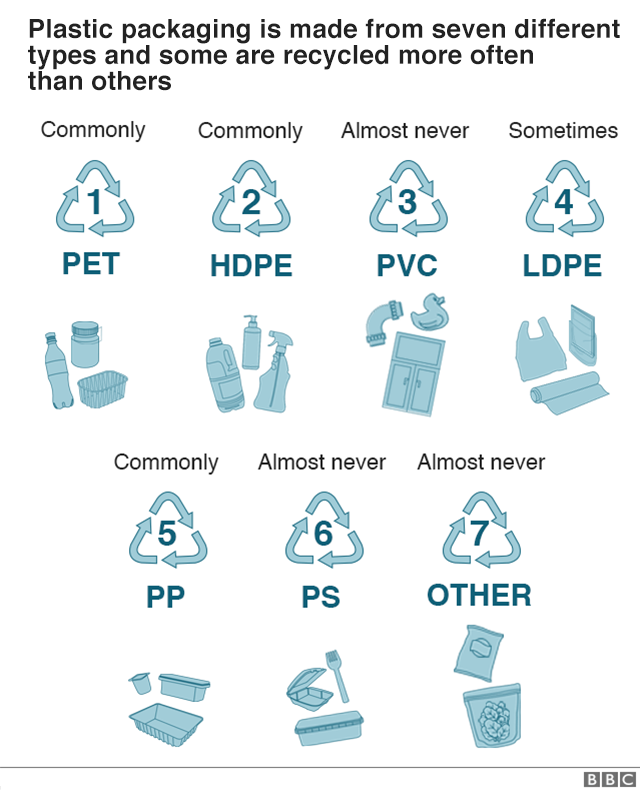
After health scares with polyvinylidene chloride, cling film is now often made with low-density polyethylene, though that's less, well, clingy. It's also used to make those single-use supermarket bags now being banned around the world. High-density polyethylene is the kind of stuff you might get milk in.
Fizzy drinks come in polyethylene terephthalate.
And if you're not lost already, consider that plastic packaging is increasingly made from multiple layers of these and other substances, such as biaxially-oriented polypropylene or ethylene-vinyl acetate.
There's a reason for this, say packaging gurus - different materials have different properties, so multiple layers can give you the same performance from a thinner - and thus lighter - piece of packaging.
But these compound packaging materials are harder to recycle.
The trade-off is hard to fathom. Depending on how much of the heavier, recyclable packaging would in practice be recycled, you might find that the lighter, non-recyclable packaging actually generates less waste. And once you start looking into plastic packaging, this kind of counterintuitive conclusion comes up all the time.
Some packaging is a foolish waste. But are shrink-wrapped cucumbers really so silly if it means they stay fresh for 14 days rather than three? Which is worse 1.5g (0.05oz) of plastic wrap or entire cucumbers going off before being eaten? Suddenly it's not so obvious.
Plastic bags stop bananas going brown so quickly, or new potatoes going green; they catch grapes that fall off bunches. About a decade ago, one UK supermarket experimented with taking all its fruit and vegetables out of their packaging - and its food wastage rate doubled.
And it's not just shelf life - what about waste created before food gets to the shop in the first place? Another supermarket, stung by criticism for putting apples in plastic-wrapped trays, tried selling them loose from big cardboard boxes - but so many were damaged in transit that the approach used more packaging per apple actually sold.
According to a UK government report, only 3% of food is wasted before it gets to shops. In developing countries, that figure can be 50% - and that difference is partly due to how the food is packaged. As more of us live in cities, far from where food is grown, this matters.
Even the dreaded single-use shopping bag might not be the villain it seems.
If you've bought sturdy, reusable bags from your supermarket, it's likely they're made from non-woven polypropylene - and they are less damaging, but only if you use them at least 52 times. That's according to a report by the Danish government, which weighed up the varied environmental impacts of producing and disposing of different kinds of bag. And if your reusable bag is organic cotton, don't feel smug - the researchers reckon they need 20,000 uses to justify themselves. That's a shopping trip every day for over half a century.
The market can be a wonderful way of signalling popular desires. Shoppers in 1940s America wanted convenient, pre-cut meat - and what economists call the "invisible hand" of the market delivered the technologies that made it possible. But our desire for less waste may not yield to market forces, because the issue is complicated and our choices at the checkout may accidentally do more harm than good.
We can send that message on a more circuitous route only, through governments and pressure groups, and hope that they - and well-meaning industry initiatives - will work out some sensible answers.
It seems clear the solution will not be no packaging - it will be better packaging, dreamed up in research and development labs of the kind that gave us moisture-proof cellophane all those decades ago.