... A FORUM TO STIMULATE DEBATE ... ... JUST ADD A COMMENT AT ANY ENTRY BELOW... ... FOR THE SUSTAINABLE DEVELOPMENT OF TOWN AND VALLEY ...
Showing posts with label water. Show all posts

Wednesday, 27 March 2019

Sidmouth's fatberg on BBC's Blue Planet Live > "How our lifestyle affects our waters, wildlife and nature."

Sidmouth's fatberg hit the headlines at the beginning of the year - with a host of other issues:
Futures Forum: The Sidmouth fatberg and plastic pollution: "the wet wipe monster"
Futures Forum: Dealing with Sidmouth's fatberg: pop into South West Water's pop-up shop

Some of these issues were looked at this afternoon on BBC's Blue Planet Live:
BBC One - Blue Planet Live

Which starred Sidmouth's very own fatberg - as featured in the Herald:

Sidmouth features on BBC’s Blue Planet UK

PUBLISHED: 17:30 27 March 2019
Beth Sharp


The fatberg under Sidmouth. Picture: South West Water

Sidmouth’s famous fatberg made a star appearance on the BBC’s Blue Planet UK.


The fatberg under Sidmouth. Picture: South West Water

The BBC One programme aired at 4.30pm Wednesday, March 27 and looked into how our lifestyle affects our waters, wildlife and nature in general. It also featured the scientists who are working to find solutions to manmade problems.

Presenter Steve Brown interviewed South West Water’s director of wastewater, Andrew Roantree and spoke about the dangers posed to the oceans by fatbergs.

Viewers were treated to footage taken at the University of Exeter where scientist heated up a sample of the fatberg to dissect what treasures it hid inside - including wet wipes, cotton wool buds, panty liners and other sanitary products.

Interviews revealed the extent of the work that had to be undertaken by South West Water workers to remove the fatberg. For example the amount of built-up gasses was so concentrated in the fatberg, a spark could have set off an explosion.

Visit bbc.co.uk/iplayer to catch up on the programme.


Sidmouth features on BBC’s Blue Planet UK | Latest Sidmouth and Ottery News - Sidmouth Herald
Sidmouth’s fatberg to feature on BBC’s Blue Planet | Latest Sidmouth and Ottery News - Sidmouth Herald

It was also on the BBC Breakfast Show - but perhaps not very pleasant to look at over the cornflakes:
BBC News: BBC Breakfast viewers in uproar over ‘gross’ fatberg segment | TV & Radio | Showbiz & TV | Express.co.uk

And that should be the last of it:
Works to remove Sidmouth's fatberg will soon be completed | Latest Sidmouth and Ottery News - Sidmouth Herald
.
.
.


Wednesday, 20 March 2019

Climate change: Environment Agency says that within 25 years England will not have enough water to meet demand

There's just been a big conference on water resources:
19th and 20th March 2019 – Annual Waterwise Conference – Book Here Now – Waterwise

The big news coming out of that is that we are going to be running out:
Water shortage on way in the next two decades experts warn | The Weather Channel
England Could Run Out of Fresh Water in 25 Years - EcoWatch
This is what the UK needs to do to avoid running out of water | WIRED UK

The BBC reports: 

Climate change: Water shortages in England 'within 25 years'

19 March 2019

Within 25 years England will not have enough water to meet demand, the head of the Environment Agency is warning.

The impact of climate change, combined with population growth, means the country is facing an "existential threat", Sir James Bevan told the Waterwise Conference in London. He wants to see wasting water become "as socially unacceptable as blowing smoke in the face of a baby. We all need to use less water and use it more efficiently."

Sir James Bevan was appointed chief executive of the Environment Agency - the public body responsible for protecting the environment and wildlife in England - in 2015 after a career as a diplomat.

He told his audience that, in around 20 to 25 years, England would reach the "jaws of death - the point at which, unless we take action to change things, we will not have enough water to supply our needs".


By Roger Harrabin, BBC Environment Analyst

The tone of Sir James' warnings is more strident than we're used to. Phrases like "existential threat" and "jaws of death" are, he admits, designed to jolt people into facing uncomfortable truths.

The problem is the unfortunate combination of growing population and potentially shrinking supply by 2040. That implies a suite of tough decisions like persuading consumers and firms to use less water.

The most pressing decisions, though, are over hardware. Infrastructure developments like giant pipes transferring water to the South East will be years in the planning. There's a risk to wildlife, too.

But most controversial are plans for reservoirs. Locals have been fighting one in South Oxfordshire since the 1990s. Protestors say they acknowledge the water shortage problem but believe water firms are exaggerating the level of population growth. What's more, they say, reservoirs in a water shortage area like the Thames Valley is not a wise solution. And they will fight on.


'Use 40 litres less a day'

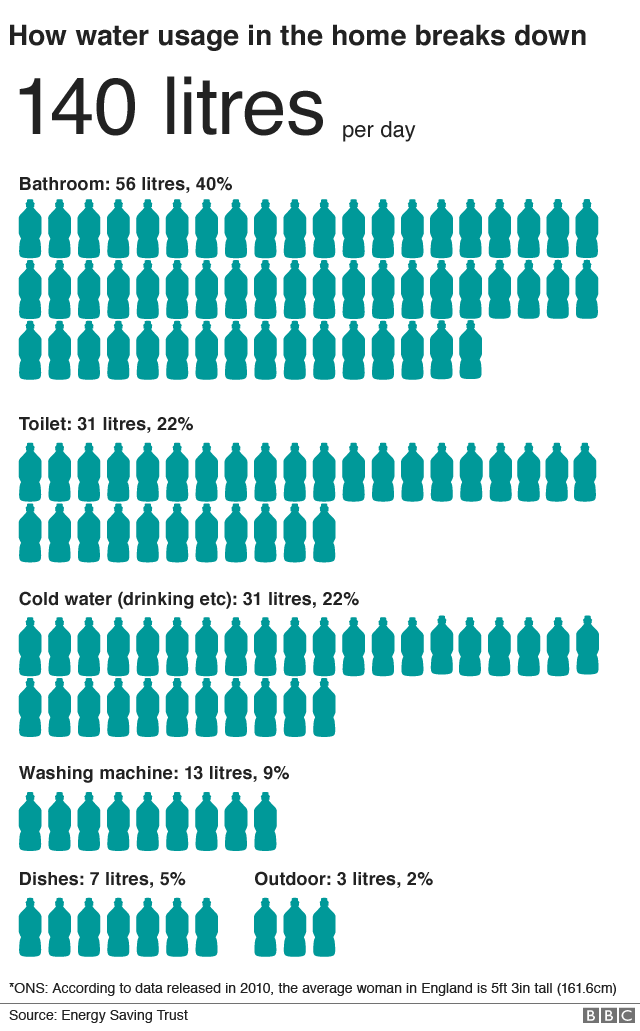
Alongside action being taken by the government, water companies and regulators, Sir James wants the public to use less water, and use it more efficiently. Currently, people in England use an average of 140 litres of water a day. Sir James is calling on people to cut their usage to 100 litres - the target set by Waterwise, which campaigns for water efficiency.

"In the last few decades we've radically changed behaviour on smoking (everybody did it) and seatbelts (nobody wore them)," he is expected to say. "In the last two years we've changed behaviour on plastic. We need water wastage to be as socially unacceptable as blowing smoke in the face of a baby or throwing your plastic bags into the sea."

Sir James' list of 'things we can all do'

> Get a low-flush toilet
> Take short showers, not deep baths
> Use the most efficient shower-head
> Get a water-efficient washing machine
> Don't use your dishwasher until it's full
> Turn the tap off when brushing your teeth
> Don't water your lawn (it will survive)

"If by 2050 we reduced per capita consumption to 100 litres a day, leakage by 50%, and did nothing else, it would provide enough water for an additional 20 million people without taking any more from the environment," Sir James said.

Sir James in his speech declined to get embroiled in the political arguments over whether water companies should remain privatised or be taken back into public ownership. However, he did say that the present companies needed to up their game - on fixing leaks, bearing down on pollution and making the necessary investments that would future-proof the water delivery system.

Need for new reservoirs

And as well as reducing demand for water, he also called for a big push on maximising its supply.

This, he said, would include:
> Water transfers between regions, from areas of water surplus to areas of deficit
> Desalination plants that convert brackish water from into clean drinking water
> New reservoirs to be built to hold water for use in times of severe water stress

"We have not built a new reservoir in the UK for decades, largely because clearing all the planning and legal hurdles necessary is so difficult and local opposition so fierce," he explained.

But, Sir James argued, the economic case for greater resilience was clear, citing a 2016 Environment Agency report that found "that while a severe drought would cost each household more than £100, the cost per household of the investment that would greatly reduce the risk was only £4 a year."

The Environment Agency has previously warned of water shortages by 2050 and the government has already suggested that people's water use should be reduced, in its 25-year plan published last year.

Scotland, Wales and Northern Ireland have separate public bodies responsible for environment protection, because the environment is a devolved matter.


Climate change: Water shortages in England 'within 25 years' - BBC News
.
.
.

Tuesday, 5 March 2019

Climate change: The Lower Otter Restoration Project >>> talk on "The challenges and opportunities of adapting to climate change" by Dr Sam Bridgewater: Friday 8th March

The Otter Estuary provides a vital eco-system:


Marshes in the Lower Otter Estuary (C) N Chadwick :: Geograph Britain and Ireland

A year and a half ago, an important project was launched by Clinton Devon Estates:
Futures Forum: Lower Otter Restoration Project launched >>> deadline for feedback on plans: 20th July

It's imaginative - and necessary:
Lower Otter Restoration Project: Preferred option for scheme announced | Latest Exmouth News - Exmouth Journal

The Estate's Nature Conservation Manager: 
Clinton Devon Estates appoints new Nature Conservation Manager for the East Devon Pebblebed Heaths a - Clinton Devon Estates

... will be giving a talk on Friday in Sidmouth, hosted by the Devonshire Association: 

The Lower Otter Restoration Project (E Devon Branch)

Fri. 8 March 2019 at 2:30 pm

A talk ‘The Lower Otter Restoration Project – the Challenges and Opportunities of adapting to Climate Change’ by Sam Bridgewater.

Details 

Date: Fri. 8 March 2019 
Time: 2:30 pm 

Event Tags:Climate change

Organiser 
Hazel Harland 
Phone: 01395 445665 
Email: hazeljharland@gmail.com 

Venue Manor Pavilion Theatre, Sidmouth Manor Road
Sidmouth, Devon EX10 8RP Website: http://www.manorpavilion.com/

The Lower Otter Restoration Project (E Devon Branch) – The Devonshire Association
.
.
.

Friday, 18 January 2019

Dealing with Sidmouth's fatberg: pop into South West Water's pop-up shop

What are we going to do with our fatberg?
Futures Forum: The Sidmouth fatberg and plastic pollution: "the wet wipe monster"
Futures Forum: Sidmouth's fatberg is 'fed by the luxury lifestyles and toilet habits of well-off residents'

Some very helpful answers have been forthcoming from a pop-up shop from South West Water.

As reported by Devon Live:


Monster Sidmouth fatberg now has its own pop-up shop to discuss your toilet habits - Devon Live 


And by the Herald:


VR footage of Sidmouth fatberg among tools used in new pop-up shop

PUBLISHED: 14:46 17 January 2019 | UPDATED: 09:05 18 January 2019

Andrew Roantree and Sharna Smith of South West Water outside the pop-up shop. Ref shs 03 19TI 8533. Picture: Terry Ife


Andrew Roantree and Sharna Smith of South West Water outside the pop-up shop. Ref shs 03 19TI 8533. Picture: Terry Ife


An educational pop-up shop is using virtual footage of Sidmouth’s sewers to help promote responsible waste disposal in the wake of the town’s fatberg.

Andrew Roantree and Sharna Smith of South West Water outside the pop-up shop. Ref shs 03 19TI 8527. Picture: Terry Ife
Sidmouth hit international headlines last week when it was revealed a 64-metre man-made monster of grease, oil and wipes had been building under The Esplanade.
South West Water has opened a shop in the former Mare and Foal shop until January 26 to answer questions and encourage residents to pledge to look at their disposal habits.
Andrew Roantree, South West Water’s director of waste water, showed the Herald around the shop before it opened on Tuesday.
Residents questioned why the fatberg had not been discovered sooner after the town’s last check was carried out two to three years ago, due to Sidmouth being a ‘low risk area’.
The fatberg under Sidmouth. Picture: South West Water
Mr Roantree said: “That routine check was quite significant event for that piece of sewer. It is not something that we do that frequently, partly because the historic risk of that site has been very low in terms of any operational problems. It did come as quite a large surprise for the guys who went inside. It’s quite a big exercise to try and get inside that sewer, it’s a very confined space to access.
“Anybody from Sidmouth who has been down there will see one triangular manhole cover in the middle of the road and that is it. That is the access into this pretty substantial underground system. Very often, some of those checks will be lifting the man hole cover and seeing what you can see from the surface or walking in the sewer.
“We were very keen that we didn’t want to trip up trade over Christmas and equally we need to get in and out before Easter ideally, so we avoid disrupting any trade in the town before the population starts to build for the summer.”
Work is due to begin on February 4 and is scheduled for eight weeks for the 10-man team to pick axe and jet away the fatberg.
The cost of the operation is £130,000 to clear but the company says customers will not take the hit.
The director said that due to the blockage being at the far end of The Esplanade, machinery and vehicles would only end up taking over the turning circle.
The fatberg under Sidmouth. Picture: South West Water
Fencing will be place with heavy machinery and tankers coming and going through the town during the day.
The clean-up team will be using breathing apparatus along with shovels and pickaxes to hack away at the discarded waste. They will also be using special sewage jetting equipment which blasts high powered water at the fatberg so that pieces can be sucked up by a machine.
The cleared fat will then be transported to a water treatment site where it will be converted into green energy.
Mr Roantree said: “One challenge will be odour, we do not know at the present moment what it will be like when we start breaking it up. There is a risk it could be quite odorous, that will largely be contained down in the sewer. It’s only point of exit is that one manhole cover. So there isn’t a huge space for that odour and we don’t know precisely until we start breaking it up quite what is going to give out. One dimension is the weather because this sewer is live, we cannot stop the flow.”
The shop will be open six days a week, with dedicated Love Your Loo advisors available to explain the operation going forward.
Visitors will be able to make pledges to show what they will look to do differently or pick up a gunk pot to collect up fats, oils and greases from going down the sink.
The fatberg under Sidmouth. Picture: South West Water
South West Water will be talking about ThinkSink and Love Your Loo campaigns - which educates customers on the importance of only flushing the 3Ps.
A pair of virtual reality goggles will transport the watcher down the sewers to see footage from the team who discovered the fatberg.
Young visitors will be able to test their knowledge by taking part in a challenge to hunt for the unflushable items from a ball pit and will see their efforts recorded on a score board.
Residents dropping by the shop said they found it informative and called for more to be done from companies to better label items as non-flushable.
Image of manhole/area above the fatberg. Picture: South West Water
One resident said: “It’s very informative, the general public do not understand what it means by flushable. It’s education really. Some items should put that they are not flushable on their packet.
Another resident said she collected fats and would take them to the tip but asked what provisions there were if people could not drive.
The pop-up centre will be open six-days-a-week, Monday to Friday 10am to 3pm and 3.30pm on Saturday and will run until January 26.
Also read:

South West Water opens fatberg pop up shop in Sidmouth | Latest Sidmouth and Ottery News - Sidmouth Herald
.
.
.
Friday, 11 January 2019

Plastic-free wet wipes

Wet wipes are not good for our waste-water system:
Futures Forum: The Sidmouth fatberg and plastic pollution: "the wet wipe monster"

We are not actually flushing them 'away' anyway:
Futures Forum: Slavoj Žižek: on there being "no metaphysical 'beyond' to put our waste" ..... on "the crisis of late capitalism" ..... and on "the comforting mythology of the recycling industry."

As they end up making a real mess:
Futures Forum: Plastic pollution > March of the Wet Wipes @ Radio 4's Costing the Earth 

Here's one initiative to deal with the waste: 
Plastic-free flushable wet wipe that doesn't cause blockages will soon go on sale in the UK | Daily Mail Online


Wet wipes to get 'Fine to Flush' logo to tackle fatbergs


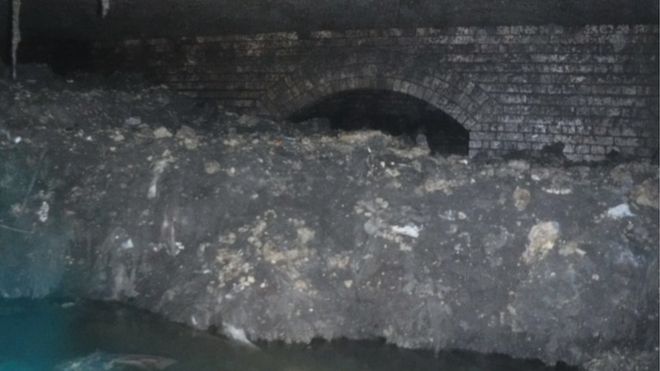
The fatberg in Sidmouth, DevonImage copyrightSOUTH WEST WATER
Image captionThe fatberg in Sidmouth is the largest South West Water has ever discovered

A new standard for flushable wet wipes has been announced, amid concerns about sewer-blocking fatbergs, solid masses of fat, wet wipes and grease, which can be hundreds of feet long.
Water UK, the industry body, says wipes will need to pass strict tests to gain the approved logo, Fine to Flush. It said wet wipes labelled flushable do not break down and are behind 93% of blockages in UK sewers. There are some 300,000 sewer blockages each year, costing the country £100m. That's according to Water UK.
"This is an important step in the battle against blockages. We've all seen the impact of fatbergs recently, and we want to see fewer of them," said Michael Roberts, chief executive, of Water UK.
A 210ft (64m) fatberg found near Sidmouth this week is the biggest South West Water (SWW) has found and expected to take about eight weeks to remove. Others have been found, including an 820ft (250m) fatberg weighing 130 tonnes which blocked a Victorian-era sewer in east London in 2017 and took nine weeks to remove.
The Fine to Flush tests, set out in a 30 page document, scrutinise whether the wipes are able to clear the u-bend, avoid snagging and avoid chemical residues. The tests are being carried out by Swindon-based WRc.
Andy Drinkwater, who is in charge of the tests, said one product, from Natracare, will meet the standard. However, Natracare wipes will not initially display the logo as the packaging was ready before the Fine to Flush image was finalised.

Fine to Flush logoImage copyrightWATERUK

There are seven or so other products being tested by WRc at the moment, Mr Drinkwater said. Testing each product can cost up to £8,000, he added.
Laura Foster, head of clean seas at the Marine Conservation Society, said: "We know that there is huge confusion for consumers on which products can be flushed, resulting in millions being spent on blockages every year."


Wet wipes to get 'Fine to Flush' logo to tackle fatbergs - BBC News
.
.
.

1819: the birth of Joseph Bazalgette, builder of London's sewer network

Are the sewers under Sidmouth's Esplanade Victorian?


Enormous fatberg the size of six double-decker buses discovered blocking sewer in seaside town in Devon | The Independent

The builders of this piece of infrastructure did not anticipate it being clogged up with tons of plastic wet-wipes:
Futures Forum: The Sidmouth fatberg and plastic pollution: "the wet wipe monster"


London's Victorian sewer system is quite magnificent: 


Believe it or not, this is part of the sewer system: the inside of Crossness Pumping Station, south east London. Image: Steve Cadman/Wikipedia Commons.

Tubes, bridges & sewers: The centuries old infrastructure Londoners still use today | CityMetric
Building London’s sewerage system: an engineering wonder with lessons for today - Ockham's Razor - ABC Radio National (Australian Broadcasting Corporation)

It was Joseph Bazalgette who built the system - and he is celebrating his bicentenary:
BBC Radio 3 - Free Thinking, Born in 1819: Ruskin, Clough and Bazalgette.
The History Press | The Great Stink of London

We should perhaps be careful, though, of lionising these Victorian builders of infrastructure:

Sir Joseph Bazalgette (1819-1891)


Image c

  • Began career as railway engineer and was appointed chief engineer to London's metropolitan board of works in 1856
  • At that time London lacked adequate sewage system to cope with increasing population and new flush-toilets. After the hot summer of 1858 created the Great Stink of London, MPs passed legislation to enable new sewage system, overseen by Bazalgette
  • More than 80 miles of underground brick main sewers and 1,100 miles of street sewers built. Outflows were diverted downstream where they were dumped into the Thames
  • Scheme involved major pumping stations at Deptford, Crossness, Abbey Mills and Chelsea Embankment
  • New system was opened by Edward, Prince of Wales in 1865, although the whole project was not actually completed for another 10 years

One of the Victorian schemes that few would dare to criticise is the London sewer network, built by Joseph Bazalgette in the 1860s after growing volumes of sewage in the Thames resulted in the Great Stink. But Andrew Tyrie MP, chairman of the Commons Treasury committee and a former adviser to two chancellors, suggests this is an example of overspending by the Victorians.
"It may be that even some of the apparently most successful Victorian projects from which we are still benefiting were over-specified," he says. "More money was spent on them than needed, and there were a good number of projects which didn't get built because that money was absorbed in over-specified public sector contracts."
Tyrie says that when assessing a potential project it is critical to compare the predicted benefits with other possible uses of resources. Too often this was not done in the Victorian era.

According to Casson, one of the key problems with the development of the Victorian railways and with many other infrastructure projects was the role of the politicians.
"There is a conflict between politicians seeking popularity and prioritising schemes because that is what the people want, rather than the rational calm and calculated approach to railway construction of the civil servants. I think today we see something of the same."
For Helm, it is clear that society needs to take bold decisions on infrastructure, "while recognising upfront that there are going to be mistakes and there are going to be costs".
But the idea that the Victorian record can be used to justify big schemes today rests on rather shaky foundations.


Should we build just like the Victorians did? - BBC News 
File: Bust of Sir Joseph Bazalgette, The Embankment - geograph.org.uk - 636339.jpg - Wikimedia Commons
.
.
.

Tuesday, 8 January 2019

The Sidmouth fatberg and plastic pollution: "the wet wipe monster"

There has been a huge amount of media interest in Sidmouth's fatberg: 

The discovery of a monster fatberg, lurking in the depths of Sidmouth, has hit global headlines.

Sidmouth residents blamed for monster fatberg near playground - Devon Live

In the States:
"Fatberg" Blocks Sewers of Southwest England, Official Says | Time
‘Don’t feed the fatberg’: Huge mass blocks English sewer | The Wichita Eagle
'Fatberg' containing wet wipes, oil, fat found in sewer in England - USA Today
‘Don’t feed the fatberg’: Huge mass blocks English sewer - The Washington Post

And beyond:
Sidmouth fatberg - ABC News (Australian Broadcasting Corporation)
English town told: stop feeding 'fatberg' - The Australian
Sidmouth fatberg | News, Videos & Articles - Global News
Massive ′fatberg′ found blocking sewer system in England | News | DW | 08.01.2019

As Cllr Stuart Hughes has pointed out, this is pollution:

Stuart Hughes, a Sidmouth council member who had previously expressed concerns about the town’s sewage pumping station, according to an article in The Sidmouth Herald, received news of the fatberg with concern.

“This isn’t the first time that something like this has happened,” Mr. Hughes said in an email on Tuesday, adding that “the antiquated sewage system and pipes” made this a very worrying find. “Whilst locals and visitors are embracing the issues surrounding use of plastics, they now need to be educated in not pouring fats and oils down the drain,” he said.

Mr. Roantree of South West Water had a similar message. “Put your pipes on a diet,” he said, “and don’t feed the fatberg.”


210-Foot Fatberg Blocks Sewers of English Seaside Town - The New York Times

And along with fats and oils, the main culprit is wet-wipes:

Enormous fatberg discovered in East Devon sewer

PUBLISHED: 00:01 08 January 2019 | UPDATED: 18:19 08 January 2019
Beth Sharp


The fatberg under Sidmouth. Picture: South West Water

A 64-metre pile of hardened fat, oils and wet-wipes has been discovered in a Sidmouth sewer.

A fatberg is formed like a snowball – as wet-wipes get flushed down toilets, fat oils and grease congeal together, gradually forming a hard mass.

South West Water’s director of Wastewater, Andrew Roantree, said: “It shows how this key environmental issue is not just facing the UK’s cities, but right here in our coastal towns. It is the largest discovered in our service history and will take our sewer team around eight weeks to dissect this monster in exceptionally challenging work conditions.

“If you keep just one new year’s resolution this year, let it be to not pour fats, oil or grease down the drain, or flush wet-wipes down the loo. The consequences can be significant - including sewer flooding in your own home. Put your pipes on a diet and don’t feed the fatberg.”


What is less known is that wet wipes are made of plastic:

And they pollute:

As shown graphically last summer: 


Meet Wallace the wet wipe monster - South West Water
A wet wipe monster and giant seagulls have invaded Teignmouth - Devon Live


Wet wipes turn nasty - YouTube

Also from last summer:


Wet wipes could face wipe-out in plastic clean-up


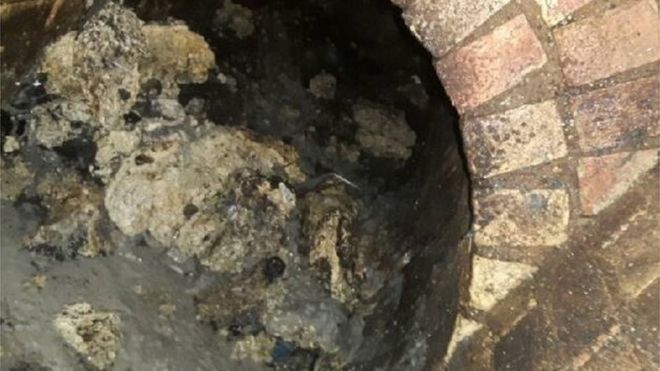
fatbergImage copyrightTHAMES WATER
Image captionWet wipes are a key component of fatbergs - like this giant one that weighed as much as 10 double decker buses

Wet wipes, used for sticky fingers and removing eye make-up, as well as on other parts of the anatomy, could themselves be wiped out over the next couple of decades.
The government says its plan to eliminate plastic waste "includes single use products like wet wipes". The wipes contain non-biodegradable plastic. So manufacturers will either have to develop plastic-free wipes or consumers will have to go without.
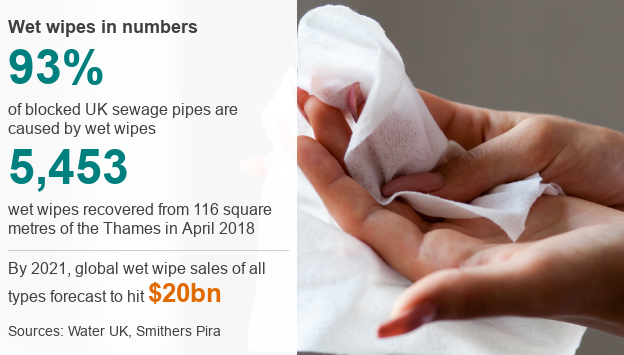
Wet wipes are behind 93% of blockages in UK sewers, a key element of the infamous giant obstacles known as fatbergs, according to Water UK, the trade body representing all of the main water and sewerage companies in the country.

Data Pic: Some 93% of blocked UK sewage pipes are caused by wet wipes. 5,453 wet wipes were recovered from a 116 square metre section of the River Thames in April 2018. The global wet wipes market is forecast to hit $20bn in sales by 2021.

That has prompted the government and industry to focus on persuading consumers not to flush them into the waste water system.
"We are continuing to work with manufacturers and retailers of wet wipes to make sure labelling on packaging is clear and people know how to dispose of them properly," a spokesperson for the Department of the Environment (Defra) said.


Media captionA lazy person's guide to cutting plastic from your life

However, Defra says it is also "encouraging innovation so that more and more of these products can be recycled and are working with industry to support the development of alternatives, such as a wet-wipe product that does not contain plastic and can therefore be flushed".

Reality check: What is a fatberg?

Despite the name, fatbergs are actually mainly made up of wet wipes. They account for a startling 93% of the material blocking our sewers according to Water UK, the membership body for water providers.
They collected samples to analyse from blockages in sewers, pumps and wastewater treatment works. Wet wipes - mostly baby wipes, but also those used to remove make up and clean surfaces - made up the vast majority of the material.
Fat, oil and grease only made up 0.5%. The other 7% was made up of a range of other materials including feminine hygiene products, cotton pads and plastic wrappers. Toilet paper made up just 0.01% of the material blocking our pipes and sewers.
Environmental charities including Greenpeace and the Marine Conservation Society say they are not surprised by this high number, since wet wipes are often marketed as "flushable".

The wet-wipe industry has flourished over the last decade with manufacturers offering an ever broader range of wipes, for sensitive skin, babies' bottoms, removing make-up, applying insect repellent, deodorant or sunscreen. However most are made of polyester and other non-biodegradable materials.
One manufacturer, Jeremy Freedman, managing director of Guardpack, has written to his MP to say banning them would be environmentally disastrous.
Mr Freedman told the BBC what he saw as their benefits: "If you go to TGI Friday and Nando's, for example, you'll see our products there. These wipes are biodegradeable, take 3ml of liquid on average. If they weren't able to use these, they would need to wash their hands, using on average one litre of water. They are also widely used in the medical industry and, for people with incontinence and disabled people, these wipes are critical to their lifestyle."
He said many of the wipes he produced were made of 100% biodegradable materials, but warned they were under no circumstances flushable.
Defra is in the process of exploring how changes to the tax system or charges could be used to reduce the amount of single-use plastics wasted.
Prime Minister Theresa May pledged in January to eradicate all "avoidable plastic waste" by 2042. The government has also said it will consult over whether or not to ban plastic straws, cotton buds and drink stirrers.

Wet wipes could face wipe-out in plastic clean-up - BBC News
.
.
.