... A FORUM TO STIMULATE DEBATE ... ... JUST ADD A COMMENT AT ANY ENTRY BELOW... ... FOR THE SUSTAINABLE DEVELOPMENT OF TOWN AND VALLEY ...
Showing posts with label fracking. Show all posts

Monday, 31 December 2018

How effective and how risky is environmental activism?

Last year was not a good year to be an environmental activist:
207 Killed in 2017, The Deadliest Year for Land Defenders - National Geographic
Why Do Environmentalists Keep Getting Killed Around the World? | Science | Smithsonian
At What Cost? Our Report on attacks on Land & Environment Defenders in 2017 | Global Witness
Environmental defenders being killed in record numbers globally, new research reveals | Environment | The Guardian

This year has not been too good either, especially in some parts of the world:
Environmental Defenders Under Pressure Across Southeast Asia | The Diplomat

As well as in India:
Environment protesters killed by Indian police were shot through the head and from behind, autopsy results reveal | The Independent 
Environmental Governance and Human Rights: The Role of The Civil Society And Challenges in India - Modern Diplomacy

And in Latin America:
Honduran court convicts seven of killing environmental activist | News | Al Jazeera
#ArchivoDemoAbierta2018: a year of environmental challenges | openDemocracy

Brazil is about to get a new president - and things are going to get worse:
Environmental Activists Under Assault in Brazil
Brazil’s new president Jair Bolsonaro promised to exploit the Amazon—but can he? - National Geographic
The Economists, Military, Moralists & Politicians Running Brazil - Bloomberg

In the United States, people are getting more active as the state apparatus becomes more passive:

Environmentalists count wins and losses from 2018

December 31 2018

A survey of 10 environmental groups and experts found many feel that regulations and protections are under assault, driving an increase in public activism. Public awareness of environmental issues is up, but that’s just a silver lining in dark days for federal, state and local environmental protections, according to environmental experts and activists.


Environmentalists count wins and losses from 2018

Interestingly, it is women who are increasingly engaging in activism:

Women Who Risk Everything to Defend the Environment

By Sarah Hurtes Nov 30 2018


According to Bridget Burns, director of the Women's Environment and Development Organization (WEDO), an advocacy organization focused on women's environmental leadership, there has been an increase in women-led groups in the U.S. pushing the fight for clean air and water. This is echoed by Rachel Cox from Global Witness, who argues that despite the obstacles they face, women activists are increasingly taking on leadership roles in the many battles against mining, deforestation, and other destructive industries. Think Winona Laduke, Julia Butterfly Hill, or Yong Jung Cho—to name a few.

Women tend to lead this fight, Yeampierre believes, because of their life-giving connection to their children and the earth, and their frustration with gender inequity. “We think like people who come from struggle,” she says, adding that women of color have been holding this space for years, and are now, finally, getting the visibility they deserve. “We tend to have this respect for Mother Earth as an extension of our culture and spirituality. So it's not surprising for me to see such an intergenerational group of badasses leading the way.”


Women Who Risk Everything to Defend the Environment — Female Environmental Activists and the Danger They Face

Some in North America may regard this as 'alarmist':
Environmental Activism Resembles Religion | National Review

Especially when it's effective:
Oil activists credited, blamed for killing Canada's oil industry | Newshub
Pipeline CEOs, facing environmental activism, vow to fight back - CNBC

And yet in other parts of the world, the freedom to protest without fear is being increasingly exercised:

In South Africa:
Environmental activism is not a whites-only issue | Opinion | M&G

And in West Africa:

Gambian Environmental Activists Take Swift Action Against Chinese Plant Accused of Polluting Their Water - Atlanta Black Star 

Gambians embrace new freedoms with environment activism

By ABDOULIE JOHN Associated Press Dec 4, 2018

BANJUL, Gambia (AP) — Hundreds of Gambians were grateful for the jobs created by a Chinese-run fish processing plant that arrived in 2014. Then they were shocked when dead fish began washing up on a nearby shore.

Residents of the coastal town of Gunjur reported chemical residue on their skin after swimming that made them itch. Environmental activists blamed the Chinese-owned company, Golden Lead Import & Export. After activists said the company had failed to remove a pipe accused of spewing toxic waste into the sea, local youth issued an ultimatum: Dig the pipe up, or we will. In March they did, storming the beach.

"We'll be willing to face any charges in defense of our community," their leader, Amadou Scattred Janneh, told The Associated Press. He is now out on bail facing criminal trespass charges.


For more than two decades, few in this tiny West African nation dared to speak out under the dictatorship of President Yahya Jammeh. Opposing voices were silenced by arrests and killings during his dictatorship.

A new era began when Jammeh was swept out of power and went into exile early last year. And as new President Adama Barrow's government has promised wider freedoms, Gambians are now speaking up as part of a nascent environmental movement.

After the protest over the fish processing plant, Gambia's government ultimately allowed the company to reinstate the pipe but required waste water to be treated before being discharged. The company's general manager, Bakary Darboe, denies causing marine pollution and has accused the activists of damaging property.

Janneh's arrest hasn't stopped other environmental activists in Gambia from holding regular demonstrations over the depletion of natural reserves along the country's coastline.

Such activism is long overdue, filmmaker and activist Prince Bubacarr Sankanu told The Associated Press. "The pressure on our meager natural resources is getting higher and higher, thus making proactive environmental activism an inevitable tool for good governance," he said.

Another high-profile demonstration earlier this year ended in the deaths of three protesters who had demanded the end of sand mining activities by the Julakay Entreprise company in the village of Faraba Banta. The sand is used in construction but the practice has been accused of damaging Gambia's coastline and local farming, which is often residents' only source of income.

Inspired in part by such confrontations, Gambia's president in September set up a land commission to look into the challenges of administering one of the country's most important resources. Nearly 80 percent of the population relies on agriculture for a living.

"As a country, we have been hurt because the foundation of our democracy had been shaken and corrupted," Barrow said during the commission's swearing-in ceremony. "The former government abused the rights of the citizens, and many communities lost their land for political or dubious reasons."


Finally, things might even be moving in China, from “responsive authoritarianism” 
The tensions underlying how China deals with environmental complaints | LSE Business Review

... to interventions by celebrities: 

Li Bingbing:
The actress who took on China's ivory trade

Shafi Musaddique 10 Dec 2018

Aghast with the lack of media attention on the ivory trade, she turned to her 40 million followers on popular Chinese social media site Weibo.

The Beijing-based actress has learned that the large following she has amassed can be harnessed for a greater cause. Li generated enough traction for the UN to describe her “Say No to Ivory” campaign as having the biggest impact of any other project that year.

She remains confident that ivory will fall out of favor largely due to changing tastes and awareness from young people on the impact illegal ivory can have on the environment. “As my generation, I didn’t see a lot of ivory trade. We didn’t even use those things,” she said.


.
.

Monday, 5 November 2018

"We do not accept that individuals in the Government do not care about climate change, nor that it’s too late to change course. We simply state here and now that the Budget must be a nadir for this Government’s tainted climate record – and that urgent action in the coming days must be announced. Anything short of that would be an unforgivable betrayal of future generations."

There were positive reactions to the budget when it came to small independent shops:
Futures Forum: Will the budget save the High Street?
Futures Forum: Following the business rates announcement, Hayman's the butchers believes the high street and independent shops will have a chance to prosper again.

But for all of central government making the right noises on the environment:
Futures Forum: Green Great Britain Week > "plans to tackle climate change, boost the low carbon economy, and deliver a green Brexit appear to have little substance"

... the really pressing issues are not being taken on board:
Futures Forum: “The loss of biodiversity is a silent killer”
Futures Forum: Climate change: the IPCC report provides a "simple and empowering" message for businesses, giving them a clear call to action to consider how to cut emissions within their operations.

Many have not been impressed by the budget:
A ‘wait and see’ Budget, when we need an economic reboot | New Economics Foundation
Budget 2018: Environmental groups condemn lack of commitment to tackle climate change and wildlife declines | The Independent

A strong message has been sent to the Prime Minister:

MPs and environmental groups accuse Theresa May of ‘unforgivable betrayal’ on climate change in Budget

Lack of climate policy represents ‘abject failure to govern in the interests of the people’, letter says


Harry Cockburn
2 days ago

16 comments

MPs and the heads of environmental organisations have written to Theresa May saying the Budget presented to parliament on Monday is an “unforgivable betrayal of future generations”, due to its “worrying lack” of policy to combat climate change.

Green Party co-leader Caroline Lucas and six other MPs, including Labour’s Clive Lewis and former Lib Dem leader Tim Farron signed the letter, which says “pushing policymaking into the long grass of Brexit at this stage represents an abject failure to govern in the interests of the people you are elected to serve.”

The chief executives of Greenpeace, 10:10 Climate Action and Global Witness were also among the signatories, who said the Budget was “a nadir for this government’s tainted climate record” and demanded “urgent action in the coming days must be announced”.


Read more
Groups condemn lack of environmental action in Budget
Hammond’s business-as-usual Budget is its own form of extremism
Is protest the only way to make governments listen on climate change?
Groups condemn lack of environmental action in Budget


“Not only did the chancellor fail to mention climate change in his speech, but the policies he put forward – from subsidy to polluters via the fuel duty freeze to a mass road building programme – will increase the UK’s climate impact,” the letter says.

It also takes issue with the government’s fracking programme and highlights the findings of the IPCC (Intergovernmental Panel on Climate Change) commissioned by the United Nations, published three weeks ago and which issued the most urgent and far-reaching call yet for world governments to cut their greenhouse gas emissions and stop global warming.

“[The report] was very clear about what governments need to urgently do – yet your government has all but ignored its publication in this Budget,” the letter says.

Mr Hammond’s Budget included £28.8 billion for the National Roads Fund for Highways England between 2020 and 2025, an extra £420m on top of the current fund of £300m immediately available to councils to tackle potholes, and fuel duty has been frozen for the ninth consecutive year, despite the fact it was revealed freezing fuel duty costs the Treasury £800m a year.

The chancellor also killed off plans for a “latte levy”, which would have taxed disposable coffee cups.

The only green initiative announced was £60m towards planting trees – 500 times less than the sum going towards roads.

Here is the letter to the prime minister in full:

Dear Prime Minister,

On Monday, your Government presented its Budget, and in doing so revealed a profoundly worrying lack of policy changes to combat the greatest threat of our time: climate change. Not only did the Chancellor fail to mention climate change in his speech, but the policies he put forward – from subsidy to polluters via the fuel duty freeze to a mass road building programme – will increase the UK’s climate impact.

With fracking now proceeding, and continued tax breaks being handed out to fossil fuel firms, we believe it is now vital we call out failure from a generation of politicians who will not live to see the devastation that their policies will wreak on future generations.

The most recent IPCC report was very clear about what Governments need to urgently do – yet your Government has all but ignored its publication in this Budget. We should be very clear here about timescales. It’s almost too late already, so pushing policymaking into the long grass of Brexit at this stage represents an abject failure to govern in the interests of the people you are elected to serve.

We do not accept that individuals in the Government do not care about climate change, nor that it’s too late to change course. We simply state here and now that the Budget must be a nadir for this Government’s tainted climate record – and that urgent action in the coming days must be announced. Anything short of that would be an unforgivable betrayal of future generations.

Caroline Lucas MP

Clive Lewis MP

Liz Saville-Roberts MP

Anna McMorrin MP

Tim Farron MP

Alex Sobel MP

Roger Godsiff MP

Gillian Caldwell, CEO, Global Witness

John Sauven, Director, Greenpeace

Hugo Tagholm, Director, Surfers Against Sewage

Guppi Bola, Director, Medact

Alice Bell, Director, 10:10 Climate Action


MPs and environmental groups accuse Theresa May of ‘unforgivable betrayal’ on climate change in Budget | The Independent
.
.
.

Friday, 19 October 2018

Green Great Britain Week > "plans to tackle climate change, boost the low carbon economy, and deliver a green Brexit appear to have little substance"

This week, the Transition Town group in Crediton has been asking:
Sustainable Crediton - What changes will you be making to live more sustainably?

Because this week has been a government-sponsored 'Green Great Britain Week':
Green GB Week: Landmark week of action to celebrate Clean Growth - GOV.UK

It's very much about promoting the official notion of 'green growth':

Working in partnership with business and civil society, the government is introducing the first ever Green GB Week – an annual week designed to highlight the opportunities clean growth offers the UK and raise understanding of how business and the public can contribute to tackling climate change.

The UK has led the world to date in cutting emissions while creating wealth. Between 1990 and 2016, the UK reduced its emissions by over 40% while growing the economy by more than two-thirds – the best performance in the G7 on a per person basis.

The global move to cleaner economic growth – through low carbon technologies and the more efficient use of resource – is one of the greatest industrial opportunities of our time.

This is why we put clean growth at the heart of both our Clean Growth Strategy, and the Industrial Strategy through our new Clean Growth Grand Challenge. We want to maximise the economic and industrial advantages of both the global and our domestic shift to clean growth across the whole of the UK.


Green Great Britain Week – Get involved in the week by attending or hosting an event or activity or by spreading the message on social media

There have been all sorts of projects...

Businesses and NGOs have been getting politicians to do things:
Green Great Britain Week – Minister learns about ecodriving in our electric vehicle taster session | Energy Saving Trust

Universities and research organisations have been involved:
Green Great Britain Week - News - Medical Research Council
First annual Green Great Britain Week launches at Imperial | Imperial News | Imperial College London

Including a session courtesy of the University of Leeds:


Green Great Britain Week: Climate Question Time - YouTube

And Community Energy England has been busy in Bristol today:

On "Climate Action in Communities" day, 19 October, we are supporting a conference, The Energy Transition: Top Down v Grassroots, with Bristol Energy Network and Bristol City Council to explore how local authorities and communities have been tackling climate change over the past decade since the Climate Change act was first enacted. This will be followed by the Community Energy Awards, co-organised with Community Energy Wales.

Green Great Britain Week | Community Energy England

However: 

'Green Great Britain Week' opens with fracking

Joseph Dutton | 16th October 2018


Fracking in the UK resumed yesterday after a seven-year hiatus.

The government's fossil fuel push has dirtied ‘Green’ Great Britain Week

Shale gas developer Cuadrilla received permission to start fracking at its Preston New Road site in Lancashire on Friday, after the High Court dismissed a last-minute legal challenge. Campaigners had initially won an interim injunction earlier in October against Lancashire council, arguing that emergency procedures at the fracking site were inadequate.

This will be the first fracking operation in the UK since 2011, when activity was halted after drilling by Cuadrilla caused two earthquakes at its Preese Hall site in Lancashire.

Environmental standards

Cuadrilla had planned to begin new fracking operations over the weekend but poor weather conditions and strong winds from Storm Callum led to operations being delayed. The storm has caused the deaths of two people and led to widespread flooding across the west and Wales.

This October could yet become the wettest on record, and scientists have warned that extreme weather in the UK is likely to increase because of climate change – something laid out in the government’s own Green Great Britain Week event brochure.

The five-day long Green Great Britain Week is the government’s flagship event to mark the 10th anniversary of the Climate Change Act, that it hopes will bring “the whole country together to celebrate UK leadership and look forward to the next ten years".

The government intends to use it to promote the scale of the opportunities to reduce UK emissions to tackle climate change, grow the low carbon economy and create a better environment, with businesses, schools, community groups, and charities taking part.

The week is part of the government’s headline promise to deliver a ‘green Brexit’ with higher environmental standards in the UK once we leave the EU, and its 25-year environment plan which set out the aim to make this the first generation to leave the environment in a better state than that in which it was inherited.

Economic growth

But the restart of fracking directly undermines the entire process, and the aims of Green GB Week. The disjointed approach from government is further highlighted by the fact on Monday morning while Cuadrilla was gearing up to start fracking, energy minister Claire Perry was due to give a talk at a conference on climate change, before later delivering a speech to parliament on Green GB week and the government’s plans for clean growth.

Just last week, it was also reported that Perry was considering reducing the earthquake safeguarding limits that were put in place after the two earthquakes caused by fracking in 2011. This would be the latest in a series of proposals aimed at removing regulation to help fracking develop at a commercial scale.

In May Greg Clark, the secretary of state energy, proposed changing planning law in England so decisions on fracking would be taken by government ministers, and not local authorities. Under the proposals shale gas sites in future could even be classed as ‘permitted development’, meaning they do not require planning permission.

He also proposed transferring the regulation of fracking to a newly created and streamlined body, away from the Environment Agency, the Health and Safety Executive and the Oil and Gas Authority as it is currently regulated.

The government has spent nearly a decade putting its support beyond developing shale gas, ensuring it could be a commercial success, and an industry that will deliver jobs and economic growth to the UK.

But with just one gas well fracked since 2011, it is under increasing pressure to deliver on these claims. This is despite internally lowering expectations on the future size of a potential shale gas industry.

Green Brexit

The changes to the planning procedure and alter limits on earthquake monitoring could be viewed as attempts at ensuring the sector grows and the UK has commercial development of shale.

But a lack of public support and the absence of a social licence for fracking remains a huge stumbling block – and the government’s own polling shows renewables remain more popular with the public than fracking.

The assistance offered to the shale sector stands in contrast to the cuts the government has made to renewables. In May the government was strongly rebuked by the independent Environmental Audit Committee for the decline in clean energy investment in the UK.

A string of decisions since 2015 to remove support for renewables have resulted in a fall in clean energy investment by 10 percent in 2016 and 56 percent in 2017.

The resumption of fracking is a significant milestone for the shale gas sector, but it is too early to determine if it will be a success. Drilling results from this site will not be known by Cuadrilla until the new year.

But the resumption of fracking is also highly significant for the government. The support being given for new fossil fuel production in the UK means it's plans to tackle climate change, boost the low carbon economy, and deliver a green Brexit appear to have little substance.

This Author

Joseph Dutton is a policy adviser for the global climate change think-tank E3G. All views are his own. He tweets at @JDuttonUK

Saturday, 13 October 2018

“The science is crystal clear, we need to phase out fossil fuels starting with the most damaging, the ‘unconventional’ fossil fuels such as tar sands and ‘fracking’.”

We are going to see more fracking happening in the UK:
Futures Forum: Fracking in Britain?

As reported in today's press: 

Fracking for shale gas will go ahead Saturday in the UK for the first time since it was linked to earthquakes in 2011 after a last-ditch legal challenge failed to halt operations.

Fracking restarts in UK tomorrow after last-ditch Lancashire legal challenge fails

It's not popular: 

An open letter from charities including the Campaign to Protect Rural England, Friends of the Earth, Greenpeace, RSPB and the WWF label fracking proposals a ‘perversion of local democracy’

Environmental heavyweights call on the Government to drop plans to fast-track fracking - Campaign to Protect Rural England

Tomorrow's Observer carries a damning comment from 'the father of climate change': 

Top climate scientist blasts UK’s fracking plans as 'aping Trump’

James Hansen, ‘father of climate science’, accuses Britain of ignoring science
James Hansen said the UK’s policy would contribute to ‘climate breakdown’.
 James Hansen said the UK’s policy would contribute to ‘climate breakdown’. Photograph: Chip Somodevilla/Getty Images

One of the world’s leading climate scientists has launched a scathing attack on the government’s fracking programme, accusing ministers of aping Donald Trump and ignoring scientific evidence.
James Hansen, who is known as the father of climate science, warned that future generations would judge the decision to back a UK fracking industry harshly.
“So the UK joins Trump, ignores science… full throttle ahead with the worst fossil fuels,” Hansen told the Observer. “The science is crystal clear, we need to phase out fossil fuels starting with the most damaging, the ‘unconventional’ fossil fuels such as tar sands and ‘fracking’.”
Hansen has also written to the UK energy minister, Claire Perry, to underline his objections, warning that the decision was a serious policy error that would contribute to “climate breakdown”.
His intervention came as the first fracking operation in England for seven years – which had been due to get under way on Saturday in Lancashire – was postponed until Monday because of bad weather.
It also followed the Intergovernmental Panel on Climate Change (IPCC) report last week that warned the world has only 12 years left to avoid catastrophic climate change, calling on governments to take radical and far-reaching measures to decarbonise their economies.
Last week it emerged that Perry was considering relaxing rules on the earthquake limits on fracking, making it easier for companies to push ahead at sites in England.
But in his letter Hansen warned that young people could inherit an environment “out of their control” if fracking was pursued. “If the UK were to join the US by developing gas fields at this point in time it will lock in the methane problem for decades,” he wrote, adding that fracking would fatally undermine the UK’s attempt to fulfil its climate obligations.
“The fossil fuel companies are well aware methane is a potent greenhouse gas, and yet they seem willing to continue on a path which can have disastrous consequences for our grandchildren,” Hansen said.
The Conservative party’s fracking programme – which aims to release fossil fuel gas from wells at sites across England – has been dogged by criticism from environmentalists as well as fierce local opposition. There is a moratorium on the practice in Scotland and Wales.

Protesters stand outside Cuadrilla’s Preston New Road fracking site near Blackpool, yesterday.
Pinterest
 Protesters stand outside Cuadrilla’s Preston New Road fracking site near Blackpool, yesterday. Photograph: Andrew Yates/Reuters

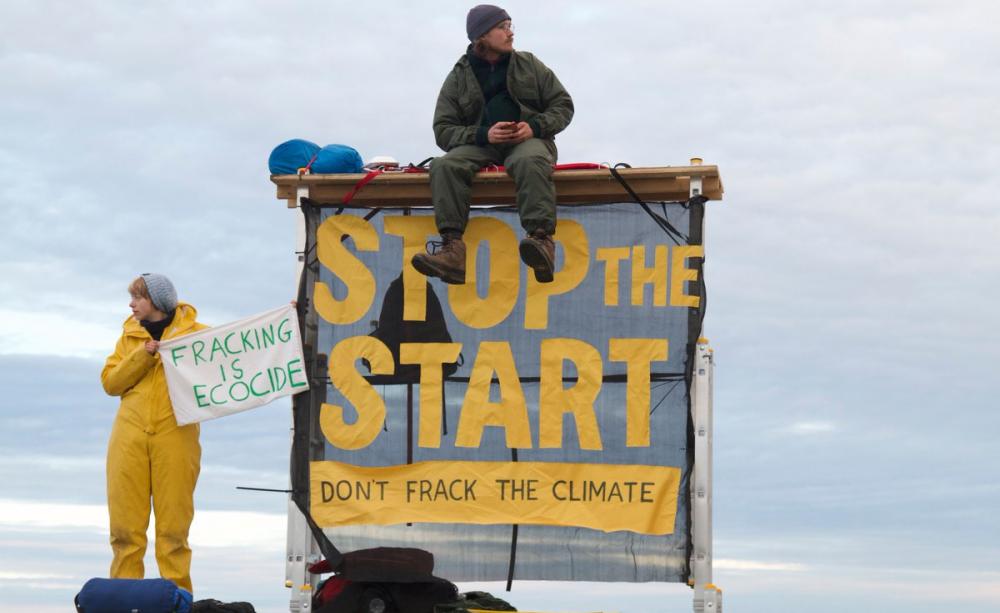
Last month three environmental activists were jailed for their part in a direct action campaign at the Preston New Road fracking site near Blackpool in Lancashire.


The Campaign to Protect Rural England (CPRE), which obtained a copy of Hansen’s letter, said it was “imperative that the government heeds the advice, concerns and warnings of leading scientists over fracking”.
“The severity of the warnings from the IPCC report underline why fracking is a dead duck,” said Tom Fyans, director of campaigns and policy at the CPRE. “We must speed up the transition to renewable energy – we have absolutely no time to mess around introducing a new carbon-emitting fossil fuel industry.”
The Department for Business, Energy and Industrial Strategy defended its support of the controversial energy source. “Shale gas has the potential to be a new domestic energy source, enhancing our energy security and delivering economic benefits, including the creation of well-paid, quality jobs,” it said in a statement, adding it would respond to Hansen’s letter “in due course”.
It pointed out that the UK’s Committee on Climate Change “recognises that natural gas can help the UK meet its 2050 carbon emissions reduction target” and that since 1990 the UK has “cut emissions by more than 40% while growing our economy by more than two thirds; a feat unmatched by other G7 countries”.
However there is growing disquiet in Tory ranks about the government’s fracking plans. Almost two dozen Conservative MPs are reported to be opposed to fracking and willing to “destroy the government’s majority” if ministers seek to push proposals to relax rules through parliament.
Fyans said it was essential that the government listen to the “views and concerns of communities who will see their local environment industrialised” if fracking goes ahead.
“The current proposals to fast-track fracking through the planning system, which the government are consulting on, will take local people’s voices out of the discussion,” he said. “Whether or not you agree with fracking, it is a fundamental democratic right for people to be able to voice their concerns – we cannot deny communities this opportunity.”
The pressure is also building from the scientific community. The IPCC report called on governments to take radical action to decarbonise their economies. And in his letter Hansen warned that any politicians or officials who push ahead with fracking would bear “disproportionate responsibility” for the consequences.
“I urgently call upon politicians of any persuasion to reflect on the peer-reviewed scientific information that is readily available and which clearly points to the need to rapidly phase down fossil emissions,” he wrote. “A task made much more difficult and probably implausible if the world exacerbates the problem by expanding fossil fuel emissions via fracking technology.”
Top climate scientist blasts UK’s fracking plans as 'aping Trump’ | Environment | The Guardian
.
.
.

Thursday, 11 October 2018

Fracking in Britain?

Last month, we had our first fracking martyrs:
Anti-fracking activists jailed for 'causing a public nuisance' during four-day protest | The Independent

Nobody seems to like fracking:
From green activists to Tory MPs, why does everyone hate fracking so much? | The Independent

However, the current government has made it a much easier thing to do:
Futures Forum: The system is rigged against onshore wind ... and is about to be rigged in favour of fracking
Futures Forum: The new National Planning Policy Framework has been "illegally adopted because the government failed to assess its environmental impact"

As reported this week:
The Tories have made fracking as easy as building a garden wall | The Independent
Fracking earthquake laws could be relaxed as government aims to encourage gas extraction | The Independent

There have been developments in the last twenty-four hours though...

Today's press is suggesting some bias in the proceedings to jail 'the Fracking Three':
Judge who jailed Fracking Three has family links to oil and gas firms | Daily Mail Online
Judge who jailed fracking protesters with 'excessive' sentence has family links to oil and gas firm - Mirror Online

And tomorrow, the courts will decide whether to stop the first drilling:
High Court to rule on bid to temporarily halt Cuadrilla fracking | Somerset County Gazette
Energy Voice | Cuadrilla to find out fracking fate tomorrow - News for the Oil and Gas Sector

It takes an outsider to give some perspective: here's the view from the New York Times:

Fracking in Britain? A Driller Tries Again 7 Years After Triggering Earthquakes

Battling big expense and persistent protests, Cuadrilla Resources returns to again attempt shale gas production after its first effort triggered small tremors.


Demonstrators took to the street last week outside Preston Prison in Britain to support three activists who were jailed for blocking Cuadrilla’s fracking site. Credit Andrew Testa for The New York Times

By Stanley Reed
Oct. 11, 2018

LITTLE PLUMPTON, England — In a farmer’s field in northwestern England, a decade-old energy company hopes to overcome its decidedly rocky history of shale drilling in the United Kingdom.

Seven years after earthquakes followed its first attempt at hydraulic fracturing, that company, Cuadrilla Resources, has returned with a government-enforced go-slow approach. It has set up a chain of seismic monitors three miles beyond its dig to gauge tremors. Contractors from Schlumberger, the oil field services firm, plan to pace themselves and spend up to three months stimulating the wells using the process known as fracking. In the United States, a similar effort would take just a few days.

Francis Egan, the chief executive of Cuadrilla, will be monitoring closely when the first gush of water, sand and chemicals cracks the shale bed called the Bowland basin. So will wary homeowners and environmentalists who have battled Cuadrilla in court. They were in court on Thursday in the latest effort to delay the project.

This plot of land outside the city of Blackpool, where cows graze and anti-fracking activists have set up camp nearby, may decide the future of fracking in Britain and other parts of Europe. Mr. Egan, in an interview last week, said his own business calculation could be reduced to a simple truth: “It’s all down to the rocks.”


The Cuadrilla site on Preston New Road near Blackpool. The company is taking a slow approach, imposed by the government, after its last efforts triggered tremors. Credit Andrew Testa for The New York Times

In a country that has long valued a robust oil industry, fracking has been an exercise in frustration for energy explorers. Britain has been ambivalent about the innovative water-blasting method even as it has transformed the United States into a major petroleum exporter.

The central government of Prime Minister Theresa May has supported shale exploration, in part because of the declining output from oil and gas fields in the North Sea. But local councils have been far more critical of possible environmental and community costs.

Their skepticism matters because they have a large sway over land use. A series of small earthquakes in 2011, when Cuadrilla drilled in another site, was documented by the British Geological Survey and stoked discontent with fracking. The controversy stirred demands for more stringent safety measures as well as debate over the risk to water and green space in the English countryside.

“I used to fish these ponds and walk these little lanes,” said John Norcross, a groundskeeper from the nearby village of Marston, who supports the protesters. “I don’t want this insidious thing anywhere in our county.”


A protest camp near Cuadrilla’s fracking site. The company estimates that the northern district of Lancashire holds 200 trillion cubic feet of natural gas just in its license area. Credit Andrew Testa for The New York Times

What happens in this northern district of Lancashire — which Cuadrilla estimates holds 200 trillion cubic feet of natural gas just in its license area — could embolden both sides. Yet, a safe and unremarkable dig where Cuadrilla has prepared two wells is essential for the company.

“I think it will be absolutely critical,” said Peter Styles, a professor emeritus of geophysics at Keele University in Newcastle who has studied shale and concerns over this site, called Preston New Road.

Antipathy often arises in discussions about shale drilling across Europe. Environmental fears have led to some bans, de facto or de jure, in France and Germany. Poland and Romania, where coal remains a vital energy source, were receptive, but interest from big energy companies soon melted. Chevron, among others, has not found sufficient resources to justify the expense of drilling.

Much of Europe relies on imports from Russia or the Middle East. Still, analysts forecast that Britain and Europe will have to find new energy sources, and that has pried an opening for Cuadrilla and other explorers.


Katrina Lawrie has spent the last 18 months living on a farm near the Cuadrilla site, monitoring traffic and attending protests. “I truly believe that fracking is absolutely disastrous not only for the environment and the water but to communities, too,” she said. Credit Andrew Testa for The New York Times

Mr. Egan, who spent decades working in the international oil and gas industry, was brought into Cuadrilla after the earthquakes. He was hired to upgrade the company’s procedures and shore up credibility with the British regulators.

In an interview last week, Mr. Egan stressed that the company was cautious in its approach and adding some high-end technological help. Cuadrilla has built a seismic warning system to a degree of sensitivity set by the government; any slight tremor of 0.5 on the Richter scale means shutting down the operation for at least 18 hours, he said.

Mr. Egan remains optimistic about the market possibilities because extensive core samples of rock from the site show the energy that could be unbound. The rock fractures easily, and “we know there is a lot of gas in it.” Still, until the company runs what are called flow tests, late this year or early in 2019, “we won’t know what rate it’s going to come out,” he said.

Surveys show Britain has potentially large shale gas resources, but more drilling needs to be done to assess how much, if any, can be produced economically. A quick calculation of its potential, though, reveals that big profits are possible. If just 10 percent of the 200 trillion cubic feet believed to be under Cuadrilla’s license area in Lancashire can be recovered, that would equal about seven years of current British gas consumption.


Protesters keep a 24-hour vigil in a shack almost directly across from Cuadrilla’s gate. Credit Andrew Testa for The New York Times

Mr. Egan said that exploration had been expensive but that Cuadrilla would eventually push costs down to $15 million or less for a well. He estimates a well might produce as much as $30 million in revenue — using the average price of gas in recent years — over its life span. There is “absolutely no doubt” that Cuadrilla could make money if gas can be extracted from the shale, he said.

Ownership of Cuadrilla is now roughly split between Riverstone Holdings, an American private equity firm focused on energy, and A. J. Lucas, an Australian company.

Industry executives believe that although Britain may be a decade or two behind the United States, these companies are clearing a path to a viable shale gas business.

Cuadrilla and another company have successfully appealed when local governments rejected applications. Lancashire, for instance, turned down Cuadrilla’s plans in 2015. Cuadrilla won an appeal from a higher planning agency a year later. Cuadrilla has also gone to court to protest the protesters and obtained an injunction in July barring them from obstructing its work site. In September, a judge in nearby Preston jailed three protesters for blocking the site and climbing on trucks there.


Industry executives believe that although Britain may be a decade or two behind the United States, companies there are on the way to a viable shale gas business. Credit Andrew Testa for The New York Times

“It’s painful, obviously, in terms of time and costs, but what is actually happening is establishing precedent and, almost, case law,” said John Blaymires, chief operating officer of Igas Energy, another shale company.

The optimistic view of executives like Mr. Egan and Mr. Blaymires is that what looks like near-paralysis to outsiders is actually the trials and errors of a fledgling industry. Artem Abramov, who follows shale for Rystad Energy, an Oslo-based market research firm, forecasts that by 2040 shale drilling could account for half of British gas production. That would mean thousands of wells must be drilled, an engineering and training challenge.

The political side may be more difficult.

Unlike in the United States, where shale abounds in more remote areas, shale drilling in Britain has been pursued near some residential areas. Truck traffic and the movement of heavy machinery have spurred complaints, and a survey in July by YouGov found that 42 percent of respondents said Britain should not extract gas from shale rock by fracking; 29 percent approved.

Katrina Lawrie, 40, has spent the last 18 months living at a farm near the Cuadrilla site, monitoring traffic in and out and routinely attending protests. “I truly believe that fracking is absolutely disastrous not only for the environment and the water but to communities, too,” she said in an interview.

Protesters keep a 24-hour vigil in a makeshift shack almost directly across from Cuadrilla’s gate. A retired university professor, Celia Briar, was among those who said they were motivated by local and global concerns about fracking. Ms. Briar said she feared gas from New Preston could seep into the groundwater supply, affecting milk and vegetables.

“To contaminate a major food-growing area for a little bit of gas is insane,” she said.

For those who favor the industry, time is the enemy.

That so little has been accomplished in a decade could make investors reluctant to spend years pursuing shale resources — as well as fighting bouts of controversy. “We are a lot less likely now to see shale gas play a major role in U.K. supply than we were six years ago,” said John Williams, senior principal at Pöyry Management Consulting, an Oxford firm that has studied the economics of shale gas for clients, including Cuadrilla.