Revealed: the WORST
offenders when it comes to the packaging pollution emergency on our beaches.
45,000 of you turned out for the biggest Spring Beach
Clean ever -- but you didn’t just tidy up our beauty spots. You carefully
categorised and counted up exactly what you found. And now we’ve analysed all
the data. 2019’s worst companies for packaging pollution on our beaches are:
Coca Cola. Walkers and Pepsi owner PepsiCo.
Cadbury’s owner Mondelez. McDonald’s…. and Nestlé.
We’ve sent a detailed report to the government who’re
considering action. Can you help us sound the alarm and demand these
companies clean up their act?
It’s been an exciting
rollercoaster lately in the Surfers Against Sewage office. Thank you so much
for watching and sharing ‘The Creature’ our film designed to inspire more
people to join the #GenerationSea movement.
It worked! More than a quarter of a million people have
watched ‘The Creature’, it has been shared with more than 5 million people on
social media and the number of signatures on our petition to the government
has nearly doubled! Behind every name is an individual with skills and ideas
to build this movement and help turn the tide for ocean life.
Now it’s time we took this fight to the corporations.
They’re making huge profits from cheap throwaway packaging while turtles,
seals, whales and birds pay the price. Share to sound the alarm:
Click
here for our news story to share with friends on email
Right now, the government is considering new
legislation that would force companies to take responsibility for the damage
they do with throwaway packaging.
We’ve sent them a detailed report with the evidence
from the Big Beach Clean -- now we need you to help spread the word that
these companies need to clean up their act.
With signatures, shares, beach cleans, talking to
friends and family, and now taking the fight to corporations, every day we
build a stronger movement to protect the ocean. #GenerationSea.
Thanks,
Ben Hewitt, Director of Campaigns and Projects,
Surfers Against Sewage
PS: Here’s
what SAS supporter Dani wrote on Facebook after watching ‘The
Creature’...thank you Dani. We couldn’t agree more.
"Very powerful 🙏😢 We know from beach cleans what a massive
difference individuals and communities can make in the fight against plastic
pollution, we just need to continue to make people aware of the power they
have."
Our campaigns
are powered by people like you. Protect what you love by donating
or visiting
our shop.
Thank you!
SURFERS AGAINST SEWAGE
Registered Charity in England & Wales No. 1145877
This is unbelievable -- western governments are dumping millions of
tonnes of plastic waste on developing countries with paradise
coastlines instead of recycling it! Now a summit in Geneva is
deciding whether to stop the export of plastic trash to countries
that can't process it, but the Trump administration is trying to
block it. A massive show of support could make the difference
-- so let’s build an urgent worldwide campaign with a single
clear message: stop dumping plastic in paradise!
This is unbelievable -- western governments are dumping millions
of tonnes of plastic waste on developing countries instead of
recycling it!
We’ve all seen shocking pictures of paradise beaches choked with plastic
waste. But I bet none of us knew the plastic could be from Europe, the
US, and Canada!
Right now, in a bid to tackle this scandal, a summit in Geneva is
deciding whether to stop the export of plastic to countries that
can't process it.
There’s huge support for the idea, but big business and powerful
governments like the Trump administration are trying to block it.
Champions say a massive show of public support could make the
difference, and will take our voices into the room in 48 hours
-- so let’s speak out urgently with a single clear message: stop
dumping plastic in paradise!
Plastic is literally choking our oceans. Everywhere we look we see the
carnage -- dead whales washing up with stomachs full of plastic, seabirds
suffocating, turtles drowning in plastic nets. And most of the plastic
enters the sea in developing countries without strong recycling
systems.
Which is why it’s so INSANE that rich countries are shipping
their plastic waste to some of these exact countries!
Now we have a chance to change it. A coalition of countries led by Norway
is pushing to add plastic to a deal on hazardous waste, meaning it
couldn’t be exported unless there were safeguards it would be properly
processed, and giving poorer countries the right to refuse it.
We can’t solve the plastic crisis engulfing our oceans while using
pristine coastlines as a global plastic dump. The decision will be made
in days -- so join now to tell our governments: stop dumping
plastic in paradise!
Our movement has fought the scourge of plastic pollution
again and again. We’ve helped win bans on plastic bags, funded clean up
plans on polluted rivers, and delivered a giant call to ban throwaway
plastics to the UN. Now we need to rise to defend our oceans again.
With hope and determination,
Risalat, Rewan, Bert, Iain, Spyro, Alex, Rosa, and the rest of the Avaaz
team
This year’s
Big Spring Beach Clean was the BIGGEST EVER.
A record-smashing 45,771 people showed up on beaches,
river banks and mountain tops with bags, good humour and determination.
That’s enough people to fill more than 500 double decker buses! And
together we filled 17,700 full bin bags of plastic pollution.
Can you believe 10,000
more people joined in the Beach Clean than last year?! We are completely
blown away in the Surfers Against Sewage office.
It’s proof that a powerful #GenerationSea movement
really is growing to protect our oceans. More and more people are saying it’s
time to turn the tide before it’s too late. Together, we’re becoming the voice
of the ocean from our beaches, to the corridors of power.
We’re now beginning the analysis of the plastic
pollution we collected. For too long, corporations have gotten away with
ignoring the problems they cause. And politicians have let them. We’ll let
you know the results soon and how you can take action.
Meantime, a massive thank you to everyone who took part
in the Big Spring Beach Clean, as well as everyone who was there in spirit!
Especially big
thanks to our volunteers and Regional Reps who organised the 752 cleans
across the British Isles, from Shetland in the far north to Jersey in the
south. A special shout out to those organised by schools and Duke of
Edinburgh participants.
Thanks again,
Jack Middleton, Community Manager at Surfers Against
Sewage
The planet is barreling toward 1.5 degrees of global warming as soon as 2030 unless we enact “unprecedented changes in all aspects of society,” a dire United Nations report warned in October.
To reduce our impact on the climate and avert disaster, it’s going to take more than switching to high-efficiency light bulbs. But the most effective ways that individuals, policymakers and businesses can reduce our carbon footprint might surprise you.
Let’s see how much you know about what can be done to fight climate change.
Rank the solutions
The group Project Drawdown has ranked the most effective climate change solutions, and below, we’ve separated some of the top ones by category.
Actions are labeled to indicate whether they can be implemented by individuals, companies or policymakers.
What you can do
What industries can do
What policymakers can do
Drag the solutions below to rank the ones you think would have the biggest effect on curbing climate change.
Materials stripped from old iPhones by Apple’s recycling robot are making their way into the company’s new products for the first time.
The robot, christened Daisy, dismantles 1.2m iPhones each year in an effort to retrieve 14 valuable metals and materials, including gold, cobalt, aluminium and tin, some of which are now being reintroduced to Apple’s production lines.
Cobalt retrieved from old batteries are used to create new batteries in a range of Apple products, and salvaged tin is used in the solder on the main logic boards of 11 different devices, according to the company’s annual Environmental Responsibility report.
The inner iPhone components Daisy is capable of recycling (Photo: Apple)
Aluminium housing recovered from old Apple products retrieved from Apple’s Trade In programme has been remelted and used to make the latest MacBook Air, which went on sale at the end of last year.
Apple declared its intention to one day manufacture all future products using only recycled and renewable materials in 2017, and said it diverted more than 48,000 metric tons of electronic waste from landfill last year.
More than 7.8m Apple devices were refurbished in 2018, which would have been put up for resale on the company’s website.
iPhones and other smartphones contain precious and valuable metals, including gold, silver, aluminium, copper and tungsten, and rare earths such as terbium, yttrium, lanthanum, neodymium, gadolinium and praseodymium.
Extracting metals and other components from electronics during the recycling process is notoriously problematic, as environmentally-unfriendly chemicals and smelting methods are often used to break down electronics during extraction.
Daisy dismantled 1.2m iPhones last year (Photo: Apple)
Daisy can recover materials traditional recyclers cannot at a higher quality, and is currently operational in the Netherlands and Texas in the US, Apple said.
For every 100,000 iPhones, Apple’s Daisy recycling robot has the potential to recover 1,500kg of aluminium, 1.1kg of gold, 6.3kg of silver, 32kg of rare earth elements, 83kg of rare metal tungsten, 1,000kg of copper, 29kg of tin, 790kg of cobalt and 1,400kg of steel.
Around 50m metric tons of electronic waste (e-waste) is predicted to have been generated throughout 2018, rising at a rate of 5 per cent per year, according to Statista.
But the first commercially viable version of the now ubiquitous material - cellophane - was conceived in a more innocent age, before anyone worried about plastic in landfill, or the sea, or the food chain.
It begins in 1904, at an upmarket restaurant in Vosges, France, when an elderly patron spilled red wine over a pristine linen tablecloth. Sitting at a nearby table was a Swiss chemist called Jacques Brandenberger, who worked for a French textile company. As he watched the waiter change the tablecloth, he wondered about designing a fabric that would simply wipe clean. He tried spraying cellulose on tablecloths but it peeled off in transparent sheets. But might those transparent sheets have a market?
By World War One, he'd found one: eye-pieces for gas masks. He called his invention "cellophane" and in 1923 he sold the rights to the DuPont corporation in America. Its early uses there included wrapping chocolates, perfume and flowers.
But DuPont had a problem. Some customers weren't happy. They'd been told cellophane was waterproof, and it was, but it wasn't moisture-proof. Candies stuck to it; knives rusted in it; cigars dried out.
DuPont hired a 27-year-old chemist, William Hale Charch, and tasked him with finding a solution. Within a year, he'd done it - the cellophane was coated with extremely thin layers of nitrocellulose, wax, a plasticiser and a blending agent.
Sales took off. The timing was perfect. In the 1930s, supermarkets were changing - customers no longer queued to tell shop assistants what food they required. They picked products off the shelves instead.
See-through packaging was a hit. And, as Harvard Business School researcher Ai Hisano points out, had "a significant impact not only on how consumers purchased foods but also on how they understood food quality". Cellophane let them choose food on the basis of how it looked, without sacrificing hygiene or freshness.
One study - admittedly funded by DuPont - found that wrapping crackers in cellophane boosted sales by more than half. And retailers had no shortage of similar advice. "She buys meat with her eyes," said a 1938 edition of The Progressive Grocer.
In fact, the meat counter was the hardest to make self-service. The problem was that meat, once cut, would quickly discolour. But trials suggested a self-service meat counter could sell 30% more food.
With such an incentive, solutions were found: pink-tinted lighting, antioxidant additives and - of course - an improved version of cellophane, which let through just the right amount of oxygen. By 1949, DuPont adverts boasted about the "pleasing new way" to buy meat - "pre-cut, weighed, priced and wrapped in cellophane right in the store".
But cellophane would soon fall out of fashion, overtaken by the likes of Dow Chemical's polyvinylidene chloride. Like its predecessor, this was an accidental discovery first used in conflict - in this case, weatherproofing fighter planes in World War Two. And, like cellophane, it needed plenty of research and development before it could be used on food - it was originally dark green and smelled disgusting. Once Dow sorted that out, it hit the market as Saran Wrap - now more widely known as cling film.
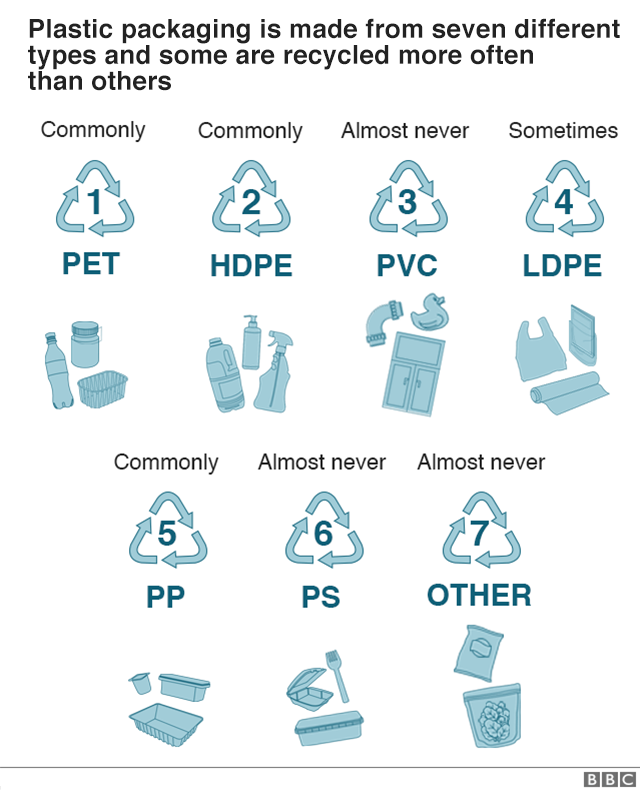
After health scares with polyvinylidene chloride, cling film is now often made with low-density polyethylene, though that's less, well, clingy. It's also used to make those single-use supermarket bags now being banned around the world. High-density polyethylene is the kind of stuff you might get milk in.
Fizzy drinks come in polyethylene terephthalate.
And if you're not lost already, consider that plastic packaging is increasingly made from multiple layers of these and other substances, such as biaxially-oriented polypropylene or ethylene-vinyl acetate.
There's a reason for this, say packaging gurus - different materials have different properties, so multiple layers can give you the same performance from a thinner - and thus lighter - piece of packaging.
But these compound packaging materials are harder to recycle.
The trade-off is hard to fathom. Depending on how much of the heavier, recyclable packaging would in practice be recycled, you might find that the lighter, non-recyclable packaging actually generates less waste. And once you start looking into plastic packaging, this kind of counterintuitive conclusion comes up all the time.
Some packaging is a foolish waste. But are shrink-wrapped cucumbers really so silly if it means they stay fresh for 14 days rather than three? Which is worse 1.5g (0.05oz) of plastic wrap or entire cucumbers going off before being eaten? Suddenly it's not so obvious.
Plastic bags stop bananas going brown so quickly, or new potatoes going green; they catch grapes that fall off bunches. About a decade ago, one UK supermarket experimented with taking all its fruit and vegetables out of their packaging - and its food wastage rate doubled.
And it's not just shelf life - what about waste created before food gets to the shop in the first place? Another supermarket, stung by criticism for putting apples in plastic-wrapped trays, tried selling them loose from big cardboard boxes - but so many were damaged in transit that the approach used more packaging per apple actually sold.
According to a UK government report, only 3% of food is wasted before it gets to shops. In developing countries, that figure can be 50% - and that difference is partly due to how the food is packaged. As more of us live in cities, far from where food is grown, this matters.
Even the dreaded single-use shopping bag might not be the villain it seems.
If you've bought sturdy, reusable bags from your supermarket, it's likely they're made from non-woven polypropylene - and they are less damaging, but only if you use them at least 52 times. That's according to a report by the Danish government, which weighed up the varied environmental impacts of producing and disposing of different kinds of bag. And if your reusable bag is organic cotton, don't feel smug - the researchers reckon they need 20,000 uses to justify themselves. That's a shopping trip every day for over half a century.
The market can be a wonderful way of signalling popular desires. Shoppers in 1940s America wanted convenient, pre-cut meat - and what economists call the "invisible hand" of the market delivered the technologies that made it possible. But our desire for less waste may not yield to market forces, because the issue is complicated and our choices at the checkout may accidentally do more harm than good.
We can send that message on a more circuitous route only, through governments and pressure groups, and hope that they - and well-meaning industry initiatives - will work out some sensible answers.
It seems clear the solution will not be no packaging - it will be better packaging, dreamed up in research and development labs of the kind that gave us moisture-proof cellophane all those decades ago.