climate change:
IPCC: Global warming is getting deeper
The report of the Intergovernmental Panel on Climate Change is mindbogglingly thorough and cautious - the work of 259 top scientists from 30 countries

8:28PM BST 27 Sep 2013
 266 Comments
Yesterday’s giant climate report was met with a dance and a scream. The dance came when the governments and scientists of the Intergovernmental Panel on Climate Change (IPCC), finally put the finishing touches to the most important analysis yet of its kind after a series of sessions that allowed them only six hours’ sleep in the last 52. The conference manager, Francis Hayes – a former Met Office scientist – donned a Russian hat and performed a Cossack caper in celebration.
The mass scream was part of a demonstration outside the former Stockholm brewery in which they had convened by protesters venting their frustration that governments have largely failed to act on previous warnings. They hope that will change. For this is the first in a year-long series of giant IPCC reports to prepare the ground for an attempt to forge an international agreement on tackling global warming in Paris in December 2015.
Mind you, there are those who say the IPCC has long been leading the world a merry dance. As some extreme sceptics see it, a small clique of scientists has been concocting, against all the evidence, one of history’s greatest hoaxes, bamboozling governments into addressing a problem that doesn’t actually exist. But the conspiracy theory fails at the briefest reality check.
The summary report published yesterday, and the million-word full version that will follow, result from a mindbogglingly thorough process. Together they were written by 259 top scientists from 30 countries, drawing on 9,200 mostly recent scientific publications – and checked by 1,089 reviewers, whose 54,677 comments all had to be taken into account. And over the past week “every single word” has been justified to 110 governments.
Unsurprisingly, this painstaking procedure produces cautious reports. It was not until 2007 that the IPPC straight-forwardly accepted that humanity was causing global warming, nearly 20 years after leading scientists had begun publicly saying so. Even then, it grossly underestimated the resulting sea level rise, and wholly failed to a predict a dramatic melting of Arctic sea ice that year. Yesterday’s report increased its assessment of the likelihood that humanity is warning the planet from 90 to 95 per cent. Yet it, too, errs on the side of caution on Arctic ice, and takes little account of what scientists say is one of the most alarming developments: the release of methane from melting permafrost to reinforce the gases already warming the planet. Its conclusions are nevertheless alarming. Atmospheric levels of greenhouse gases are “unprecedented in at least the last 800,000 years”. The Antarctic ice sheet is melting five times – and the Greenland one six times – faster than just a decade ago. And whatever changes take place will only be reversible over many hundreds, even thousands, of years.
What it does not conclude, despite widely publicised sceptic assertions, is that the world is warming at about half the rate it previously estimated. Its actual reduction is by just one hundredth of a degree centigrade, from 0.13 to 0.12 degrees per decade.
The IPCC did, however, address a much more substantial sceptical point, that the temperature increase at the Earth’s surface has slowed down since 1998 to about 40 per cent of its average rate since 1951 – something it accepts it didn’t predict. One reason is that 1998, the year invariably chosen by sceptics, was one of the warmest ever: if 1995 or 1996 is chosen as the starting point, the rate actually exceeds the long-term average. But, even then, the warming has been much slower than in the previous decade.
That seems partially due to rather less heat reaching the Earth from the Sun, since it is going through a cooler phase in its regular cycle and dust from volcanoes is providing some screening. Even so, enough is getting though to warm the planet somehow: to deny that it is doing so is to challenge not global warming but the laws of physics themselves.
It has almost certainly ended up in the oceans, like more than 90 per cent of all the solar heat we receive, and there are some indications that it has penetrated deep down where our monitoring is poor. If that is so, it could provide temporary, if illusory, relief. The process could just as well reverse when conditions change, seriously accelerating warming. Such slow-downs have happened before, only for rapid heating to resume. Despite the IPCC’s work, however, there is so far little sign that governments will do enough to avert dangerous climate change. Looking back at its report, it seems, future generations are more likely to scream than to dance.
IPCC: Global warming is getting deeper - Telegraph
The Telegraph has provided a lot of debate on the subject over the last 24 hours, with this analysis of the mathematics of probability:
IPCC global warming report: what do the figures mean?
An IPCC report has concluded that global warming is "unequivocal" and man's involvement is "clear". Statistician David Spiegelhalter analyses the figures behind the announcement.

4:13PM BST 27 Sep 2013
The IPCC use the term ‘extremely likely’ to mean ‘between 95% and 100% probability’. But what does this mean? When people sell us car insurance they calculate probabilities using data on lots of people like us. But we’ve only one planet, and so this probability must be based on a degree of judgment by the scientists.
One way to interpret this judgment of ‘at least 95% probability’ is to compare it to a situation where the chances are really ‘known’. Suppose a trustworthy person had a bag with 20 tickets in it, numbered 1 to 20, and one ticket is to be drawn at random. They then, rather generously, offered you a bet that you would only lose if ticket number 7 were drawn - so there is an agreed 95% chance of winning.
Then we can interpret the IPCC’s statement as meaning that, rather than choosing this attractive offer, they would prefer to place the same bet on human influence having been the dominant cause of the observed warming since the mid-20th century.
Clearly the IPCC scientists are extremely confident in this conclusion.
IPCC global warming report: what do the figures mean? - Telegraph
IPCC report: global warming is 'unequivocal' - Telegraph
IPCC report is 'full of hocus pocus science', claim sceptics - Telegraph
If you still believe in 'climate change' read this… – Telegraph Blogs
IPCC report: Sceptics guide to climate change - Telegraph
The Daily Mail has a different take on the Report:
IPCC climate change report: Humans are causing global warming but we STILL can't explain why Earth's barely got any hotter in the last 15 years | Mail Online
Whereas George Monbiot in the Guardian today also considers the intrinsic 'conservatism' of the scientific temperament:
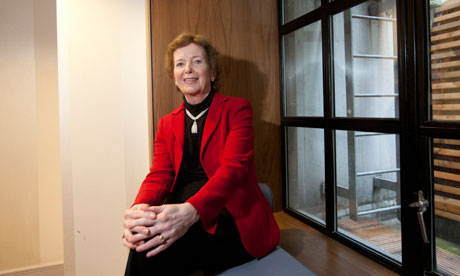
Former Irish president Mary Robinson emphasized the need to leave fossil fuels untouched. Photograph: Martin Argles for the Guardian
Already, a thousand blogs and columns insist the Intergovernmental Panel on Climate Change's new report is a rabid concoction of scare stories whose purpose is to destroy the global economy. But it is, in reality, highly conservative.
Reaching agreement among hundreds of authors and reviewers ensures that only the statements which are hardest to dispute are allowed to pass. Even when the scientists have agreed, the report must be tempered in another forge, as politicians question anything they find disagreeable: the new report received 1,855 comments from 32 governments, and the arguments raged through the night before launch.
In other words, it's perhaps the biggest and most rigorous process of peer review conducted in any scientific field, at any point in human history.
There are no radical departures in this report from the previous assessment, published in 2007; just more evidence demonstrating the extent of global temperature rises, the melting of ice sheets and sea ice, the retreat of the glaciers, the rising and acidification of the oceans and the changes in weather patterns. The message is familiar and shattering: "It's as bad as we thought it was."
What the report describes, in its dry, meticulous language, is the collapse of the benign climate in which humans evolved and have prospered, and the loss of the conditions upon which many other lifeforms depend. Climate change and global warming are inadequate terms for what it reveals. The story it tells is of climate breakdown.
This is a catastrophe we are capable of foreseeing but incapable of imagining. It's a catastrophe we are singularly ill-equipped to prevent.
The IPCC's reports attract denial in all its forms: from a quiet turning away – the response of most people – to shrill disavowal. Despite – or perhaps because of – their rigours, the IPCC's reports attract a magnificent collection of conspiracy theories: the panel is trying to tax us back to the stone age or establish a Nazi/communist dictatorship in which we are herded into camps and forced to crochet our own bicycles. (And they call the scientists scaremongers …)
In the Mail, the Telegraph and the dusty basements of the internet, Friday's report (or a draft leaked a few weeks ago) has been trawled for any uncertainties that could be used to discredit. The panel reports that on every continent except Antarctica, man-made warming is likely to have made a substantial contribution to the surface temperature. So those who feel threatened by the evidence ignore the other continents and concentrate on Antarctica, as proof that climate change caused by fossil fuels can't be happening.
They make great play of the IPCC's acknowledgement that there has been a "reduction in surface warming trend over the period 1998–2012", but somehow ignore the fact that the past decade is still the warmest in the instrumental record.
They manage to overlook the panel's conclusion that this slowing of the trend is likely to have been caused by volcanic eruptions, fluctuations in solar radiation and natural variability in the planetary cycle.
Were it not for man-made global warming, these factors could have made the world significantly cooler over this period. That there has been a slight increase in temperature shows the power of the human contribution.
But denial is only part of the problem. More significant is the behaviour of powerful people who claim to accept the evidence. This week the former Irish president Mary Robinson added her voice to a call that some of us have been making for years: the only effective means of preventing climate breakdown is to leave fossil fuels in the ground. Press any minister on this matter in private and, in one way or another, they will concede the point. Yet no government will act on it.
As if to mark the publication of the new report, the Department for Business, Innovation and Skills has now plastered a giant poster across its ground-floor windows: "UK oil and gas: Energising Britain. £13.5bn is being invested in recovering UK oil and gas this year, more than any other industrial sector."
The message couldn't have been clearer if it had said "up yours". It is an example of the way in which all governments collaborate in the disaster they publicly bemoan. They sagely agree with the need to do something to avert the catastrophe the panel foresees, while promoting the industries that cause it.
It doesn't matter how many windmills or solar panels or nuclear plants you build if you are not simultaneously retiring fossil fuel production. We need a global programme whose purpose is to leave most coal and oil and gas reserves in the ground, while developing new sources of power and reducing the amazing amount of energy we waste.
But, far from doing so, governments everywhere are still seeking to squeeze every drop out of their own reserves, while trying to secure access to other people's. As more accessible reservoirs are emptied, energy companies exploit the remotest parts of the planet, bribing and bullying governments to allow them to break open unexploited places: from the deep ocean to the melting Arctic.
And the governments who let them do it weep sticky black tears over the state of the planet.
Climate change? Try catastrophic climate breakdown | Environment | The Guardian
IPCC climate report: human impact is 'unequivocal' | Environment | theguardian.com
.
.
.