... A FORUM TO STIMULATE DEBATE ... ... JUST ADD A COMMENT AT ANY ENTRY BELOW... ... FOR THE SUSTAINABLE DEVELOPMENT OF TOWN AND VALLEY ...

Saturday, 2 November 2013

The PassivHaus: cheaper than you think to build.... and only £20 annual heating bills.....

This appeared in today's Guardian:

Actively cutting energy bills in Oldham – welcome to the 'Passivhauses'

A Passivhaus looks like any other home, but it's not, thanks to a box of tricks in the loft that's helping residents' health and wealth

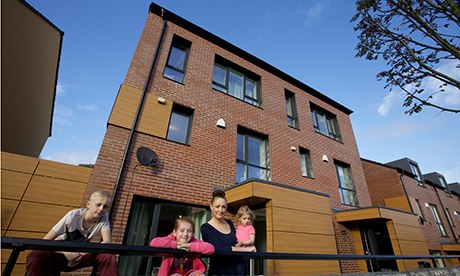
Justine Hutton and her children at their passive house in Oldham
Justine Hutton and her children at their passive house ('Das Passivhaus') in Oldham. Photograph: Christopher Thomond
As the first bitter autumn wind whips off Crompton Moor, pensioner Inez and her son David, who live below in the Lancashire town of Oldham, have the heating on high and the double-gazed windows of their three-bedroom house tightly shut.
They have just paid £550 for the gas they used over the three summer months and each time the bill goes up, life in their 1960s pre-cast concrete terrace house gets harder. This winter they expect to have to choose between warmth and other necessities.
passivhaus
Fifty yards round the corner in St Mary's Close, Justine Hutton and her two children Kieran and Alissia watch TV in T-shirts in a similar-sizedproperty. The single radiator is cold and they have a window open, although the temperature inside is 21C. The family will only pay around £20 to heat their home for the whole year. The only heat source is their bodies and the electric cooker.
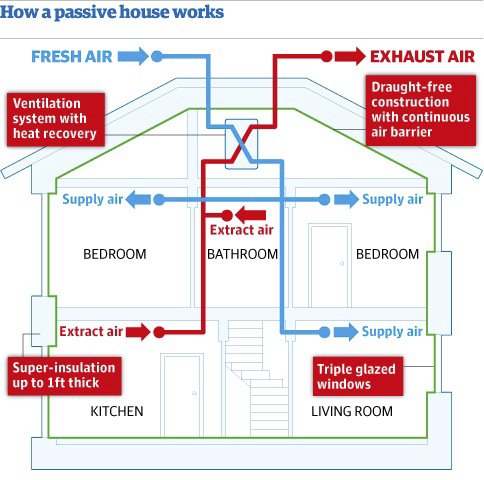
Inez's house is one of nearly 7m in Britain that have uninsulated solid walls and are little more than cold boxes. But Justine's is one of Britain's very few "Passivhauses" – super-low energy buildings (the German name translates literally to "passive houses"). It's packed with insulation, is triple-glazed and looks like any other new home, except for a box of tricks in the loft which uses warm air sucked out of the kitchen and bedrooms to heat fresh air being sucked in.
"I'd never heard of a Passivhaus and I don't know anything about climate change," says Hutton, who is about to start work as a healthcare assistant in Oldham hospital. She pays social housing group Contour £97 a week to rent the house which costs £95,000 to build.
"I Googled it but I was still sceptical. But it's great. There are no draughts and it's quiet. I was in a freezing council house which I used to pay £35 a week to heat, way more than 10% of our income, and it was still cold. It was horrendous what we were paying and it was a breeding ground for illness. They should definitely build more like this".
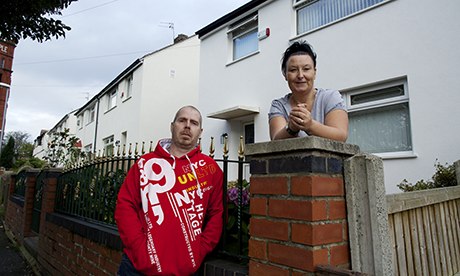
Alison Isaacs and her husband Darryl-Paul outside their home in OldhamAlison Isaacs and her husband Darryl-Paul outside their home in Oldham which has been insulated in a scheme expected to save the council and NHS hundreds of thousands of pounds. Photograph: Christopher Thomond
Nigel Banks, sustainability director of regeneration group Keepmoat, which has built this and nearly a third of Britain's other low-energyhomes, said: "We have found that we can build a three-bed Passivhaus for only about £20,000 more than a normal house, not the £50,000 extra that government thought when it relaxed building standards."
The St Mary's development of 93 houses stands on old back-to-back Victorian streets which were demolished in the 1960s to make way for concrete-built flats which quickly deteriorated. The £14.8m scheme, which is paid in part with energy company "green levy" funds, has two Passivhauses and four other "Code 6" ones, which have enough insulation and solar energy to keep heating costs to about £3 a week.
"Britain can now build really low-energy houses massively cheaper than it could just a few years ago. But it's frustrating because the government has rolled back the building standards. If the green levy is dropped, then thousands of people in Oldham and elsewhere will stay cold and ill and it will cost the NHS dearly," says Banks.
One mile away in Fitton Hill, Oldham council, a large housing group and Oldham NHS Clinical Commissioning Group (CCG) are investing £200,000 between them to retro-fit 1,000 cold homes with new boilers and exterior insulation. The health service calculates it will save £300,000 a year in reduced hospital admissions and social costs, and the council hopes each household will save around £450 a year. Each home also draws on energy company green levy money.
"Oldham is a cold town. It has got poorer health than most of the country. There's not much money about. Around one in five, or 20,000 homes here, are in fuel poverty," says Alan Higgins, director of Oldham council public health.
"We think each person lifted out of fuel poverty will save the health service about £250 a year. Data suggests there are 20% more deaths in Oldham in winter than in summer because of extra respiratory illnesses and heart problems [linked to cold homes]. If you get a cold winter and people cannot heat their homes, you get more people turning up in A&E and suffering."
Spray-painter Darryl-Paul Isaacs and his wife Alison say they saw a difference in health soon after the building work was done. Their son, Darryl-James, 12, is badly asthmatic and they are both prone to depression and other illnesses.
"It takes the pressure off us financially and mentally," says Darryl-Paul. "There's no work round here. We'd normally take him to the doctor at this time of year. Not now.
"It's the stress. Sometimes he has to go to hospital for a nebuliser. As a parent if you can go a night without worrying that he'll have another attack and have to take three days off school, you feel better."
"We were paying about £450 a quarter for heating and the house was freezing. We had to sacrifice lots of things. A 10% rise in energy bills this year would definitely have pushed us over the edge."
"Energy price hikes really hurt here, especially with single elderly people," says Peter Beck, a building surveyor with Keepmoat. "There is no way you can lift someone on a pension of £7,500 a year out of fuel poverty. Developments like this would just not happen without the green levy."
The council and hospital will monitor the scheme over a year to try to measure the health benefits to people escaping fuel poverty. "Addressing it is definitely the right thing to do. But it's not just about economics. The cost of fuel is going up out of all proportion to people's ability to pay. It's about the quality of a life, too," says Denis Gizzi, director of Oldham NHS CCG.


Actively cutting energy bills in Oldham – welcome to the 'Passivhauses' | Environment | The Guardian

See also: Passivhaus: The world's leading fabric first approach to low energy buildings
Passivhaus is gaining ground | Opinion | Architects Journal
7 stunning passive houses (that won't cost much to heat this northern winter) : Renew Economy


Making Energy Efficiency Sustainable


BUSINESS 
|
 
10/14/2013 @ 4:28PM |3,208 views
 
By The Economist Intelligence Unit, an Energy Realities Partner 
How can governments and energy companies overcome the hurdle of engaging consumers?
On a hill overlooking the campus of the University of Nottingham, seven pilot houses showcase different versions of the future energy-efficient homes that the University’s Department of Architecture and Built Environment’s Institute of Sustainable Energy Technology has erected in partnership with utility and construction companies.
One two-bedroom structure, the state-of-the-art Nottingham H.O.U.S.E. (Home Optimizing the Use of Solar Energy), was designed and built by the department’s students with the sponsorship of Saint Gobain, a construction manufacturer and supply chain company.
Known as the Timber House, the building is constructed out of eight individual modular units and features photovoltaic panels, gray water recycling from the shower for use in the toilets, and air-tightness membranes to keep the structure draft-free, including compartmentalized living spaces to keep heat loss to a minimum. Designed according to the world’s most stringent design codes—the German Passivhaus Institute and UK Code for Sustainable Homes Level 6, or zero-carbon—the building’s physics approach to design enables the house to regulate its temperature, making it essentially self-heating, with just a small top-up heat pump required to keep it warm.
The potential represented by the Timber House underlines the importance of getting the design of the building right from the beginning, says Professor Mark Gillott, chair in sustainable building design and co-director of the Institute of Sustainable Energy Technology at the University of Nottingham.
“What we are talking about is well-designed ventilation and draft-free structures,” he adds, noting that the energy consumed by the UK’s housing stock is responsible for around 27% of the country’s carbon emissions.


Statoil Energy RealitiesVoice: Making Energy Efficiency Sustainable - Forbes
.
.
.

Biodiversity in Sidmouth: "Is planting a million bulbs a 'good thing'?"

A recent posting considered the planting at the Sidmouth Beach Garden:

'Biodiversity' is a huge topic and there is perhaps poor understanding of exactly what it means... 
Over manipulation of environments by ourselves may have adverse effects...
We need to be careful about where our introduced  genetic material comes from...
Futures Forum: Biodiversity in Sidmouth: Beach Garden

This could mean introducing too much of a 'good thing'. 
This note has been received from one of our correspondents:
  
Aside from the choice of genetic material for introductions, mass plantings of any one plant may be corruptive to biodiversity.
Some commercially bred plants may not provide any food accessible to insects. Others may be very attractive to insects and as a mass planting will be favoured by insects at flowering but in so doing their presence may be detrimental in reducing pollination of other local plants in flower at that time. 


This might seem rather churlish, considering the enthusiasm and involvement by the wider community, as reported in another recent posting:
Futures Forum: Keith Owen Fund: one million bulbs: community planting: reports

Moreover, other parts of the country consider it is also seen as a 'good thing': 

The aim is for the community to become more actively involved in their local park, for example they will take part in environmental projects such as tree and bulb planting to help improve the biodiversity in the area.
Newtownabbey Borough Council - Outdoor Areas: Love My Park Scheme

However, there are concerns that some kinds of planting can actually be bad for biodiversity:

What are the main threats to biodiversity?

Addressing the major threats to biodiversity, including those arising from invasive alien speciesclimate change, pollution, and habitat change


Five main threats to biodiversity are commonly recognized in the programmes of work of the Convention: invasive alien species, climate change, nutrient loading and pollution,habitat change, and overexploitation. Unless we successfully mitigate the impacts of these direct drivers of change on biodiversity, they will contribute to the loss of biodiversity components, negatively affect ecosystem integrity and hamper aspirations towards sustainable use

.Indicators for trends in nutrient loading and invasive alien species have been identified under the focal area addressed here, and are described below. Information on habitat change is provided by the indicator trends in extent of selected biomes, ecosystems and habitats. Overexploitation is discussed under the focal area on sustainable use.
6. What are the main threats to biodiversity?

What is meant by 'invasive alien species'? 
Typical are Spanish bluebell - Hyacinthoides hispanica - and Japanese Knotweed - Fallopia japonica:

Strictly speaking, however, any 'invasive alien' is simply a 'non-native' or 'non-indigenous' species:
Invasive species - Wikipedia, the free encyclopedia
Introduced species - Wikipedia, the free encyclopedia

What about 'non-native' bulbs? Here's the beginning of a long discussion thread:

In praise of … daffodils

What's so wrong with larger, louder varieties of the native daffodil?

Rural bling, lamented the man on the radio a few days ago, of the noisy golden trumpets that are now lining roads and gardens across the country. 
Narcissus pseudonarcissus, the native British daffodil, is being shouldered out by larger, louder varieties. 
It is easy to see why the daffodil, symbol of hope and rebirth, is associated with the vanity of the Greek youth Narcissus, transfixed forever nodding in approval at his glorious reflection. And in an ideal world, nothing could be more wonderful than seeing the early drifts of snowdrops on the verges of country lanes replaced by the delicate, pale golden heads of our own native daffodils
But left to themselves, these natives want the damp, misty woodland of the Welsh borders, not the rubbish-strewn roadsides of England's highways. In this latter, unpromising setting, it takes all the vigorous vulgarity of February Gold or Cheerfulness to be seen over the strips of tyre and the fast-food debris that would overwhelm the more fastidious natives. 
And although the daffodil hybridises easily, there is, according to Natural England, little evidence yet that the genetic identity of the native is being damaged. It might also be worth remembering that the narcissus pseudonarcissus that so impressed Shakespeare and Wordsworth may well be an immigrant from Spain – it just got here earlier. It is really just a question of botanical aesthetics, and when it's robust bling rather than the debris from last night's takeout, then bling is better.


I


In praise of … daffodils | Editorial | Comment is free | The Guardian

In the case of planting bulbs bought en masse from an outside supplier, there are further issues:


Wildlife habitats - Leith Community Crops in Pots

See also: Futures Forum: Biodiversity
.
.
.

Biodiversity in Sidmouth: Beach Garden

To quote a member of the Vision Group who was involved in this project in April this year:


'Biodiversity' is a huge topic and there is perhaps poor understanding of exactly what it means. 

The greatest corruption of biodiversity is due to modern farming practices which we here in Sidmouth cannot do too much about. However, we could focus on little pockets of our own environment.  

If we focus on plants as one factor in biodiversity we are also providing food and habitat for insects, birds and animals and providing detritus for fungi etc. . .

We might increase biodiversity by enhancing environments to enable species already present to flourish. By example, leaving grasses uncut until the end of the season, encouraging native bushes or hedging. Naturally changing environments may themselves promote diversity eg. a fallen tree. Over manipulation of environments by ourselves may have adverse effects.

The beach garden is an example of where we can make a difference. Sidmouth in Bloom should be congratulated for getting this project off the ground

About a year ago this was an area of shingle protected from the worst of the storms where a few native plants were already growing. The intention is to enhance the environment to encourage those plants and to introduce further plants raised from seed collected from beach environments close by to Sidmouth. One plant which we have tried to introduce is sea kale which reportedly used to grow on that part of the beach. 

It is important to stress the need for using locally sourced seed. Having local populations of a particular plant that may be slightly genetically different from their neighbours is useful. If for example one local population is hit by a disease, then there is a chance that some nearby population is sufficiently genetically diverse to have resistance to that disease. 

We need to be careful about where our introduced  genetic material comes from however, as  so called UK seed companies may well acquire seed from all over Europe, or wider. Adding the same species from somewhere else may be thought of as increasing the local genetic diversity, but really in the longer term it would be reducing it by making the wider gene pool more homogeneous. 

The notice board on the beach site is a great asset in attempting to involve and inform. 


The project was covered by the press at the time:


TV star declares Sidmouth Oceanscene open! - News - Sidmouth Herald


It is in fact doing very well, half a year on:


Vision Group for Sidmouth - Sidmouth Beach Garden - Inauguration

And here's the full report:


The Sidmouth Beach Garden

Sidmouth in Bloom (SIB) are developing an area of beach where the storm tides
rarely reach and beach plants have already started to colonise. They have taken
over management of the site from East Devon DC and persuaded them not to kill
of all the vegetation with weedkiller. Plants such as the sea beet, tree mallow,
horned poppy and rock samphire are already colonising the site and the aim is to
increase the biodiversity by introducing other native beach plants that have not
yet reached the site. Devon Plant Heritage Group is backing the project by
helping to grow beach plants from seed sourced from other parts of the county.

Our aim is to encourage proper beach plant communities to develop on our
beach.

Why should we encourage these plants to grow on the beach?

Beach, dune and saltmarsh plant habitats are relatively rare and the plant
communities that grow in them are highly specialised. These habitats are being
reduced as more and more development occurs around the coastline and they are
also under threat due to climate change and rising sea levels. By their nature
beaches form relatively unstable and transient habitats that can be easily
destroyed by severe storms or damaged by oil spills etc. Storms, acting together
with longshore drift can remove large areas of shingle from one area destabilising
or removing the local beach plant community, and depositing the shingle
elsewhere where it may block of estuaries and saltmarshes. Once the sea is
prevented from washing into a saltmarsh the marsh will lose salinity and change
to a freshwater environment.

Most beach plants are capable of growing in a more stable land environment but
do not succeed there as they cannot compete against more aggressive land
species. Thus some of them like the sea wormwood (Artemisia maritima) will grow
readily in good garden soil, but like most garden plants will only survive if the
gardener continues to weed out more aggressive competitors that would normally
take over the site. Some of these coastal plants are relatively tender and cannot
survive the harsh frosts of inland. Plants like the rock samphire (Crithmum
maritimum) tend to grow in sea walls, rocky crevices in clifs or very close to the
sea where the warmth from the sea or the shelter lessens the chance of freezing.
Most of the plants have a high tolerance to salt water which allows them to grow
in an environment which would be hostile to the more competitive land plants.

What role do these plants play in our heritage?

Many of our domesticated food plants have been derived from beach plants, thus
the various leaf beets, beetroot and sugar beet have evolved from the sea beet,
and carrots, parsnips, peas, brassicas, asparagus, turnips and radishes are derived
from wild beach plants or close relatives. Rocket is a beach plant that is
now widely cultivated for salads, whilst seakale and some of the saltmarsh plants
are grown or collected as gourmet foods. In particular the Saltwort (Salsola kali),
known as Agretti in Italy, is cultivated or harvested from the wild across southern
Europe and a closely related beach plant is harvested and eaten in Japan.
Glasswort (various Salicornia species) are collected around our coasts as Marsh
Samphire.

How can I help?

Please help to maintain and encourage the growth of our native beach plants and
discourage vandalism at this or other beach plant sites across the country.
You may wish to help to maintain this or other planted areas around Sidmouth by
contacting Sidmouth in Bloom (SIB). (Lynette or Peter 01395 578081)

If you are interested in plants and gardening you could join Plant Heritage. This
UK wide organisation that runs the National Plant Collections scheme operates at
a local county level. It organises garden events and ofers discounted entries to
many gardens (often not open to the public) across the country and to the
National Collections. The Devon group is the largest local group and is ofering
discounted membership during spring 2013. Pick up the leaflets for details (John
01395 578689, or Penny/David 01363 866401.

If you are interested in local flora and fauna a Biodiversity Group is being formed
within Vision Group for Sidmouth. See their website for details or contact Louise

There are also various Beach clean-up parties such as Sidcomb (organised by SIB)
or by other bodies such as Vision Group for Sidmouth, Sustainable Ottery etc.,
which can be good fun and a chance to meet like-minded individuals.

Finally

It is important that we educate children and visitors in the role of beach plants in
our heritage and that we help these plants to survive in their very transient
environment.

Dr John D Twibell, Chairman - Devon Group of Plant Heritage


Vision Group for Sidmouth - Beach Garden

See also: Futures Forum: VGS AGM: Sidmouth in Bloom
.
.
.