Today's Daily Mail carried a very clear message:
10 years ago we launched our campaign to ban plastic bags | Daily Mail Online
And there have been plenty of other related stories in today's Mail:
UN's Head of Environment praises Mail's plastic campaign | Daily Mail Online
Pret a Manger introduces 10p plastic bottle deposit | Daily Mail Online
California's tony Malibu bans plastic utensils, straws | Daily Mail Online
HOW DAMAGING ARE PLASTIC BOTTLES? | Daily Mail Online
.
.
.
Tuesday, 27 February 2018
Monday, 26 February 2018
Brexit: and the future of the Cornish language
There is quite a fight going on next door in Cornwall over Brexit:
Cornwall MP Derek Thomas defends signing Theresa May 'ransom note' for hard Brexit - Cornwall Live
Including over fishing:
Cornish fishermen fear catch in Brexit talks
Enthusiastic Leave supporters feel they will be left with raw deal to protect the City
A fisherman off the coast of Newlyn. Some sailed hundreds of miles days before the EU referendum to join a pro-Brexit flotilla on the Thames © Bloomberg
Joshua Chaffin in Newlyn FEBRUARY 18, 2018
Fishermen from the Cornish port of Newlyn were among the most spirited Brexiters. Days before Britain’s 2016 EU referendum, some sailed more than 300 miles from England’s westernmost reaches to join a pro-Brexit flotilla on the Thames — their presence intended as a visceral reminder of working people hard done by the EU’s overweening regulation.
Soon they will find out whether it was all worth it. As Britain tries to negotiate a two-year transition agreement with Brussels that is supposed to provide a smooth path for industry after the country leaves the EU next year, its fishermen fear they may be getting a raw deal.
Cornish fishermen fear catch in Brexit talks - Financial Times
Brexit news: EU forces 84% of fish caught off Cornish coast to FRANCE | Politics | News | Express.co.uk
And farming:
.
.
Brits try EU migrants' vegetable picking jobs in Cornwall - BBC News
Winnowing EU migrants means rotting crops - Financial Times
And culture:
Brexit threatens ancient tongue in Britain's southwest
Loveday Jenkin, a leading Cornish language campaigner – standing next to the winding gear from a traditional Cornish tin mine. - Stephen Beard/Marketplace
Listen To The Story
Marketplace
download
Could one of the casualties of Brexit be the Cornish language? Much older than English, it is an offshoot of the Celtic tongue that was spoken across Britain when the Romans arrived in the first century B.C., and was driven to the periphery of the country after the Anglo-Saxon invasions began in the fifth century. Cornish is now spoken regularly by only a few hundred people in Britain’s most southerly county of Cornwall. But it has been making a comeback in recent years, some say, thanks to the European Union. Could that renaissance be in jeopardy?
“Brexit is a setback" said Loveday Jenkin, a leading campaigner for Cornish. “EU funding enabled us to set up a Cornish language office to raise the profile of the language above being part of a subculture of a few people to something that is integral to the identity of Cornwall.” The EU funding has helped finance language classes, a translation service and even bilingual street signs in English and Cornish.
Jenkin and other language campaigners do not expect the British government to funnel cash into Cornish culture after Brexit to make up for any short fall from the EU.
“You can’t expect English people to see any value in the Cornish language,” said teacher and poet Paul Hodge. “They only think about Cornwall as a place to take a holiday. They just don’t care about us. The rest of the EU does care about us,” he said.
But could Britain’s private sector ride to the rescue? Other advocates for Cornish argue that there is a good commercial case for supporting the language. As a poor but scenically beautiful county, Cornwall is utterly dependent on tourism; having its own unique language could help in the marketing.
“It’s a way of branding and promoting Cornwall, both in the U.K. and internationally, as a place apart,” claimed Garry Tregidga, head of the Institute of Cornish Studies.
Business is beginning to get the message. A local ice cream company is already using the language as a marketing tool, employing English and Cornish in its TV ads that have been aired across the U.K. Jenkin said that money is starting to trickle in from corporate sponsorship, too.
“Business is starting to realize the value of the language and starting to support it a bit. With the decline in government and taxpayers’ money, the language community is looking more to business to help support things that we’re doing,” she said.
While she laments the loss of public funding, Jenkin and the other enthusiasts for Cornish are confident that their language will not die.
After all, it has survived the Roman conquest, the Anglo-Saxon invasion and the suffocating dominance of English. But it’s still alive and adapting. It’s even coined a word for the latest threat: “Bretonborth” – the Cornish for Brexit.
Brexit threatens ancient tongue in Britain's southwest - Marketplace
.
.
.
Cornwall MP Derek Thomas defends signing Theresa May 'ransom note' for hard Brexit - Cornwall Live
Including over fishing:
Cornish fishermen fear catch in Brexit talks
Enthusiastic Leave supporters feel they will be left with raw deal to protect the City
Joshua Chaffin in Newlyn FEBRUARY 18, 2018
Fishermen from the Cornish port of Newlyn were among the most spirited Brexiters. Days before Britain’s 2016 EU referendum, some sailed more than 300 miles from England’s westernmost reaches to join a pro-Brexit flotilla on the Thames — their presence intended as a visceral reminder of working people hard done by the EU’s overweening regulation.
Soon they will find out whether it was all worth it. As Britain tries to negotiate a two-year transition agreement with Brussels that is supposed to provide a smooth path for industry after the country leaves the EU next year, its fishermen fear they may be getting a raw deal.
Cornish fishermen fear catch in Brexit talks - Financial Times
Brexit news: EU forces 84% of fish caught off Cornish coast to FRANCE | Politics | News | Express.co.uk
And farming:
.
.
Brits try EU migrants' vegetable picking jobs in Cornwall - BBC News
Winnowing EU migrants means rotting crops - Financial Times
And culture:
Brexit threatens ancient tongue in Britain's southwest
By Stephen Beard
November 28, 2017

November 28, 2017

Loveday Jenkin, a leading Cornish language campaigner – standing next to the winding gear from a traditional Cornish tin mine. - Stephen Beard/Marketplace
Listen To The Story
Marketplace
download
Could one of the casualties of Brexit be the Cornish language? Much older than English, it is an offshoot of the Celtic tongue that was spoken across Britain when the Romans arrived in the first century B.C., and was driven to the periphery of the country after the Anglo-Saxon invasions began in the fifth century. Cornish is now spoken regularly by only a few hundred people in Britain’s most southerly county of Cornwall. But it has been making a comeback in recent years, some say, thanks to the European Union. Could that renaissance be in jeopardy?
“Brexit is a setback" said Loveday Jenkin, a leading campaigner for Cornish. “EU funding enabled us to set up a Cornish language office to raise the profile of the language above being part of a subculture of a few people to something that is integral to the identity of Cornwall.” The EU funding has helped finance language classes, a translation service and even bilingual street signs in English and Cornish.
Jenkin and other language campaigners do not expect the British government to funnel cash into Cornish culture after Brexit to make up for any short fall from the EU.
“You can’t expect English people to see any value in the Cornish language,” said teacher and poet Paul Hodge. “They only think about Cornwall as a place to take a holiday. They just don’t care about us. The rest of the EU does care about us,” he said.
But could Britain’s private sector ride to the rescue? Other advocates for Cornish argue that there is a good commercial case for supporting the language. As a poor but scenically beautiful county, Cornwall is utterly dependent on tourism; having its own unique language could help in the marketing.
“It’s a way of branding and promoting Cornwall, both in the U.K. and internationally, as a place apart,” claimed Garry Tregidga, head of the Institute of Cornish Studies.
Business is beginning to get the message. A local ice cream company is already using the language as a marketing tool, employing English and Cornish in its TV ads that have been aired across the U.K. Jenkin said that money is starting to trickle in from corporate sponsorship, too.
“Business is starting to realize the value of the language and starting to support it a bit. With the decline in government and taxpayers’ money, the language community is looking more to business to help support things that we’re doing,” she said.
While she laments the loss of public funding, Jenkin and the other enthusiasts for Cornish are confident that their language will not die.
After all, it has survived the Roman conquest, the Anglo-Saxon invasion and the suffocating dominance of English. But it’s still alive and adapting. It’s even coined a word for the latest threat: “Bretonborth” – the Cornish for Brexit.
Brexit threatens ancient tongue in Britain's southwest - Marketplace
.
.
.
Brexit: and the South West to lose out the most
There has been a lot of talk about how the likes of the North East will suffer the most from Brexit:
Leave-voting areas to be hit hardest by Brexit
Impact report says UK growth will be reduced regardless of talks outcome
Vote Leave campaigners during the referendum on EU membership in 2015 © AFP
George Parker, Political Editor FEBRUARY 7, 2018
Parts of the UK that voted Leave in the 2016 EU referendum will suffer most as a result of Brexit, according to a government impact assessment.
The study found that the north-east and the West Midlands would suffer the biggest hit to growth, while London, which voted heavily for Remain, would be the least affected. The regional data are part of an analysis compiled by government economists that found growth would be reduced over the next 15 years, whatever the results of Brexit negotiations.
Pro-Brexit Tory MPs have criticised the analysis, with Jacob Rees-Mogg, a prominent Eurosceptic, claiming that the Treasury had “fiddled the figures”. The government said the report did not model for Theresa May’s unspecified “bespoke” trade deal. The study was intended to be shown to cabinet ministers in private but a leak was obtained by BuzzFeed. Now MPs are being allowed to view the detailed contents.
The full report concludes that growth would be slowed by 2 per cent if Britain agreed a Norway-style single market deal, by 5 per cent if it agreed a Canada-style free trade agreement, and 8 per cent if it left on World Trade Organization terms.
But regional variations were significant. London’s growth rate would fall by 1 per cent, 2 per cent and 3.5 per cent under the three scenarios, suggesting the impact on the capital’s economy would be half that of the national average. By contrast, Northern Ireland’s economy would lose 2.5 per cent, 8 per cent and 12 per cent of growth under the three Brexit outcomes, with a similar outcome for the West Midlands; the north-east would lose 3 per cent, 11 per cent and 16 per cent.
George Parker, Political Editor FEBRUARY 7, 2018
Parts of the UK that voted Leave in the 2016 EU referendum will suffer most as a result of Brexit, according to a government impact assessment.
The study found that the north-east and the West Midlands would suffer the biggest hit to growth, while London, which voted heavily for Remain, would be the least affected. The regional data are part of an analysis compiled by government economists that found growth would be reduced over the next 15 years, whatever the results of Brexit negotiations.
Pro-Brexit Tory MPs have criticised the analysis, with Jacob Rees-Mogg, a prominent Eurosceptic, claiming that the Treasury had “fiddled the figures”. The government said the report did not model for Theresa May’s unspecified “bespoke” trade deal. The study was intended to be shown to cabinet ministers in private but a leak was obtained by BuzzFeed. Now MPs are being allowed to view the detailed contents.
The full report concludes that growth would be slowed by 2 per cent if Britain agreed a Norway-style single market deal, by 5 per cent if it agreed a Canada-style free trade agreement, and 8 per cent if it left on World Trade Organization terms.
But regional variations were significant. London’s growth rate would fall by 1 per cent, 2 per cent and 3.5 per cent under the three scenarios, suggesting the impact on the capital’s economy would be half that of the national average. By contrast, Northern Ireland’s economy would lose 2.5 per cent, 8 per cent and 12 per cent of growth under the three Brexit outcomes, with a similar outcome for the West Midlands; the north-east would lose 3 per cent, 11 per cent and 16 per cent.
Why Brexit is a double blow to the regions that voted to leave the EU
February 20, 2018 3.29pm GMT
Olivier Sykes
Lecturer in European spatial planning, University of Liverpool
Philip O'Brien
Lecturer in Urban Planning, University of Liverpool
Olivier Sykes
Lecturer in European spatial planning, University of Liverpool
Philip O'Brien
Lecturer in Urban Planning, University of Liverpool

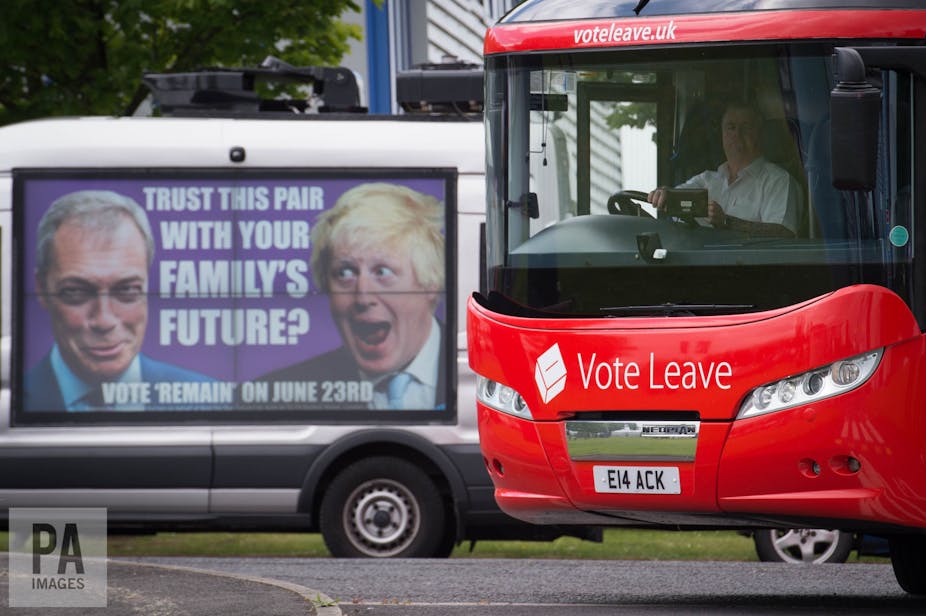
Vote Leave won the Brexit vote in areas that will be worst affected. Stefan Rousseau/PA Archive/PA Images
Impact studies have revealed how different parts of the UK will suffer from Brexit more than others. One irony, as many have pointed out, is that a lot of these regions voted for Brexit. Another irony, which is less talked about, is that these are also regions that benefit a great deal from EU regional policy.
The UK is an unevenly developed state. Some territories (such as London) are much more well off than others (such as the northeast of England) as a result of decades of investment (or under-investment) in their economies. Others benefit from varying levels of devolution, which gives them a relatively greater autonomy to tailor policy to their own needs, and stronger political representation within Britain and the EU.
Over recent decades, when the UK government has fallen short in terms of regional policy to address the needs of less economically favoured regions, the EU has provided much-needed support. So the key question now is what will happen to the regions which have relied on this in the event of any Brexit? So far this remains unanswered.
A further irony here is the fact that the UK was instrumental in the foundation of a European regional policy, working alongside Ireland and Italy to place the idea firmly on the agenda. This was one of the many influences the UK exerted over the direction of the EEC and its successor, the EU. And it is a contribution that is well recognised and appreciated across Europe.
The creation of such a policy at European level in the mid-1970s was timely for the UK’s economically depressed areas. It was soon to coincide with a Conservative government led by Margaret Thatcher that was inclined to let regions fend for themselves.
But the EEC and forceful UK politicians like Michael Heseltine still believed the state and targeted public investment had a role to play in giving places that were suffering economic, social and environmental challenges a fighting chance to regenerate themselves. European regional policy emphasised the importance of “territorial cohesion”. This is the idea that all regions and their people should have a chance to grow and enjoy a good quality of life. Nobody and no place should be left behind...
Why Brexit is a double blow to the regions that voted to leave the EU
It now seems that it will be the South West which will suffer the most:
South West ‘could suffer more than other regions’ after Brexit
Dominic Brady
26 Feb 18
The South West could be hit harder than other parts of England when the UK leaves the EU, according to panel members at a one-off Brexit discussion convened by CIPFA in Bristol.
High numbers of EU workers could be lost from industries in the region, which must get better at ‘fighting its own corner’, attendees at the event on Friday last week heard.
Kate Kennally, chief executive of Cornwall Council, pointed out the South West had a growing number of tech start-ups but it was not good at promoting its own industries. “We have a big part of the UK that doesn’t have a big voice,” she said. She added Cornwall voted leave because of “a sense of profound insecurities about public services” and that “this could be a moment where there needs to be a good deal of bravery”.
Kennally also pointed out: “Exeter, Bristol, Plymouth are the cities most reliant on exporting to the EU.”
Nigel Costley, regional secretary of the trade union federation the TUC, said: “I don’t think we are well equipped to respond to [Brexit]. I fear we are going to be the losers in the South West. I do not see us fighting our corner very well.” Costley added the TUC would prioritise the protection of jobs and workers’ rights but that “parts of the South West [were] very vulnerable to a sudden shock that may come from [Brexit]”.
Matt Griffith, head of policy for not-for-profit company Business West, which helps businesses in the area grow, said the South West would be the area most affected by changes to exports. He added: “The automotive sector and aerospace sector [in the region] have a high number of EU workers”.
Automotive manufacturers in the South West include Eberspacher, Goodridge Fluid Transfer Systems and Honda, according to the Automotive Council UK. The South West ‘aerospace cluster’ – with aerospace companies and their supply chains based there - is reportedly worth more than £7bn and one of the largest in Europe.
Alan Greer, professor of public policy at the University of West England, also pointed out that “80% of slaughterhouse vets are EU nationals”. He highlighted the difficulty in producing a unified position on public spending for a region as large and diverse as the South West. Greer explained: “There is a tension between big South West cities such as Bristol and the region as a whole.”
Kennally said the South West “has got to be competitive” in bidding for migrant labour. She suggested some sort of “regional immigration allowances” might help the region.
Labour suggested a regionalised immigration system at the start of last year, although deputy leader Tom Watson said this would allow higher immigration to London but tighter restrictions for other parts of the country.
Kennally added: “[The UK] shouldn’t have [an] immigration based on what is right for London”.
Julia Goldsworthy, chair of the panel and CIPFA’s Brexit Advisory Commission for Public Services, asked what devolution opportunities leaving the EU presented for the South West.
Kennally answered: “Local government is seeing this as being a huge area for making a play for devolution”.
The panel’s concerns over Whitehall-centric Brexit negotiations echoed those expressed by leaders of the UK’s largest cities last week, when they lead a delegation to Brussels to highlight the interests of local authorities in the talks.
CIPFA organised the event in Bristol to discuss the impact of Brext on public services in the South West.
South West ‘could suffer more than other regions’ after Brexit | Public Finance
.
.
.
Impact studies have revealed how different parts of the UK will suffer from Brexit more than others. One irony, as many have pointed out, is that a lot of these regions voted for Brexit. Another irony, which is less talked about, is that these are also regions that benefit a great deal from EU regional policy.
The UK is an unevenly developed state. Some territories (such as London) are much more well off than others (such as the northeast of England) as a result of decades of investment (or under-investment) in their economies. Others benefit from varying levels of devolution, which gives them a relatively greater autonomy to tailor policy to their own needs, and stronger political representation within Britain and the EU.
Over recent decades, when the UK government has fallen short in terms of regional policy to address the needs of less economically favoured regions, the EU has provided much-needed support. So the key question now is what will happen to the regions which have relied on this in the event of any Brexit? So far this remains unanswered.
A further irony here is the fact that the UK was instrumental in the foundation of a European regional policy, working alongside Ireland and Italy to place the idea firmly on the agenda. This was one of the many influences the UK exerted over the direction of the EEC and its successor, the EU. And it is a contribution that is well recognised and appreciated across Europe.
The creation of such a policy at European level in the mid-1970s was timely for the UK’s economically depressed areas. It was soon to coincide with a Conservative government led by Margaret Thatcher that was inclined to let regions fend for themselves.
But the EEC and forceful UK politicians like Michael Heseltine still believed the state and targeted public investment had a role to play in giving places that were suffering economic, social and environmental challenges a fighting chance to regenerate themselves. European regional policy emphasised the importance of “territorial cohesion”. This is the idea that all regions and their people should have a chance to grow and enjoy a good quality of life. Nobody and no place should be left behind...
Why Brexit is a double blow to the regions that voted to leave the EU
It now seems that it will be the South West which will suffer the most:
South West ‘could suffer more than other regions’ after Brexit
Dominic Brady
26 Feb 18
The South West could be hit harder than other parts of England when the UK leaves the EU, according to panel members at a one-off Brexit discussion convened by CIPFA in Bristol.
High numbers of EU workers could be lost from industries in the region, which must get better at ‘fighting its own corner’, attendees at the event on Friday last week heard.
Kate Kennally, chief executive of Cornwall Council, pointed out the South West had a growing number of tech start-ups but it was not good at promoting its own industries. “We have a big part of the UK that doesn’t have a big voice,” she said. She added Cornwall voted leave because of “a sense of profound insecurities about public services” and that “this could be a moment where there needs to be a good deal of bravery”.
Kennally also pointed out: “Exeter, Bristol, Plymouth are the cities most reliant on exporting to the EU.”
Nigel Costley, regional secretary of the trade union federation the TUC, said: “I don’t think we are well equipped to respond to [Brexit]. I fear we are going to be the losers in the South West. I do not see us fighting our corner very well.” Costley added the TUC would prioritise the protection of jobs and workers’ rights but that “parts of the South West [were] very vulnerable to a sudden shock that may come from [Brexit]”.
Matt Griffith, head of policy for not-for-profit company Business West, which helps businesses in the area grow, said the South West would be the area most affected by changes to exports. He added: “The automotive sector and aerospace sector [in the region] have a high number of EU workers”.
Automotive manufacturers in the South West include Eberspacher, Goodridge Fluid Transfer Systems and Honda, according to the Automotive Council UK. The South West ‘aerospace cluster’ – with aerospace companies and their supply chains based there - is reportedly worth more than £7bn and one of the largest in Europe.
Alan Greer, professor of public policy at the University of West England, also pointed out that “80% of slaughterhouse vets are EU nationals”. He highlighted the difficulty in producing a unified position on public spending for a region as large and diverse as the South West. Greer explained: “There is a tension between big South West cities such as Bristol and the region as a whole.”
Kennally said the South West “has got to be competitive” in bidding for migrant labour. She suggested some sort of “regional immigration allowances” might help the region.
Labour suggested a regionalised immigration system at the start of last year, although deputy leader Tom Watson said this would allow higher immigration to London but tighter restrictions for other parts of the country.
Kennally added: “[The UK] shouldn’t have [an] immigration based on what is right for London”.
Julia Goldsworthy, chair of the panel and CIPFA’s Brexit Advisory Commission for Public Services, asked what devolution opportunities leaving the EU presented for the South West.
Kennally answered: “Local government is seeing this as being a huge area for making a play for devolution”.
The panel’s concerns over Whitehall-centric Brexit negotiations echoed those expressed by leaders of the UK’s largest cities last week, when they lead a delegation to Brussels to highlight the interests of local authorities in the talks.
CIPFA organised the event in Bristol to discuss the impact of Brext on public services in the South West.
South West ‘could suffer more than other regions’ after Brexit | Public Finance
.
.
.
Brexit: and TTIP
A couple of months after the referendum, the Express was reporting about anxieties over a possible TTIP agreement:
What is TTIP and what does Brexit mean for the the US-EU trade deal | World | News | Express.co.uk
And many were relieved that Brexit would mean not taking part in TTIP:
We thought the best thing about Brexit would be avoiding TTIP - but the fight isn't over yet | The Independent
And there were apparently quite a few things to be worried about:
Futures Forum: TTIP, the NHS and the South-West
Futures Forum: The Transatlantic Trade and Investment Partnership >>>> "an increasingly contentious topic"
Both Brexit and TTIP are indeed interrelated:
Futures Forum: Brexit: and the Transatlantic Trade and Investment Partnership
Last week, the Sun revealed how there was renewed interest in the TTIP model for future trade with the UK:
Secret documents show European capitals are considering a far-reaching pact based on their past negotiations with the US
By Nick Gutteridge in Brussels
23rd February 2018
EU countries are defying their own chief negotiator and mulling a bumper trade deal for Britain, The Sun can reveal.
A “Brexit trade note”, meant for diplomats’ eyes only, suggests a Canada-style (CETA) agreement championed by Michel Barnier would be insufficient. Instead it is far more flattering of a deal based on the Transatlantic Trade and Investment Partnership (TTIP), which was thrashed out with Barack Obama but never signed.
Leaked docs show EU capitals considering trade deal with UK - The Sun
The Financial Times was more sanguine earlier today:
Britain, the EU and post-Brexit regulation
UK’s hopes for mutual recognition agreements reflect wishful thinking
Alan Beattie 6 HOURS AGO
What is TTIP and what does Brexit mean for the the US-EU trade deal | World | News | Express.co.uk
And many were relieved that Brexit would mean not taking part in TTIP:
We thought the best thing about Brexit would be avoiding TTIP - but the fight isn't over yet | The Independent
And there were apparently quite a few things to be worried about:
Futures Forum: TTIP, the NHS and the South-West
Futures Forum: The Transatlantic Trade and Investment Partnership >>>> "an increasingly contentious topic"
Both Brexit and TTIP are indeed interrelated:
Futures Forum: Brexit: and the Transatlantic Trade and Investment Partnership
Last week, the Sun revealed how there was renewed interest in the TTIP model for future trade with the UK:
Secret documents show European capitals are considering a far-reaching pact based on their past negotiations with the US
By Nick Gutteridge in Brussels
23rd February 2018
EU countries are defying their own chief negotiator and mulling a bumper trade deal for Britain, The Sun can reveal.
A “Brexit trade note”, meant for diplomats’ eyes only, suggests a Canada-style (CETA) agreement championed by Michel Barnier would be insufficient. Instead it is far more flattering of a deal based on the Transatlantic Trade and Investment Partnership (TTIP), which was thrashed out with Barack Obama but never signed.
Leaked docs show EU capitals considering trade deal with UK - The Sun
The Financial Times was more sanguine earlier today:
Britain, the EU and post-Brexit regulation
UK’s hopes for mutual recognition agreements reflect wishful thinking
Alan Beattie 6 HOURS AGO
True, the EU did contemplate pushing this further in the Transatlantic Trade and Investment Partnership with the US, tentatively exploring the idea of equivalence, or accepting trading partners’ rules if they were judged to produce the same outcome. Despite vast tomes produced on the subject, including this 530-page page-turner on vehicle crash test standards, those talks, along with the rest of TTIP, went almost nowhere.
Britain, the EU and post-Brexit regulation
So, to what extent is the UK or even the EU going to get a version of TTIP?
Well, we've had more 'leaks':
Greenpeace trade-leaks.org | TTIP | CETA | TiSA | JEFTA | MERCOSUR » Brexit, trade and the environment: what’s the big deal?
Futures Forum: Brexit: and the future of food and farming: from the Initiative for Free Trade
A new campaign from 38 Degrees looks at the issues:
Liam Fox
A leaked dossier has exposed that a group of powerful trade lobbyists are pressuring the government to ditch our food, environment and health standards - so that the UK can make a trade deal with Donald Trump:
Britain, the EU and post-Brexit regulation
So, to what extent is the UK or even the EU going to get a version of TTIP?
Well, we've had more 'leaks':
Greenpeace trade-leaks.org | TTIP | CETA | TiSA | JEFTA | MERCOSUR » Brexit, trade and the environment: what’s the big deal?
Futures Forum: Brexit: and the future of food and farming: from the Initiative for Free Trade
A new campaign from 38 Degrees looks at the issues:
Liam Fox
A leaked dossier has exposed that a group of powerful trade lobbyists are pressuring the government to ditch our food, environment and health standards - so that the UK can make a trade deal with Donald Trump:
A hard-Brexit think tank accidentally published its plans for US-UK ‘shadow trade talks’ - Unearthed
If they win it could mean dangerous chemicals in the food we eat, to allowing our NHS to be sold off:
Theresa May Refuses To Rule Out The NHS Being Part Of UK/US Trade Deal
This is because of something called “investor-state dispute settlement.” It’s already part of some trade deals America has with other countries, and when it was proposed as part of negotiations of an earlier trade deal, known as TTIP, leading lawyers warned it could pose a “real and serious risk” to our NHS.
The leaked dossier proves that these shady lobbyists are worried about the public turning against them: IFT FTA [page 7]
There's one big hurdle. The lobbyists are bankrolled by big business - which means they've got the security to plan for a five year campaign. [page 10]
Hundred of thousands of us have already signed the petition demanding the public aren’t locked out of future trade deals:
Just look what we did when we were faced with TTIP, the biggest corporate takeover attempt in our lifetime. Thousands upon thousands of us joined together and we brought that dangerous deal to its knees:
How 38 Degrees members helped stop TTIP - 38 Degrees
Home - 38 Degrees
Meanwhile, the leader of the opposition has been talking TTIP:
Jeremy Corbyn speech: Labour leader says Britain should hand over millions to EU so we can stay closely tied to Brussels after Brexit - The Sun
Although Conservative Home is naturally sceptical over any deal under Labour:
Labour’s Brexit fudge would allow the EU to sign us up to deals like TTIP with no veto or NHS safeguard | Conservative Home
And Guido Fawkes isn't particularly generous towards the LibDems either:
Cable Confused on TTIP - Guido Fawkes Euro Guido
.
.
.
Home - 38 Degrees
Meanwhile, the leader of the opposition has been talking TTIP:
Jeremy Corbyn speech: Labour leader says Britain should hand over millions to EU so we can stay closely tied to Brussels after Brexit - The Sun
Although Conservative Home is naturally sceptical over any deal under Labour:
Labour’s Brexit fudge would allow the EU to sign us up to deals like TTIP with no veto or NHS safeguard | Conservative Home
And Guido Fawkes isn't particularly generous towards the LibDems either:
Cable Confused on TTIP - Guido Fawkes Euro Guido
.
.
.
Sunday, 25 February 2018
Why fracking is in big trouble
The New Economics Foundation gave faint praise to the government's 'environment plan' last month:
Futures Forum: The UK's Environment Plan >>> “the rhetoric is compelling, but the substance is lacking”
Here they look in particular at fracking:
Why fracking is in big trouble | New Economics Foundation
.
.
.
Futures Forum: The UK's Environment Plan >>> “the rhetoric is compelling, but the substance is lacking”
Here they look in particular at fracking:
WHY FRACKING IS IN BIG TROUBLE
THE MORE THE INDUSTRY TRIES TO FORCE SHALE GAS ON ANGRY COMMUNITIES, THE MORE TOXIC IT BECOMES
22 FEBRUARY, 2018
No matter how you look at it, fracking as a large-scale endeavour for the UK seems pretty screwed.
The finances of frackers are creaking. Local councils are simply refusing to roll over in the face of the industry’s bully-boy tactics. Shale is getting more and more toxic, as MPs and the public turn against it. The Government doesn’t talk about it any more, and behind the scenes has massively lowered its expectations of how much fracking it thinks we’re going to get. It’s only going to get harder and harder for national politicians to claim that it’s somehow in the national interest.
If I were a would-be fracker, I’d be playing very, very nice right now. But despite it all, they’re not…
Earlier this month Derbyshire County Council’s planning committee overwhelmingly voted (9-1) to oppose INEOS’s proposals to test-frack near Eckington, not far from Sheffield. The significant thing wasn’t the scale of their opposition, but the strength of their fury. INEOS is throwing all it has at trying to force its rigs onto a community that demonstrably doesn’t want it, most perniciously going over the council’s head to secure a national planning inquiry.
The council, refusing to be silenced, gave its views on the plans anyway. These views were: go away. Councillors were seriously pissed off. The chair of the Committee took the time to specifically accuse INEOS of acting “disgracefully” in attempting to trample over local democracy. While the fight isn’t over – the national inquiry is still going ahead – INEOS now has to contend with the council’s continued formal opposition. That’s a massive win for Eckington Against Fracking and its many local supporters.
Did INEOS take all this gracefully, chastened by the reaction to its behaviour? Did it ‘eck. Its CEO slammed the “confused” council as being “led by politics” (isn’t that kind of the point?), darkly hinting that councillors are unwise to take on the “costly” public inquiry. That’s right. A company that desperately needs the tide of opinion to turn in its favour sharpish chooses instead to go to war with elected representatives for daring to stand up to them. Then again, this is the same company that’s taking legal action against the National Trust against its refusal to let it conduct seismic surveys under its land.
LOCAL COUNCILS ARE SIMPLY REFUSING TO ROLL OVER IN THE FACE OF THE INDUSTRY’S BULLY-BOY TACTICS.
As a PR strategy, this Ryanair-style combativeness seems unhelpful at the best of times. But given that the only way fracking has any kind of future in this country is if people think it’s a good idea, it seems positively self-defeating.
The thing is this. There is no social licence for fracking at all. Only 16% of the public support it. Every application even for test fracking seems to trigger resistance from councillors, on the back of the anger of a remarkably diverse cross-section of local residents. In Eckington, the tenacity and breadth of tireless local campaigns was a thing to behold. And to even get close to the amount of fracking that meets the industry’s hype, you’re talking thousands of wells. Thousands of fights.
Frackers had two options. Option one is bust: persuade communities that it’s somehow in their best interests. This is clearly not happening. Which only leaves option two: hammer away, blam-blam-blam, until someone somewhere cracks. Perhaps this explains that blunderbuss PR strategy: it’s the only thing they’ve got left. The idea must be that, eventually, campaigners will realise the game is lost, and go home.
Fat chance.
It’s hard to conceive of a way of producing energy that annoys people more than fracking. No single place is going to go under without a massive fight for its right to choose what kind of development it does and doesn’t want. Every time the industry tries to stamp this out, its toxicity and unpopularity will only grow further.
IT’S HARD TO CONCEIVE OF A WAY OF PRODUCING ENERGY THAT ANNOYS PEOPLE MORE THAN FRACKING.
More and more MPs, seeing the scale of uproar, are publicly turning against fracking (if they were ever in need of turning in the first place). Eckington’s Conservative Lee Rowley, for example – elected on an anti-fracking ticket – has been strident in his opposition to INEOS’s plans. It doesn’t take many of his colleagues to do likewise for things to start getting very uncomfortable indeed for Mrs May. Even the Conservative MP reviewing the party’s energy policy thinks the case for fracking is crumbling.
All of that makes for a toxic horse which the Government appears ever less interested in backing. The silence of Mrs May and ministers on fracking is deafening; it’s really not on message for a Government newly committed to looking and sounding green. Long gone are the days of George Osborne taking every possible opportunity to talk about how wonderful it will be when the UK is pincushioned with rigs. When the chips are down, it’s surely a political non-starter to back the hammer-fisted fossil fuel giant over the plucky villagers standing up for their future.
So there’s that. And then the ban on fracking in Scotland. And Labour’s promise to axe it if it gets into power. And the Government’s new ‘financial resilience’ checks on fracking firms. And heaven only knows what year after year of no-fracking must be doing to companies that have bet the farm on the gas flowing at some point; all of these fights must be costing a fortune.
It all makes you think that it wouldn’t be remotely surprising, really, if one by one the firms started to announce that due to some kind of ‘internal strategic review’, they’ve decided they don’t want to frack any more after all. I wouldn’t blame them. Nor, I suspect, would their bank managers.
Those will be press releases that the good people of Eckington – and hundreds of other united communities around the UK – will be all too happy to read.
A longer version of this blog originally appeared at Business Green
Why fracking is in big trouble | New Economics Foundation
.
.
.
Zero Bills Home and Passive pod exhibition house >>> >>> at Eco Build 2018
"Only 2 weeks to go until the leading event for the built environment":
Welcome - Ecobuild 2018 - The future of the built environment is here
Some very interesting projects...
Including the TDAG:
Trees & Design Action Group - Ecobuild 2018 - The future of the built environment is here
Futures Forum: Tree and Design Action Group
Futures Forum: Sidmouth Arboretum Tree Day: the report
Offsite building:
ecobuild 2018 to kick off with Offsite Awards - Ecobuild 2018 - The future of the built environment is here
Futures Forum: A solution to our housing problems: offsite manufactured homes
Futures Forum: A solution to our housing problems: CLT > cross laminated timber
Space standards:
Sustainability Showcases - Ecobuild 2018 - The future of the built environment is here
Futures Forum: How much space do you have to live in? ... for/against minimum space standards for private housing
Futures Forum: small spaces - Amazing Spaces
Of particular interest...
The ZED or Zero Bills Home:
www.zerobillshome.com | Zero Bills Home
Futures Forum: A solution to our housing problems: zero-carbon, modular housing using space above car parks
Futures Forum: Plans for Port Royal and the Eastern Town >>> apartments over car parks
And the Passiv House:
http://www.passivhaustrust.org.uk/event
Futures Forum: The PassivHaus: cheaper than you think to build.... and only £20 annual heating bills.....
Futures Forum: PassivHaus in East Devon >>> District Council refurbishes Victorian building 'using ground breaking low energy standards'
.
.
.
Welcome - Ecobuild 2018 - The future of the built environment is here
Some very interesting projects...
Including the TDAG:
Trees & Design Action Group - Ecobuild 2018 - The future of the built environment is here
Futures Forum: Tree and Design Action Group
Futures Forum: Sidmouth Arboretum Tree Day: the report
Offsite building:
ecobuild 2018 to kick off with Offsite Awards - Ecobuild 2018 - The future of the built environment is here
Futures Forum: A solution to our housing problems: offsite manufactured homes
Futures Forum: A solution to our housing problems: CLT > cross laminated timber
Space standards:
Sustainability Showcases - Ecobuild 2018 - The future of the built environment is here
Futures Forum: How much space do you have to live in? ... for/against minimum space standards for private housing
Futures Forum: small spaces - Amazing Spaces
Of particular interest...
The ZED or Zero Bills Home:
www.zerobillshome.com | Zero Bills Home
Futures Forum: A solution to our housing problems: zero-carbon, modular housing using space above car parks
Futures Forum: Plans for Port Royal and the Eastern Town >>> apartments over car parks
And the Passiv House:
http://www.passivhaustrust.org.uk/event
Futures Forum: The PassivHaus: cheaper than you think to build.... and only £20 annual heating bills.....
Futures Forum: PassivHaus in East Devon >>> District Council refurbishes Victorian building 'using ground breaking low energy standards'
.
.
.
Brexit: and the future of food and farming: from the Initiative for Free Trade
The Environment Secretary has a very positive vision of farming:
Futures Forum: Brexit: and questioning the brave new world for farming and the countryside
And indeed many beyond government see the future as offering new horizons:
Futures Forum: Brexit: and a moment of opportunity for rural England?
There are loads of issues and areas involved, just to take the more recent ones considered:
Futures Forum: Brexit: and dairy farming
Futures Forum: Brexit: and producing food in the UK
Futures Forum: Brexit: and whether subsidies are bad for sustainable agriculture...
The NFU have been upbeat, but still offer warnings to the government:
Food and farming can power Britain post-Brexit, says NFU President
20 February 2018
Time is running out. To use a farming analogy, those three cornerstones outlined in our vision are three legs of a milking stool. There’s a lot of spilt milk if you remove one of them.
We must have frictionless trade with the EU. Everything else, including the final shape of any domestic agricultural policy, is dependent on that. And of course, those who advocate a cheap food policy, of scouring the world for low cost food should bear in mind the price paid in traceability, in standards and in the off-shoring of environmental impact.
And to deliver farming’s true potential for Britain we must have a trading environment that helps, not hinders. We must have a food supply chain which shares the risk equally – rather than piling all the risk onto the farmer.
British farmers are extremely proud of the standards they adhere to – most of them linked to the Red Tractor, which ensures the very best in traceability. We mustn’t let those standards slip and be undermined by a bad trade deal during Brexit negotiations.
Food and farming can power Britain post-Brexit, says NFU President - The Pig Site
'Frictionless' EU trade is vital post-Brexit for UK farming to survive | Environment | The Guardian
And this has been echoed by a joint statement from the food and farming industries:
UK food and farming sector unites over views on Brexit | HeraldScotland
UK food and farming sector comes together in joint Brexit statement - New Food Magazine
Food and farming sector highlights Brexit impact on home-grown production - Farming UK News
Whilst environmentalists and farmers have also joined forces:
Ecologists and agriculturalists find common ground in the future of farming post Brexit - The Ecologist
Meanwhile, the Environment, Food and Rural Affairs Committee also warns:
Food standards 'must not be sacrificed to cheap imports' after Brexit, say MPs | The Independent
Farming businesses 'could be wiped out after Brexit transition' | UK news | The Guardian
It depends what sort of Brexit you're looking for, as the non-partisan Farming UK website notes:
Plot emerges 'mistakenly' calling for UK to ditch food standards to secure US deal

Plot to ditch EU food and safety standards threatens food producers, a Green MEP has said
21 February 2018
A plot has emerged "mistakenly" by leading Brexiteers to ditch EU food and safety standards post-Brexit to secure a US trade deal, according to an MEP. The coalition of conservative think tanks are pushing for a free trade agreement that would allow the import of US meats, drugs and chemicals currently banned in Britain, according to Green MEP, Molly Scott Cato.
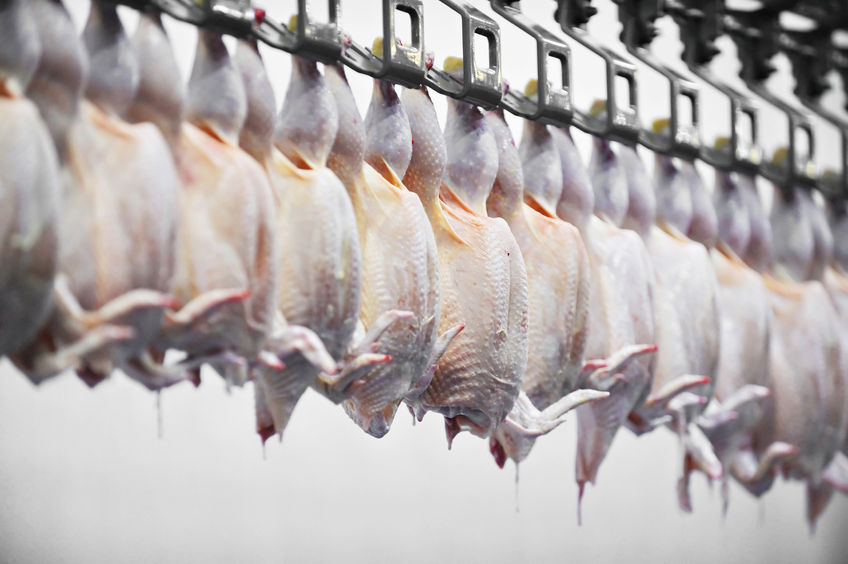
Dr Scott Cato said the revelations of the plot "emerged mistakenly" on the website of the Initiative for Free Trade organisation, which was founded by Brexit advocate and Conservative MEP Daniel Hannan. They call for Britain to recognise US standards, which are weaker than those adopted by the EU. The revelation follows worries by the British farming industry that any trade deal between the UK and US could result in chlorinated chicken and hormone-reared beef entering the market.
Dr Scott Cato, a member of the European Parliament’s Agriculture Committee, said this confirmed her "worst fears" for farmers and food producers. “For many rightwing conservatives, Brexit has always been about tearing up high EU standards on food safety, environmental protection and animal welfare, under the guise of freeing the UK from ‘red tape’,” she said. “Farmers and food producers in the South West will rightly feel deeply concerned about pressure to ditch these higher standards. Any trade agreement with the US which allows for the import of food and drugs produced without these current safeguards will threaten the viability of many small-scale farmers and food producers. They simply could not compete with the mega-farms and giant corporations of the US.”
Dr Scott Cato said many promises made by Brexiteers during the referendum campaign are being "broken" in "secret talks behind closed doors". She added: “This revelation also destroys the credibility of Michael Gove's promise to ensure a 'Green Brexit'. As more evidence emerges of the risks of a Tory Brexit we continue to demand a referendum on the final deal with the option to retain all the protections that membership of the EU offers.”
Plot emerges 'mistakenly' calling for UK to ditch food standards to secure US deal - Farming UK News
This is from Greenpeace itself:
A hard-Brexit think tank accidentally published its plans for US-UK ‘shadow trade talks’
The Initiative for Free Trade - which is supported by trade secretary Liam Fox - has now deleted the plans from its website
17.02.2018
Lawrence Carter@lawrencecarter1
A transatlantic network of conservative think tanks accidentally published its secret plans to influence US-UK trade negotiations, Unearthed can reveal. Documents outline plans to form an “unprecedented” coalition of hard-Brexit and libertarian think tanks, which will call for Britain to ditch strict EU safety standards – including rules on food and pharmaceuticals – in order to secure a sweeping US-UK trade deal.
The group will hold “shadow trade talks” in Washington and London to “hash out an ‘ideal’ US-UK free trade agreement (FTA).” It hopes this will form the “blueprint” for the real negotiations between the British and US governments. The project plan – which was discovered by Unearthed – claimed the talks would be attended by an official from Fox’s Department for International Trade (DIT), with the aim of making sure the department feels “ownership” of the process. But a DIT spokesperson told Unearthed the department had not yet received an invitation to the talks and so could not comment on whether an official would attend.
The IFT said the plan was an “internal proposal document that includes some ideas that have not yet been put into practice. It therefore shouldn’t have been put online.” No US or British government officials have yet been invited, the spokesperson added.
Trade secretary, Liam Fox, has previously told the Initiative for Free Trade (IFT) – which is organising the talks – that his department is “a very, very willing partner in your great and wonderful quest.”
The plans, which were presented in a glossy brochure, have now been removed from the IFT’s website – but Unearthed is publishing them here in full.
Shadow trade secretary Barry Gardiner told Unearthed: “This looks like another attempt by the IFT to legitimise what is an overtly political agenda by using a government department to sanction their work with right-wing think tanks overseas. There is far too cosy a relationship between some of these organisations and senior Cabinet figures”.
Fox’s connections
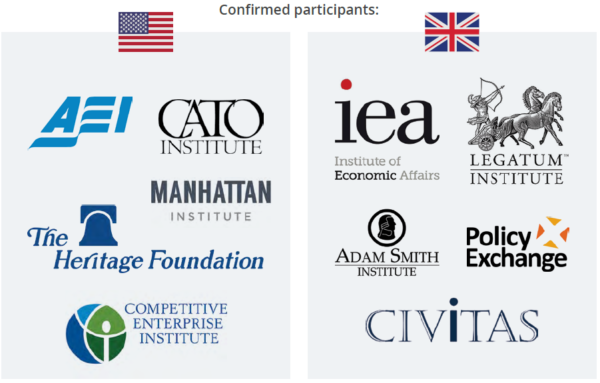
According to the documents, the shadow trade talks are set to include 10 leading right-wing think tanks from the UK and US – including the London-based Institute for Economic Affairs and the Legatum Institute, which has recommended dropping in the EU’s precautionary principle to boost trade.
More on Brexit
Brexit: Liam Fox’s department signs deal to keep trade talks secret
Trump’s top trade nominees lobbied for hormone-meat exports
Brexit: UK trade delegation to Washington had virtually no experience negotiating deals

Source: Initiative for Free Trade.
An IFT spokesperson told Unearthed that Policy Exchange, one of the UK think tanks listed in the brochure, had not yet confirmed it would join the trade talks.
On the US side, the American Enterprise Institute and Heritage Foundation are listed as participants. The Cato Institute – which was founded by billionaire oil refiner, Charles Koch – will write the first draft of the “ideal” agreement.
Trade secretary Liam Fox has longstanding links to several of the groups involved in the project, and helped launch the IFT – which is run by Conservative MEP Daniel Hannan – in September 2017. Concluding his speech at the event, Fox told Hannan his department would be “a very, very willing partner in your great and wonderful quest.”
Foreign secretary Boris Johnson also spoke at the launch, which was controversially held at the Foreign Office.
The IFT’s website boasts of its’ “extensive networks within governments”, which it will “use to promote new trade agreements and to make sure that they focus on mutual recognition”.
Angus MacNeil, chair of the international trade select committee, told Unearthed the shadow trade talks risked handing the DIT an “off the shelf agenda”. He added: “The other danger with the libertarian types is that they will drop any form of protection for business.These further plans will absolutely throw agriculture under the bus. The bus with £350m on the side”, he continued.
A spokesperson for the Cato Institute said: “Scholars in our Stiefel Center for Trade Policy Studies are currently working on a paper concerning the US-UK trade agreement, which they plan to present at a meeting in London in April.”
Libertarian blueprint
The shadow talks aim to shape the negotiations before they have even begun, the brochure says – producing “a blueprint that is looked upon favourably by both governments” and can serve as something “to work towards in the actual US-UK FTA negotiations”. The tactic of drafting model legislation and ensuring buy-in from government along the way has long been used by US libertarian groups, such as the American Legislative Exchange Council (ALEC).
The Heritage Foundation boasts that 64% of the 344 policy recommendations it made in its “Mandate for Leadership” document have been adopted by the Trump administration.
The IFT’s plan for the shadow talks says a key goal is “to ensure the blueprint reaches as many of the relevant individuals as possible, including government officials, ministers and legislators”, through the access enjoyed by the think tanks.
The document explains that although the government officials it planned to invite will not participate directly in the talks, their presence will ensure “that the respective administrations feel some involvement in and ownership of the process.” It added that the presence of UK and US officials will “lend greater weight to our endeavour”.
Watch
Brexit, trade and the environment: What’s the big deal?

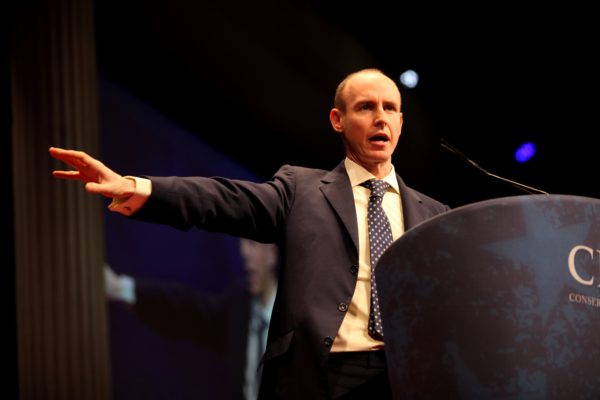
Daniel Hannan MEP is president of the IFT, which accidentally posted the plans. Photo: Wikimedia Commons/Gage Skidmore
Chlorinated chicken
The “ideal” free trade agreement outlined by the IFT in the document could transform the way the safety of imported products – such as food and pharmaceuticals – is regulated. The IFT argues that, by recognising some US standards and dropping some restrictions on the import of US agricultural products, the UK can pivot away from the EU’s precautionary principle, saving consumers money through cheaper food imports.
It says a shift away from the EU’s approach would mean that “US exporters of agricultural produce – beef, for instance – would have a brand new market to sell to”. Imports of US beef are currently restricted by the EU because of a widespread use of growth hormones that the European Commission deems unsafe.
This type of regulatory change would also allow for imports of chlorinated chicken, an issue that caused huge controversy during Liam Fox’s visit to Washington in July 2017. During an event at the American Enterprise Institute, Fox dismissed the issue as a sideshow: “the British media are obsessed with chlorine-washed chickens, a detail of the very end-stage of one sector of a potential free trade agreement. I say no more than that”.
However, documents obtained by DeSmog under freedom of information and seen by Unearthed, reveal that the chlorinated chicken issue was one of the first things Fox was lobbied about when he met with the Heritage Foundation – just a week after his appointment as trade secretary.
According to a summary of a July 2016 lunch with 16 representatives of Heritage – including his former special advisor, Luke Coffey: “participants highlighted the political significant [sic] of chlorine-washed chicken (banned in the EU) to US agriculture (COMMENT: a long-standing restriction that the US argues is without scientific basis)”.
Unearthed contacted the Heritage Foundation for comment and will update the story when we receive a response.
A hard-Brexit think tank accidentally published its plans for US-UK ‘shadow trade talks’ - Unearthed
Pressenza - Brexit between the lines: plot to ditch EU safety standards on food and drugs
Revealed: rightwing groups plot to ditch EU safety standards on food and drugs | Politics | The Guardian
See also:
Initiative for Free Trade - Wikipedia
http://www.ifreetrade.org/about
And:
Futures Forum: 'The Crisis in Democracy" > a short history of think tanks
Futures Forum: Brexit: and the Napoli
Futures Forum: Brexit: and Exeter's MP asking for scrutiny: and more news
Futures Forum: Brexit: and disaster capitalism
.
.
.
Futures Forum: Brexit: and questioning the brave new world for farming and the countryside
And indeed many beyond government see the future as offering new horizons:
Futures Forum: Brexit: and a moment of opportunity for rural England?
There are loads of issues and areas involved, just to take the more recent ones considered:
Futures Forum: Brexit: and dairy farming
Futures Forum: Brexit: and producing food in the UK
Futures Forum: Brexit: and whether subsidies are bad for sustainable agriculture...
The NFU have been upbeat, but still offer warnings to the government:
Food and farming can power Britain post-Brexit, says NFU President
20 February 2018
Time is running out. To use a farming analogy, those three cornerstones outlined in our vision are three legs of a milking stool. There’s a lot of spilt milk if you remove one of them.
We must have frictionless trade with the EU. Everything else, including the final shape of any domestic agricultural policy, is dependent on that. And of course, those who advocate a cheap food policy, of scouring the world for low cost food should bear in mind the price paid in traceability, in standards and in the off-shoring of environmental impact.
And to deliver farming’s true potential for Britain we must have a trading environment that helps, not hinders. We must have a food supply chain which shares the risk equally – rather than piling all the risk onto the farmer.
British farmers are extremely proud of the standards they adhere to – most of them linked to the Red Tractor, which ensures the very best in traceability. We mustn’t let those standards slip and be undermined by a bad trade deal during Brexit negotiations.
Food and farming can power Britain post-Brexit, says NFU President - The Pig Site
'Frictionless' EU trade is vital post-Brexit for UK farming to survive | Environment | The Guardian
And this has been echoed by a joint statement from the food and farming industries:
UK food and farming sector unites over views on Brexit | HeraldScotland
UK food and farming sector comes together in joint Brexit statement - New Food Magazine
Food and farming sector highlights Brexit impact on home-grown production - Farming UK News
Whilst environmentalists and farmers have also joined forces:
Ecologists and agriculturalists find common ground in the future of farming post Brexit - The Ecologist
Meanwhile, the Environment, Food and Rural Affairs Committee also warns:
Food standards 'must not be sacrificed to cheap imports' after Brexit, say MPs | The Independent
Farming businesses 'could be wiped out after Brexit transition' | UK news | The Guardian
It depends what sort of Brexit you're looking for, as the non-partisan Farming UK website notes:
Plot emerges 'mistakenly' calling for UK to ditch food standards to secure US deal

Plot to ditch EU food and safety standards threatens food producers, a Green MEP has said
21 February 2018
A plot has emerged "mistakenly" by leading Brexiteers to ditch EU food and safety standards post-Brexit to secure a US trade deal, according to an MEP. The coalition of conservative think tanks are pushing for a free trade agreement that would allow the import of US meats, drugs and chemicals currently banned in Britain, according to Green MEP, Molly Scott Cato.
Dr Scott Cato said the revelations of the plot "emerged mistakenly" on the website of the Initiative for Free Trade organisation, which was founded by Brexit advocate and Conservative MEP Daniel Hannan. They call for Britain to recognise US standards, which are weaker than those adopted by the EU. The revelation follows worries by the British farming industry that any trade deal between the UK and US could result in chlorinated chicken and hormone-reared beef entering the market.
Dr Scott Cato, a member of the European Parliament’s Agriculture Committee, said this confirmed her "worst fears" for farmers and food producers. “For many rightwing conservatives, Brexit has always been about tearing up high EU standards on food safety, environmental protection and animal welfare, under the guise of freeing the UK from ‘red tape’,” she said. “Farmers and food producers in the South West will rightly feel deeply concerned about pressure to ditch these higher standards. Any trade agreement with the US which allows for the import of food and drugs produced without these current safeguards will threaten the viability of many small-scale farmers and food producers. They simply could not compete with the mega-farms and giant corporations of the US.”
Dr Scott Cato said many promises made by Brexiteers during the referendum campaign are being "broken" in "secret talks behind closed doors". She added: “This revelation also destroys the credibility of Michael Gove's promise to ensure a 'Green Brexit'. As more evidence emerges of the risks of a Tory Brexit we continue to demand a referendum on the final deal with the option to retain all the protections that membership of the EU offers.”
Plot emerges 'mistakenly' calling for UK to ditch food standards to secure US deal - Farming UK News
This is from Greenpeace itself:
A hard-Brexit think tank accidentally published its plans for US-UK ‘shadow trade talks’
The Initiative for Free Trade - which is supported by trade secretary Liam Fox - has now deleted the plans from its website
17.02.2018
Lawrence Carter@lawrencecarter1
A transatlantic network of conservative think tanks accidentally published its secret plans to influence US-UK trade negotiations, Unearthed can reveal. Documents outline plans to form an “unprecedented” coalition of hard-Brexit and libertarian think tanks, which will call for Britain to ditch strict EU safety standards – including rules on food and pharmaceuticals – in order to secure a sweeping US-UK trade deal.
The group will hold “shadow trade talks” in Washington and London to “hash out an ‘ideal’ US-UK free trade agreement (FTA).” It hopes this will form the “blueprint” for the real negotiations between the British and US governments. The project plan – which was discovered by Unearthed – claimed the talks would be attended by an official from Fox’s Department for International Trade (DIT), with the aim of making sure the department feels “ownership” of the process. But a DIT spokesperson told Unearthed the department had not yet received an invitation to the talks and so could not comment on whether an official would attend.
The IFT said the plan was an “internal proposal document that includes some ideas that have not yet been put into practice. It therefore shouldn’t have been put online.” No US or British government officials have yet been invited, the spokesperson added.
Trade secretary, Liam Fox, has previously told the Initiative for Free Trade (IFT) – which is organising the talks – that his department is “a very, very willing partner in your great and wonderful quest.”
The plans, which were presented in a glossy brochure, have now been removed from the IFT’s website – but Unearthed is publishing them here in full.
Shadow trade secretary Barry Gardiner told Unearthed: “This looks like another attempt by the IFT to legitimise what is an overtly political agenda by using a government department to sanction their work with right-wing think tanks overseas. There is far too cosy a relationship between some of these organisations and senior Cabinet figures”.
Fox’s connections
According to the documents, the shadow trade talks are set to include 10 leading right-wing think tanks from the UK and US – including the London-based Institute for Economic Affairs and the Legatum Institute, which has recommended dropping in the EU’s precautionary principle to boost trade.
More on Brexit
Brexit: Liam Fox’s department signs deal to keep trade talks secret
Trump’s top trade nominees lobbied for hormone-meat exports
Brexit: UK trade delegation to Washington had virtually no experience negotiating deals

Source: Initiative for Free Trade.
An IFT spokesperson told Unearthed that Policy Exchange, one of the UK think tanks listed in the brochure, had not yet confirmed it would join the trade talks.
On the US side, the American Enterprise Institute and Heritage Foundation are listed as participants. The Cato Institute – which was founded by billionaire oil refiner, Charles Koch – will write the first draft of the “ideal” agreement.
Trade secretary Liam Fox has longstanding links to several of the groups involved in the project, and helped launch the IFT – which is run by Conservative MEP Daniel Hannan – in September 2017. Concluding his speech at the event, Fox told Hannan his department would be “a very, very willing partner in your great and wonderful quest.”
Foreign secretary Boris Johnson also spoke at the launch, which was controversially held at the Foreign Office.
The IFT’s website boasts of its’ “extensive networks within governments”, which it will “use to promote new trade agreements and to make sure that they focus on mutual recognition”.
Angus MacNeil, chair of the international trade select committee, told Unearthed the shadow trade talks risked handing the DIT an “off the shelf agenda”. He added: “The other danger with the libertarian types is that they will drop any form of protection for business.These further plans will absolutely throw agriculture under the bus. The bus with £350m on the side”, he continued.
A spokesperson for the Cato Institute said: “Scholars in our Stiefel Center for Trade Policy Studies are currently working on a paper concerning the US-UK trade agreement, which they plan to present at a meeting in London in April.”
Libertarian blueprint
The shadow talks aim to shape the negotiations before they have even begun, the brochure says – producing “a blueprint that is looked upon favourably by both governments” and can serve as something “to work towards in the actual US-UK FTA negotiations”. The tactic of drafting model legislation and ensuring buy-in from government along the way has long been used by US libertarian groups, such as the American Legislative Exchange Council (ALEC).
The Heritage Foundation boasts that 64% of the 344 policy recommendations it made in its “Mandate for Leadership” document have been adopted by the Trump administration.
The IFT’s plan for the shadow talks says a key goal is “to ensure the blueprint reaches as many of the relevant individuals as possible, including government officials, ministers and legislators”, through the access enjoyed by the think tanks.
The document explains that although the government officials it planned to invite will not participate directly in the talks, their presence will ensure “that the respective administrations feel some involvement in and ownership of the process.” It added that the presence of UK and US officials will “lend greater weight to our endeavour”.
Watch
Brexit, trade and the environment: What’s the big deal?

Daniel Hannan MEP is president of the IFT, which accidentally posted the plans. Photo: Wikimedia Commons/Gage Skidmore
Chlorinated chicken
The “ideal” free trade agreement outlined by the IFT in the document could transform the way the safety of imported products – such as food and pharmaceuticals – is regulated. The IFT argues that, by recognising some US standards and dropping some restrictions on the import of US agricultural products, the UK can pivot away from the EU’s precautionary principle, saving consumers money through cheaper food imports.
It says a shift away from the EU’s approach would mean that “US exporters of agricultural produce – beef, for instance – would have a brand new market to sell to”. Imports of US beef are currently restricted by the EU because of a widespread use of growth hormones that the European Commission deems unsafe.
This type of regulatory change would also allow for imports of chlorinated chicken, an issue that caused huge controversy during Liam Fox’s visit to Washington in July 2017. During an event at the American Enterprise Institute, Fox dismissed the issue as a sideshow: “the British media are obsessed with chlorine-washed chickens, a detail of the very end-stage of one sector of a potential free trade agreement. I say no more than that”.
However, documents obtained by DeSmog under freedom of information and seen by Unearthed, reveal that the chlorinated chicken issue was one of the first things Fox was lobbied about when he met with the Heritage Foundation – just a week after his appointment as trade secretary.
According to a summary of a July 2016 lunch with 16 representatives of Heritage – including his former special advisor, Luke Coffey: “participants highlighted the political significant [sic] of chlorine-washed chicken (banned in the EU) to US agriculture (COMMENT: a long-standing restriction that the US argues is without scientific basis)”.
Unearthed contacted the Heritage Foundation for comment and will update the story when we receive a response.
A hard-Brexit think tank accidentally published its plans for US-UK ‘shadow trade talks’ - Unearthed
Pressenza - Brexit between the lines: plot to ditch EU safety standards on food and drugs
Revealed: rightwing groups plot to ditch EU safety standards on food and drugs | Politics | The Guardian
See also:
Initiative for Free Trade - Wikipedia
http://www.ifreetrade.org/about
And:
Futures Forum: 'The Crisis in Democracy" > a short history of think tanks
Futures Forum: Brexit: and the Napoli
Futures Forum: Brexit: and Exeter's MP asking for scrutiny: and more news
Futures Forum: Brexit: and disaster capitalism
.
.
.
Subscribe to:
Posts (Atom)