... A FORUM TO STIMULATE DEBATE ... ... JUST ADD A COMMENT AT ANY ENTRY BELOW... ... FOR THE SUSTAINABLE DEVELOPMENT OF TOWN AND VALLEY ...

Saturday, 2 September 2017

Plans for Port Royal: anticipating a Regeneration Board >> Scoping Study consultants' report due to be presented to Reference Group > Thursday 21st September

REFERENCE GROUP MEETINGS:

The Port Royal Scoping Study consultants' report is key to the next steps in 'regenerating' Port Royal:
Futures Forum: Plans for Port Royal: anticipating a Regeneration Board >> Scoping Study consultation update
Futures Forum: Plans for Port Royal: anticipating a Regeneration Board >> Scoping Study consultation and "independent experts"

The report is due to be presented to the Reference Group, as stated in the notes from the last meeting of the Group:

SIDMOUTH TOWN COUNCIL 
Notes of the meeting of the Port Royal Scoping Study Reference Group 
held at Council Chamber, Woolcombe House, Woolcombe Lane, Sidmouth, 
on Thursday 29 June 2017 

Welcome and Introductions 
The Chairman of the Group, Councillor Jeff Turner, welcomed everyone to the meeting including Ed Heynes the appointed consultant for the Scoping Study. He commented that the consultants had been busy collecting information and researching the scoping area. He added that although only part way through the study, the ongoing public consultation exercise and the recent two public consultation events had been appreciated by those attending with some themes emerging from the views expressed to date.

...

Next steps 
The group noted that the consultation ended on 31 July 2017 and that after that time the consultants would produce a report on their findings. This report would be available to the Reference Group before it was included in reports to both Councils. 

EAST DEVON DISTRICT COUNCIL
Search - Reference Group - Sidmouth Town Council
12 July 2017 - Port Royal scoping project consultation still open for comments following successful Kennaway House events - East Devon

It is understood that it is planned to hold the next Reference Group meeting on Thursday 21st September at 7pm. 

And it is expected that members of the Group will be sent the final report from the consultants by that time.


COUNCIL MEETINGS:

Looking at the timetable:


> Monday 4th September at 6.30pm: Sidmouth Town Council to meet.


Port Royal is not on the agenda:
Agenda_STC-040917.pdf

> However, it is expected to be raised, as the 3Rs campaign group is expected to be present on Monday:
Futures Forum: Plans for Port Royal: an alternative view: a new campaign: an online petition > The '3Rs' vision to "retain, refurbish and reuse" > latest campaign news

> Wednesday 6th September at 5.30pm: East Devon District Council's cabinet to meet.

Port Royal is on the agenda (page 12):

5. Port Royal Update: 
Lead/reporting Officer Decision maker: Deputy Chief Executive 
proposed date for decision: Council 25 October 2017 
Other meeting dates where the matter is to be debated / considered: Cabinet 4 October 2017 
Operative Date for decision: 26 October 2017 

060917combinedcabinetagenda_opt.pdf

> It is not exactly clear, however, what 'decision' is to be made, either by the District Council's cabinet on 6th September or 4th October - or by full Council on 25th October - or by someone else on 26th October.

> Monday 2nd October at 6.30pm: Sidmouth Town Council to meet.
The agenda not available as yet.

> Wednesday 4th October at 5.30pm: East Devon District Council's cabinet to meet.
The agenda not available as yet.

> Wednesday 25th October at 6.30pm: full East Devon District Council to meet.
The agenda not available as yet.

> The 3Rs campaign group expect to present their petition to full Council then:
Futures Forum: Plans for Port Royal: an alternative view: a new campaign: an online petition > The '3Rs' vision to "retain, refurbish and reuse" > latest campaign news

DECISION-MAKING PROCESS > GATEWAYS:

It was made clear in July last year that there would be no going back once 'Gateway One' had been passed through, according to a presentation given to a joint meeting of the Town Council and Neighbourhood Plan steering group:
Futures Forum: Plans for Port Royal: anticipating a Regeneration Board >>> ‘Scoping Report for the eastern end of Sidmouth’ >>> District Council pushes for "a three month scoping exercise completed mid November" and "a decision on full planning and design approach December 2016"

The final route for making decisions on the Scoping Study were set out the following month:
Terms of Reference - Joint Working Arrangements for the Port Royal Scoping Exercise Project - Sidmouth Town Council and East Devon District Council

And these were approved after some debate at the Town Council in September:

Several questions were raised at the time: 
Futures Forum: Plans for Port Royal: anticipating a Regeneration Board >>> Scoping Report and Project Brief >>> questions

- including:

Will the end of the Study mark Gateway One? In which case, as outlined by Officer Alison Hayward at her presentations to the STC and NPSG, will it be impossible to revisit any of the elements of the Study, either quantitatively (“fact”) or qualitatively (“opinion”) – or to reconsider the scope of the Project once Gateway One has been passed?

Futures Forum: Plans for Port Royal: anticipating a Regeneration Board >>> Scoping Report and Project Brief >>> 26 questions

Meanwhile, the SVA has responded to the process more recently:
THE SID VALE ASSOCIATION’S RESPONSE TO THE PORT ROYAL SCOPING STUDY QUESTIONNAIRE | Save Our Sidmouth

We will see what comes out of the Reference Group meeting on 21st September...
.
.
.

Climate change: subsidies, the insurance industry and behavioural economics

Nobody seems to be taking the increased risk of flooding seriously - whether estate agents, planners, politicians, developers or house-buyers:
Futures Forum: Flooding and urban sprawl

Perhaps we need to listen to what the market is telling us, rather than encouraging bad behaviour. Because the market recognises the reality of climate change:

Hurricane Harvey: How subsidised insurance leads to unsafe homes


Sep 1, 2017

In Depth: A US federal programme may be encouraging housebuilding on flood plains

An old and expensive problem

For some parts of the US, flooding had been so common and so expensive for such a long period of time that private insurers all but stopped offering flood insurance for homes.

So, in 1968, the US government passed a bill to instigate a National Flood Insurance Program (NFIP). The Federal Emergency Management Agency says the program "aims to reduce the impact of flooding on private and public structures", and that it does so "by providing affordable insurance to property owners and by encouraging communities to adopt and enforce floodplain management regulations".

While private insurers cover homes, the bills are ultimately paid by the federal government, says the Washington Post. "People who couldn’t be insured for flood damage before can under the NFIP," the Washington Post says, with the program offering insurance to those who need it because they have a federally backed mortgage and live in highly flood-prone area.


Cheap land

The death and destruction left in the wake of Hurricane Harvey might seem to be a good reason for the US government to renew the flood insurance program before the deadline passes next month. Those in harm's way clearly need all the help they can get from the government.

But critics of the program blame the NFIP for the destruction caused by Harvey, and say that its renewal will lead to further devastation in the future. "Houston’s horrible situation is the precise argument for why the program needs to be wound down," says MarketWatch. Subsidised insurance for those who live in highly flood-prone regions provides an incentive for companies to build housing in such areas, the site argues.


Hurricane Harvey: How subsidised insurance leads to unsafe homes | The Week UK


How the Insurance Industry Can Push Us to Prepare for Climate Change


Matthew E. Kahn AUGUST 28, 2017


Climate change risk is rising, and yet behavioral economics research argues that we are collectively underinvesting in protecting ourselves. 

In The Ostrich Paradox: Why We Underprepare for Disasters, Robert Meyer and Howard Kunreuther point to several personal traits that expose us to greater risk from natural disasters. First, individuals focus on short time horizons and thus underprepare for future threats. Second, when major disasters do occur, individuals are shocked but quickly begin to let their guard down again. Third, people are over-optimistic and thus underestimate their own risk exposure.

And the risks are real: Zillow’s research predicts that $400 billion dollars of real estate value in Florida could be at risk from climate change by the year 2100.

It might seem, then, that private insurance can be of little help in addressing climate change. There’s concern that for-profit insurers won’t want to insure risky properties, and that individuals won’t have the wherewithal to buy insurance plans in the first place. It’s certainly true that private insurance is not enough, on its own, to mitigate and adapt to climate change. Nor can insurance fully prevent the massive harm caused by storms like Hurricane Harvey, which recently struck Houston, killing at least several residents and causing considerable damage.

Nonetheless, private insurance has a significant role to play. And we believe that the concerns raised by behavioral economics are overblown. Sure, we aren’t perfectly rational. But the emerging challenge of reducing risk exposure for coastal residents creates new opportunities for firms that can innovate and provide new solutions. Innovations in spatial sciences, combined with big data, raise the possibility of the insurance industry introducing innovative pricing strategies that induce private real estate owners and local governments to take efforts that together yield a more resilient real estate capital stock. In short, the insurance industry is adapting in order to profit from climate risk, and in doing so it will help society adapt as well.

Better Data Can Help Insurers More Accurately Price Climate Risk


Dating back to at least F. A. Hayek, economists have emphasized the central role that price signals play in markets. If it’s expensive to insure a house on the coast, individuals will have an incentive to live elsewhere. If insurers offer a discount for climate-proofing homes, homeowners will likewise have an incentive to make that investment.


How the Insurance Industry Can Push Us to Prepare for Climate Change


Insurance industry prices warming into Hurricane Harvey cost

Because US infrastructure is not built to withstand climate change the cost of the disaster will be relatively high

 
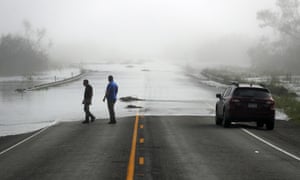
Motorists watch as flood waters from the Guadalupe river spill over a Texas highway. Photograph: Eric Gay/AP

Fiona Harvey and Jonathan Watts

Friday 1 September 2017

Hurricane Katrina in 2005 was “the first taste of a bitter cup that will be proffered to us over and over again,” according to former US vice president Al Gore at the time.

Since then, Hurricane Sandy in 2012 and now Hurricane Harvey have borne out this prediction. The latest storm may turn out to be less fatal than Katrina, which killed more than 1,800 people but in economic terms it may be as bad. Hurricane Katrina cost about $160bn (£124bn) in economic losses in today’s terms, accounting for the last decade’s inflation, while Sandy wrought about $70bn in damage.

Decade of disaster: a timeline of $1bn extreme weather damage in the US | World news | The Guardian

Preliminary estimates for the damage caused by Harvey are wide apart, spanning $90bn to $190bn, reflecting the difficulty of judging an unfolding disaster.

Bob Ward, policy and communications director at the Grantham Research Institute on Climate Change and the Environment, at the London School of Economics, says: “Hurricane Harvey may turn out to be the most damaging weather disaster to have hit the US. It will take some time before we know what the full cost is [and] in addition to the physical damage there will be the economic losses from businesses that cannot operate. If Houston is slow to recover from the impacts, the losses will mount.”

In the UK, motorists have been warned that petrol prices are likely to rise sharply as the effect of Hurricane Harvey on oil production is felt.

If past disasters are anything to go by, about half of the direct, local cost of Hurricane Harvey is likely to be picked up eventually by insurers, with the rest borne by the public purse and by individuals and businesses. Insurers have taken an increasingly active role in the last decade in warning of the potential for more intense storms, floods, droughts and other natural disasters as a result of climate change, and of our failure to protect a rising population and increasingly complex infrastructure against these effects.

“We have been working on climate change since the 1970s,” says Ernst Rauch, head of climate and public sector business development at Munich Re. “We are one of the largest risk takers and it is essential we understand these potential risks. This is crucial to us.”

For insurers, the key issue is the resilience of populations and infrastructure – the ability to deal with disasters when they happen. In most situations, this requires government planning, working with the private sector to help proof homes and buildings against severe weather. But while insurers have grown acutely aware of these risks, governments and other parts of the private sector have lagged behind.

“We see the need at a global scale for societies and public risk managers like government and local authorities to pay more attention to the reduction of risk and resilience building,” says Rauch. “Otherwise we will see an ongoing increase in losses, driven and intensified by climate change.”

Caspar Honegger, who heads global flood peril assessment at Swiss Re, reports that after Superstorm Sandy hit New York, the city asked his team to analyse the climate risks for the next 40 years. They found that rising sea levels and the increasing frequency of storms would raise average annual losses by 170% to $4.4bn.

ClimateWise – a coalition of 29 insurers including Allianz, Lloyd’s, Zurich, Prudential and Swiss Re – warned of a growing “protection gap” between the cost of natural disasters and the amount insured for. The group said weather catastrophes – which are now six times more frequent than in 1950 – are making some assets uninsurable and advised more investment in building resilience against floods and heat waves.

The online property company Zillow estimates that 1.9 million homes in the US, valued at a combined $882bn, could be submerged by the end of the century as sea levels rise and storm surges erode coastlines and riverbanks. Florida would be worst affected, losing one in eight properties, followed by Hawaii with one in 10.

Insurers now treat this as a board level issue, with chief executives reporting to their shareholders on the increasing risk from climate-related disasters, and working with the UN, World Bank and national governments. As their business relies on understanding risk, they have taken a lead not just in pricing in new risks but in encouraging efforts to reduce them. Insurers are among the top global investors in renewable energy, and some are considering divesting from fossil fuels. They have funded studies of vulnerability and ways to adapt to climate change, and urged governments to protect their populations from the potential ravages of warming.

Yet not enough is being done, warns Rauch. “Not enough account is taken of climate change at the public decision-making level. Climate change is not something that is going to have an impact in a hundred years, its impact is already felt today. That’s why we need to adapt to the consequences, such as by investing in infrastructure, fortifying homes, building levees and dykes, maybe removing homes from highly exposed zones.”

In part this lack of preparedness is down to the cost of equipping communities with better protection and better recovery mechanisms. But for more than a decade, since the pivotal Stern review of the economics of climate change in 2006, an increasing body of work has demonstrated that dealing with emissions and the probable effects of climate change now will save money in the medium and longer term. “The longer we fail to act the more expensive it will be; the sooner we act, the cheaper. Doing nothing will be much more expensive,” says Rauch.

But insurance does offer one big advantage in assessing the likely impacts of climate disasters, says Rauch. “We are very transparent. Insurance premiums reflect risk based on two factors: first is the underlying hazard, that is the probability of an event occurring, and the second is the vulnerability if an event occurs. If the hazard is driven up by climate change, you can still reduce vulnerability, by investing in protection and fortifying homes, such as by building them to higher standards. Then the premiums could remain constant. But if you keep everything as it is today and the risk goes up, they would have to rise.”

In Florida, for instance, lax building regulations mean buildings are more vulnerable, as well as more at risk, and premiums are higher accordingly – more than $2,000 for insurance coverage that would cost less than €200 in Germany, according to Rauch. “At the end of the day, insurance is a simple system and one of the biggest benefits is that we put a price tag on risk – so in a functioning market everyone can understand where the risk is higher.”


Insurance industry prices warming into Hurricane Harvey cost | Business | The Guardian
.
.
.

Friday, 1 September 2017

Plans for Port Royal: an alternative view: a new campaign: an online petition > The '3Rs' vision to "retain, refurbish and reuse" > latest campaign news

The 'grand picnic' attracted a lot of picnickers - and attention last Sunday:
Futures Forum: Grand Picnic on the Ham > reports of 'a perfect day'
Futures Forum: Plans for Port Royal: campaigns and picnics

One of the purposes being to raise awareness of the '3Rs' campaign:
Futures Forum: Plans for Port Royal: 'Alternative ideas as to how the Port Royal area of Sidmouth could be redeveloped'
Futures Forum: Plans for Port Royal: public meeting Weds 23rd August >>> the fallout

Here's an update, given on the SOS website:

Retain-Refurbish-Reuse: current plans


September 1, 2017 by sidmouthsid Leave a comment

3Rs campaign supporters have provided this update, with dates for your diary:
Delivery of petition (over 1770 signatures so far) to Sidmouth Town Council office on Monday 4th September, 11am.


Please come if you can
> Group presence at Sidmouth Town Council meeting, Monday 4th September, 6.30pm
> Delivery of petition to EDDC at the Council meeting on October 25th, please come along and support us
> Core group meeting shortly to determine next steps
> A mass march? Pledges of financial support?


How you can help:
> Continue to write to Town and District Councillors to explain what you want
> Write a letter to the Sidmouth Herald to express how you feel
> Help us build the campaign by joining the core team
> Look out for news of more events here and in the Sidmouth Herald
> Join us on Facebook: Retain Refurbish Reuse

If you would like to help in any way, please contact cgardner@eastdevon.gov.uk and your details will be passed on to a member of the team


Retain-Refurbish-Reuse: current plans | Save Our Sidmouth

See also:
Futures Forum: Plans for Port Royal: anticipating a Regeneration Board >> Scoping Study consultation and "independent experts"
Futures Forum: Plans for Port Royal: and financing the Knowle relocation project >>> or: asset-stripping vs affordable housing
Futures Forum: Plans for Port Royal: an alternative view: a new campaign: an online petition > The '3Rs' vision to "retain, refurbish and reuse" > public meeting Wednesday 23rd August >>> the line-up
.
.
.

Knowle relocation project: developers lose appeal for 'retirement development' in Sidford >>> Reason: overage

Plans for a 'retirement development' in Sidford have been rejected by the Planning Inspector - and this has profound implications for other plans elsewhere in the Valley:
Futures Forum: Knowle relocation project: developers lose appeal for 'retirement development' in Sidford >>> Reason: "lack of affordable housing is a critical issue in East Devon"

As the East Devon Watch blog notes, there is another reason why the appeal was rejected:


RETIREMENT HOUSING PLANS DISMISSED DUE TO ‘OVERAGE’ ROW

1 SEP 2017

This is a REALLY important decision as it establishes principles that surely MUST form a part of PegasusLife plans for the Knowle. And it will also apply to other developments.

Or has EDDC conveniently agreed to overlook this with PegasusLife – whose massively greater number of flats at eye-wateringly higher prices will give a MUCH greater profit than Green Close?


Retirement housing plans dismissed due to ‘overage’ row | East Devon Watch

From the Herald today:

Developer’s appeal to build 36 flats in Sidmouth dismissed

PUBLISHED: 01 September 2017

Stephen Sumner


Devon County Council closed Green Close Care Home to cut costs

A developer’s appeal over its bid to demolish a Sidmouth care home and build 36 sheltered housing apartments for the elderly has been dismissed.


Churchill Retirement Living's plans for Green Close

Churchill Retirement Living took its case to the Planning Inspectorate after East Devon District Council (EDDC) failed to decide on its application within the allotted time.

Its plans, for the site of the closed 23-bed former Green Close care home, were approved in November subject to a £41,000 contribution towards ‘affordable’ housing.

But the two sides were subsequently unable to agree on an ‘overage’ clause that would have seen Churchill share half of any profits with EDDC that exceed the former’s current forecasts.

Planning inspector Thomas Bristow said: “I accept the proposal would be beneficial in resulting in additional sheltered housing accommodation in East Devon, in supporting employment during construction, and as future occupants would make use of nearby services and facilities.

“I have also taken account of the various reports submitted by the appellants related to housing older people, which highlight the importance of housing provision for an ageing provision.

“However, the support accorded in general terms to enabling housing delivery is not at the expense of ensuring that all development makes appropriate provision for affordable housing.

“Moreover, as there is no dispute over whether the council are presently able to demonstrate a five-year housing land supply, the development proposed cannot be said to be necessary to meet housing requirements as they stand in East Devon.”

Town councillors had slammed Churchill’s £41,000 offer towards off-site ‘affordable’ housing as an ‘insult’ to Sidmouth – claiming the developer stood ‘make millions’ from the development.

EDDC accepted Churchill’s viability assessment showing it could make no more than the ‘relatively modest contribution’, but tried to impose the overage clause in case its profits exceeded expectations.

Mr Bristow found in the council’s favour and refused planning permission.

Churchill acquired the site from Green Close owner Devon County Council subject to planning permission.

A spokesman for the firm said it is considering its options.


Developer’s appeal to build 36 flats in Sidmouth dismissed - Latest Sidmouth and Ottery News - Sidmouth Herald
.
.
.

Flooding and urban sprawl

What are the impacts of flooding on new developments - and what can we do to minimise them?
Futures Forum: New developments and flood regulations in East Devon
Futures Forum: Long-term planning for flooding in the West Country

We have one or two planned developments for the Sid Valley where flooding is an issue:
Futures Forum: Knowle relocation project: and flooding
Futures Forum: Plans for Port Royal: anticipating a Regeneration Board >> Scoping Study consultation >> "a stitch-up"
Futures Forum: Beach Management Plan: Town Council chooses breakwaters to protect and regenerate beach
Futures Forum: Sidford business park... and flooding: "Right now there are more questions than answers about how the new climate change guidance is going to be implemented. But be aware: this guidance is already a material consideration for all new planning applications and therefore, a valid reason for planning objections."

Meanwhile, things are not going to get any better:
Futures Forum: Climate change: a significant impact on flooding
Futures Forum: "Exeter rainfall to increase by 73 per cent - and your paved garden will make the city flood"
Futures Forum: Climate change and flooding: last winter’s floods “were a powerful reminder that we need to work with nature to reduce flood risk – and ministers wholeheartedly agreed”.

But there are things we can do:
Futures Forum: Greening grey Britain > tackling pollution and flooding
Futures Forum: Trees and flooding
Futures Forum: The decline of the British front garden: "There's an environmental cost. Paving increases the risk of flash flooding - instead of grass and soil soaking up moisture, it runs straight off paving and overwhelms drainage systems."
Futures Forum: Reducing flooding through sustainable drainage systems >>> Water Sensitive Urban Design in the South-West
Futures Forum: Using natural flood management to protect communities against the effects of storms

One thing is clear: local communities have to be involved:
Futures Forum: Flooding and East Devon... ... and riding roughshod over the concerns of locals
Futures Forum: Flood management: how to hold back the waters >>> >>> "It will require flood schemes to be developed with communities and not just for them."

And surely it is clear by now that we should not be building on flood plains:
Futures Forum: Flooding and building houses
Futures Forum: Urban runoff and flooding in Sidmouth... Relying on 'Victorian plumbing' or building on soakaways...

Which is what has happened in the likes of Houston:


The real villains in Harvey flood: urban sprawl and the politicians who allowed it


There’s never been a more important time to understand the political machinations that led to Harvey’s destructiveness – and dismantle them

hurricane harvey
 ‘The swamps and wetlands that once characterized Houston’s hinterland have been replaced with strip malls and suburban tract homes.’ Photograph: Gerald Herbert/AP

Houston’s catastrophic flood will be framed by leaders in Texas as an unforeseeable act of God. It isn’t. Houston’s unfettered sprawl into the marshland of southeast Texas was a conscious choice by policymakers. So was building a global city on a slowly submerging swamp. Both were decisions that led to disaster.
Houston has quietly become our fourth largest and fastest-growing city, due in large part to cheap housing. But the latter has come at an exorbitant cost to its safety. The swamps and wetlands that once characterized Houston’s hinterland have been replaced with strip malls and suburban tract homes.
Those landscapes once served as a natural flood protection system for the city. Research shows that, if they hadn’t been filled and developed, Harvey’s impact would have been lessened. Sam Brody and his colleagues at Texas A&M University in Galveston have been predicting an event like this for nearly a decade. That their work went unheeded by Texas policymakers should not be forgotten.

There will be an impulse to elide past the political choices that led us to this point. We shouldn’t allow our politicians to use the use Harvey’s victims as human shields by pronouncing that now is not the time for criticism or blame. There’s never been a more important time to understand the political machinations that led to Harvey’s destructiveness, and to do everything in our power to dismantle them.Worse, a generation of civic leaders have completely deregulated Houston’s land development market. In that process, they helped build a far-flung network of poor neighborhoods on top of a swamp. In Houston, there is a simple truth: the poorer you are, the closer you live to a petrochemical plant and the likelier your home is to flood.
Much has been made about Ted Cruz’s vote against Sandy relief funding in 2013. His hypocrisy is fair game for political journalists. But the greater failure of Cruz and John Cornyn is in not seeking funding for a solution to the world’s most predictable disaster before Harvey made landfall.
Much more should be made of Texas Land Commissioner, George P Bush’s failings. As head of the General Land Office, Bush holds a unique and singular power to plan, engineer, and manage the Texas coastline.


But nearly a decade after Hurricane Ike – which hit the city eight years ago – and nearly three years since his election, there’s scant evidence that Bush has done anything to secure Texas’s coastal cities against the threat posed by climate change.
In fact, he’s yet to fully spend the more than $3bn allocated to the General Land Office after Ike. Given that Bush is likely to lead the Harvey recovery, it’s fair for us to question whether or not he’s up to the task.
The question that he and every Houstonian must ponder now is how their recovery can be better than those that followed Ike and Katrina.

Built in 2014 and already suffering a potentially catastrophic pump failure, the New Orleans surge barrier is emblematic of the greater infrastructural challenge facing coastal cities in the US.Erecting a massive barrier system akin to the $14.5bn behemoth rimming New Orleans won’t be enough. But it will be the impulse of every politician eager to project an image of strength and resilience in Harvey’s aftermath – and to expand their political brand by becoming known as Houston’s savior.
Coastal infrastructure is incredibly expensive to build and nearly impossible to maintain, especially when you realize that the maintenance is borne entirely by local governments – none of which have the financial or technical capacity to do so effectively.
Some have already begun to point to Holland, where the world’s most complex flood control system operates, and to proclaim that if the Dutch do it, so can the United States. This simply isn’t true.
The Netherlands has a much higher tax rate, giving it more resources per person to invest in its infrastructure. Dutch storms are also less intense and bring lower surge heights and less rainfall than their American counterparts.
For a lasting recovery, Houston will need to supplement whatever barrier system it builds with a broader, regional network of wetlands, retention ponds, and green infrastructure to restore the once-robust, natural flood protection lost to a half-century of urban sprawl.
Designers have been calling for such an approach since Ike made landfall. Houston should look to New York’s landscape architect-led recovery process as a model worthy of consideration.
A half-century of bad design choices and impotent planning led Houston to this crisis. Now, it’s up to a new generation of Houstonians to do what their predecessors could not – prepare the Magnolia City to rise up and meet its wetter future head on.
Houston deserves the full, fair recovery that never came after Ike. They may not get another chance.
  • Billy Fleming is research director for the Ian L McHarg Center at University of Pennsylvania School of Design, where he earned a PhD in City Planning. He is a co-author The Indivisible Guide and a co-creator of Data Refuge


The real villains in Harvey flood: urban sprawl and the politicians who allowed it | Billy Fleming | Opinion | The Guardian
“The real villains in Harvey flood: urban sprawl and the politicians who allowed it” | East Devon Watch
.
.
.