... A FORUM TO STIMULATE DEBATE ... ... JUST ADD A COMMENT AT ANY ENTRY BELOW... ... FOR THE SUSTAINABLE DEVELOPMENT OF TOWN AND VALLEY ...
Showing posts with label population. Show all posts

Thursday, 25 April 2019

Could Britain feed itself?

This evening, we heard about one country trying to get more self-sufficient in food production:
BBC Radio 4 - In Business, Green Shoots: growing food in UAE’s deserts

Meanwhile, many in the UK are thinking along the same lines:
Futures Forum: ‘Buying British in 2017’ >>> a resurgence of small businesses producing authentic, heritage products

A lot of the thinking is happening because of Brexit:
Futures Forum: Brexit: and 'What will you eat when the food runs out?'
Futures Forum: Brexit: and producing food in the UK
Futures Forum: Brexit: and food self-sufficiency
Futures Forum: Brexit: and "Feeding Britain > Food Security after Brexit"
Futures Forum: Brexit: and supporting small-scale growers to increase the resilience of the UK's food system

Last night, Radio 4's Costing the Earth looked at the issues: 

Could Britain Feed Itself?

24 April 2019

Could Britain feed itself? 

Tom Heap assesses how much more of our own food we could potentially produce. Currently we import nearly half - 30% from the EU but in a time of growing population and political change could we step up our home grown fare? 

He asks about the innovative technology helping farmers make smart use of the land they have, visits labs to ask what changes we might need to allow and sizes up our allotments, gardens and window boxes to see if we could be more productive at home. 

With some theoretical ideas and practical realities he aims to give you food for thought.

Thursday, 21 March 2019

BBC prioritises environment with new natural history programming

This weekend sees the start of a new live series on BBC TV:

Blue Planet Live

Starting on Sunday (March 24) Blue Planet Live will celebrate marine life great and small, as we take the audience on a deep dive into the world’s oceans in Blue Planet Live. The series will broadcast live nightly across the week from three different locations across the planet: East Coast, USA; the Bahamas; and Australia’s Great Barrier Reef.

Charlotte Moore, BBC Director of Content, said: "Blue Planet Live will thrill the millions of viewers who discovered so much from last year's ground breaking series that shocked the nation. BBC One continues to lead that conversation as we travel live around the globe to witness first hand the magnificent marine life within our oceans and wake up to one of the biggest environmental crisis of our times.”


Blue Planet Live: when is the wildlife documentary on BBC and is Sir David Attenborough narrating? - inews.co.uk

With more from the Radio Times:

‘One of the most pressing issues of our time’: BBC prioritises environment with new natural history programming

Chris Packham and Hugh Fearnley Whittingstall were among the BBC presenters to reveal details of their upcoming shows


By Terry Payne
Wednesday, 6th March 2019

The BBC has assembled its largest ever panel of natural history TV presenters to put the environment firmly at the top of the broadcaster’s agenda. Seven presenters, including Chris Packham, Liz Bonnin, Steve Backshall and Gordon Buchanan revealed details of programmes coming up in the next few months that will examine the threats posed to planet Earth. The launch at Kew Gardens in London comes a month before Netflix broadcasts its own clarion call for the world with the eight-part series Our Planet, and will be interpreted in some quarters as the BBC asserting its authority in the area of natural history film-making.


Left to right: Gillian Burke, Chris Packham, Steve Brown, Liz Bonnin, Steve Backshall, Hugh Fearnley-Whittingstall and Gordon Buchanan (BBC)

The BBC’s most senior television executive, director of content Charlotte Moore, said the environment was “one of the most pressing and important issues of our time”. She went on: “The audience really want to know more about the way our planet is changing. We feel that this is just the beginning of the conversation.”

Each of the presenters outlined details of the programmes they’ve made, but it was Chris Packham whose documentary polemic on population growth produced the biggest reaction. “It is in my opinion the single most important thing to talk about,” he said. “We spend a lot of time worrying about climate change, but as a species we are enormously intelligent and adaptable and our species will survive the impact of climate change. The changes we will undergo will be catastrophic and life will be nothing like it is now, but we will survive.”

But population growth poses a much bigger threat, said Packham, adding that the Earth’s population has doubled since 1968 “We are just simply running out of resources. We, here, survive on the resource poverty of other people in other parts of the world. There are too many of us and we need to have this discussion.”

Packham said his programme – which is due to air in summer 2019 – will pose questions that viewers might find hard to deal with. “For instance,” he said. “Have you considered what measles and mumps and polio and smallpox were for? Because in nature nothing is redundant. If it exists there’s a purpose for it and the cold reality is that these diseases that we have so successfully beaten through fantastic advances in medical science were part of an ecological system that regulated human population size. We’ve beaten them and at no point in the film are we saying we should turn back the clock and allow people to die of diseases again, but that’s changed the shape of our population.”

Packham spoke of his elderly and ailing father who he described as being regarded as a “burden on the NHS”. “My argument is that he is not a burden on the health service and what we should have been thinking about is how we deal with an ageing population.”

Hugh Fearnley Whittingstall went on to speak about his film on plastics – a series that sees him empty a carrier bag of plastics on a table in front of Environment Secretary Michael Gove. He said that the public was “fired up and ready” to embrace ways of reducing plastic consumption, but there had to be the will from Government and big business as well. “People are starting to take direct action by dumping plastic at the supermarket. People are indignant and they want things to change.”

Packham was asked whether he was optimistic about the future. He had an upbeat response: “I have got a sneaking suspicion that the best part of the human species time on earth is yet to come. At the moment we are making lots of mistakes but are reaching the time when we recognise that and are beginning to address that. Although the way we live on the planet will be very different due to climate change and due to excessive population, at a certain point in our future we will, perhaps, get back to a time when we can live in harmony with the planet. But I think there will be an enormous amount of discomfort for our species to get to that point. When problems arise we solve them. We are brilliant at cure but terrible at prevention.”

'Our planet is changing': The BBC prioritises environment with new documentaries - Radio Times.
.
.

Sunday, 3 March 2019

Challenging the Local Plan and its "excessive" housing numbers > "It will be good to bring this issue out in the appeal court, as it has profound consequences - not just for Waverley and not even just for West Surrey, but also county wide and nation wide."

To challenge housing figures takes a long time:
Waverley housing need target ‘overstated by 29 per cent’ | CPRE Surrey (October 2017)
Waverley ‘inflated’ housing plan to face Judicial Review | Brownfield Briefing (July 2018)
‘Excessive’ housing target challenged | News | Bordon Herald (October 2018)

And now Waverley in Surrey is able to take its case to court, with a landmark right to appeal against "excessive" Local Plan housing numbers: 

‘Excessive’ housing can go to appeal

Friday, 1 March 2019 - Planning


CAMPAIGNERS battling the impact of Waverley’s “excessive” housing targets are celebrating a landmark legal decision giving them the green light to appeal.

In a fresh twist threatening to undermine the borough council’s adopted Local Plan, which calculates 11,200 houses must be built by 2032, the Court of Appeal agreed last Thursday it would hear the joint challenge by Surrey Campaign to Protect Rural England (CPRE) and Protect Our Waverley (POW).

The challenge centres on whether Waverley had to increase its housing target by 1,600 homes in order to accept Woking’s “unmet need”.

If the joint appeal succeeds - due to be heard later this year - it will anger residents forced to accept unpopular housing schemes driven by Waverley’s determination to meet its housing target, such as a controversial scheme for up to 200 houses agreed last week in Milford (see page three).

Last week’s Court of Appeal decision reverses a High Court decision in October 2018 rejecting POW and CPRE’s case that Waverley should not be obliged to take half of Woking’s unmet need.

Celebrating CPRE’s successful appeal against October’s verdict, Andy Smith, CPRE Surrey branch director, said: “We are pleased that the Court of Appeal wish to see the matter of Woking’s so-called unmet need properly addressed, as there are big question marks over it.

“In the housing requirement numbers for both the Waverley and Guildford Local Plans, this issue of Woking’s unmet need, lurks in the background. It will be good to bring this issue out in the appeal court, as it has profound consequences - not just for Waverley and not even just for West Surrey, but also county wide and nation wide. Our countryside is at risk from excessive, arbitrary and unsustainable housebuilding targets, and that is why we needed to challenge the housing calculations.”

POW chairman Bob Lees highlighted that the appeal coincides with Woking Borough Council declaring it now has no unmet need, and new demographic figures released by the Office for National Statistics implying a much reduced need for new housing.

Welcoming last week’s decision, Mr Lees said: “This is great news. It provides Waverley Borough Council with a golden opportunity to significantly reduce the mandatory number of new houses to be built in the borough over the next 14 years. POW fought against the housing requirement at the examination of the Local Plan. POW fought again in the High Court. POW will fight in the Court of Appeal. POW is fighting to protect our Waverley against unneeded development of our towns, of our villages and in our beautiful countryside.”

Waverley has set aside a “fighting fund” of £300,000 to defend its Local Plan. Responding, borough council leader and Farnham councillor Julia Potts, said: “This news is obviously extremely disappointing for us, but we will, of course, be vigorously defending our adopted Local Plan; the plan we believe represents the best possible vision for the borough’s future.

“It means we can work in partnership with the borough’s towns and parishes to develop Neighbourhood Plans, so communities can mould new development where they live. It means we can safeguard our borough against inappropriate development.

“It should be remembered that Waverley did not bring this legal action, but we have to defend both the borough and town and parish councils, whose Neighbourhood Plans are now threatened by this action. We all want appropriate plan-led development and we did everything possible at the inspection to defend a lower housing number.

“It is extremely disappointing that a few determined individuals continue to raise these legal challenges, despite the High Court upholding the Local Plan following the hearing in October 2018 and despite it having been approved by a government inspector. We are committed to preserving and protecting the adopted Local Plan. It will remain our principal planning document and continue to guide our planning decisions.”


‘Excessive’ housing can go to appeal | News | Farnham Herald
.
.
.

Saturday, 23 February 2019

Climate refugees and a national emergency

The US president has made a new appointment:
WaPo: Climate change skeptic to lead WH climate committee - CNN Video
White House prepares to scrutinize intelligence agencies’ finding that climate change threatens national security - The Washington Post
Trump Climate Change Panel Head William Happer Compared CO2 Treatment to Hitler and the Jews - Esquire

Meanwhile, south of the border, the effects of climate change ratchet up:
Latin America’s Poor Are in the Climate Change Crosshairs
Chile still in the dark in climate change battle - BNamericas
Climate change has turned Peru's glacial lake into a deadly flood timebomb | Environment | The Guardian

Because, this is actually becoming a security threat - an issue which the President's new panel wants to address:
From the US to the Netherlands, military leaders are speaking up on climate change | The Independent

And one of the biggest issues is that of 'climate refugees':
Futures Forum: Climate refugees on the increase
Futures Forum: Peak oil, climate change and pipeline geopolitics driving conflict
Futures Forum: Climate change 'will foster terrorism and fuel immigration'

This is where The Wall meets climate change:
Trump's Border Wall Highlights the Climate–Migration Connection - Scientific American (Jan 2019) 
How Climate Change Is Driving Central American Migrants to the United States - Texas Observer (Dec 2018)
Climate change is contributing to the migration of Central American refugees - Public Radio International (July 2018) 
How climate change could drive immigration to the U.S from Mexico - USA Today (Dec 2017)

As reported in the latest Time magazine: 

The Real Culprit Behind Trump's Border Emergency? Climate Change

By JUSTIN WORLAND
February 22, 2019

President Donald Trump is expected to convene a new panel that will likely undermine the expert consensus that climate change threatens national security.

But experts say that move is at odds with his recent declaration of a national emergency at the U.S. border, where thousands of the Central American migrants have arrived after fleeing the effects of climate change.

“Yeah, they’re economic migrants, but they’re really climate refugees,” says Robert Albro, a researcher American University who has studied the effects of climate change in Latin America. But “the politics around this is so toxic that it’s unlikely to have any kind of productive forward motion in the foreseeable future.”

Trump’s new panel underscores a fundamental irony at the center of the Administration’s treatment of two complex challenges facing the U.S. today: neither new migrant caravans nor climate change can be prevented with a stalwart commitment to an “America First” agenda. Instead, both issues require precisely the kind of international cooperation and global interdependency that Trump routinely decries.

The fact that climate change is one of several primary drivers behind global migration is not controversial among experts.

Researchers and development officials have documented in recent years a slew of climate risks facing Central America, particularly Guatemala, Honduras and El Salvador. A 2016 report from the Food and Agriculture Organization showed 1.6 million people suffering from food insecurity in the region as a result of climate-change related drought, which has left rural and impoverished communities the most vulnerable. Throughout the region, the effects of climate change have made crops unprofitable, driving farmers into cities, and eventually toward the U.S. Thousands more Central Americans have suffered from malnutrition and an inability to feed their children.

“They usually don’t go after the first drought,” says Stephanie Leutert, director of the Mexico Security Initiative at the University of Texas at Austin. “But when the drought comes back and they don’t have many any more savings, they have do something.”

Government scientists, even those working for the Trump administration, have acknowledged the link between climate change and increased migration. The Fourth National Climate Assessment (NCA) — a Congressionally mandated report released last year by more than a dozen federal agencies — noted that climate change would drive future migration in the U.S. and included a section highlighting how extreme weather has contributed to past migrant crises.

The link between climate change and migration extends to other parts of the globe as well, including the Middle East. A 2017 study published in the journal Science showed that by the end of the century climate change could double the number of refugees seeking asylum in Europe. And other research has shown that climate change-related drought has worsened the conflict in Syria. While environmental devastation is not the only factor contributing to unprecedented trends in global migration, it’s clear it’s contributing to the global movement of people.

The irony undergirding Trump’s declaration of a national emergency at the U.S. border will likely have no effect on his national security panel on climate change. The 12-member committee, which was first reported by the Washington Post, will be led by William Happer, a retired Princeton University professor who has vocally denied the science of climate change and memorably compared environmentalists’ criticism of carbon dioxide to the persecution of the Jewish people during World War II. Its convocation follows a barrage of comments from Trump that have sought to undermine climate science. He has repeatedly trolled the internet with tweets about cold weather and the Administration has engaged in a concerted effort to undo the country’s environmental regulations. “I don’t believe it,” Trump said in November of the NCA and, by extension, climate change more broadly.

Still, it remains unclear what tangible effects the panel’s conclusions might have. Experts at federal agencies continue to acknowledge and prepare for the threat of climate change, including the Department of Defense which last month highlighted the threat a warmer world plays to national security in a congressionally mandated report. And in many cases agencies are compelled to act on climate change by a complex set of federal law and Supreme Court rulings.

The notion that climate change could constitute a national emergency has won over many Democrats eager for ways to implement climate policy come 2020. For that reason, many Republicans have remained skeptical of Trump’s emergency declaration. “Today’s national emergency is border security,” said Senator Marco Rubio, a Florida Republican. “But a future president may use this exact same tactic to impose the Green New Deal.”

Indeed, future Democrats may point to the migrant crisis to justify it.

Write to Justin Worland at justin.worland@time.com.


The Culprit Behind Trump's Border Emergency? Climate Change | Time
.
.
.

Thursday, 24 January 2019

Climate refugees on the increase

The shorelines of Bangladesh are not a secure place to build a home: 

A woman in Bangladesh uses bales of straw to try to protect a riverbank that is eroding away from floodwaters. Much of the country is ground zero for a global climate crisis. PHOTOGRAPH BY G.M.B. AKASH, PANOS PICTURES/RE​DUX

ENVIRONMENT


Climate change creates a new migration crisis for Bangladesh


BY TIM MCDONNELL | PUBLISHED JANUARY 24, 2019

The country, already grappling with the Rohingya crisis, now faces a devastating migration problem as hundreds of thousands face an impossible choice between battered coastlines and urban slums.

Climate change creates a new migration crisis for Bangladesh

Meanwhile, the US national security apparatus is worried about the impacts of climate change across the globe:
Futures Forum: Climate change: and the increased risks of global conflict ... the evidence ... (February 2015)
Futures Forum: Climate change: and 'security' (November 2015)

And their concerns are growing: 

Intelligence community: Warming could spark migration


Published: Thursday, January 24, 2019

A new assessment by the National Intelligence Council warns that climate change could contribute to a growing number of refugees who flee violent conflicts that erupt from competition over food and other resources. It comes as President Trump rolls back programs to address climbing temperatures.


Then there is the refugee crisis in Syria - and to what extent it has been brought about by climate change:
Futures Forum: Climate change 'will foster terrorism and fuel immigration' (January 2015)
Futures Forum: Peak oil, climate change and pipeline geopolitics driving conflict (January 2017)

These questions have been raised by an academic study just published:
Climate, conflict and forced migration - ScienceDirect
Causal link between climate, conflict, and migration -- ScienceDaily

As reported today: 

Study links climate change and war refugees

Jean Chemnick, E&E News reporter Climatewire: Thursday, January 24, 2019

A group of about 200 migrants walking north in a caravan this past fall toward the border of Guatemala and Mexico. Biba/EFE/Newscom

Researchers in the United Kingdom have found the strongest link yet between climate change, conflict and migration.

The report released yesterday by authors at the University of East Anglia looked at asylum applications for 157 countries between 2006 and 2015. It found that in certain years and certain contexts, warming-related drought sparked conflicts that sent refugees abroad.

The study found the clearest climate fingerprint on the violent conflicts that erupted in western Asia and in sub-Saharan Africa between 2011 and 2015 and that resulted in migration. Climate change had a hand in the Arab Spring uprising in Tunisia, Libya, Yemen and Syria between 2010 and 2012.

Outward migration after those conflicts is indirectly linked to climate change, according to the report.

"We can say the effect of climate change on migration is causal, and it operates through conflict," said Raya Muttarak, one of the report's co-authors.

She stressed that climate change may also contribute to low agricultural yields and gross domestic product — conditions that might set the stage for conflict or compel people to leave a country. Political and other factors may make a country more or less prone to violent conflict or outward migration. The research accounts for those factors but focuses on places where climate-fueled conflict cost human life.

Syria is a case in point. Its bloody eight-year-old civil war followed years of droughts and crop failures that caused an internal migration of Syrian farmers into city slums already crowded with Iraqi war refugees. President Bashar al-Assad's response to the humanitarian and economic hardships led to political unrest that then erupted into war. Refugees of that conflict continue to seek asylum in neighboring countries, the European Union and beyond.

The UEA study comes at a time when defense agencies, global finance and the United Nations are all grappling with the threat climate change poses to global stability. The Pentagon sent Congress a report last week calling warming "a national security issue with potential impacts to Department of Defense missions, operational plans, and installations" (Greenwire, Jan. 18; see related story).

And climate issues, ranging from more weather disasters to scarce water resources, topped a list of economic threats ranked by business and finance leaders at the World Economic Forum in Davos, Switzerland (Climatewire, Jan. 22).

Tomorrow, the U.N. Security Council is set to hold a debate in New York on "addressing the impacts of climate-related disasters on international peace and security."

The United Nations' most influential body has so far been hesitant to make the link between climate and security, and observers say it hasn't built the capacity and expertise needed to fully integrate climate concerns into its work. Doing so will require the council to spend resources and pay attention to stressors and countries it's had little to do with before, like the Dominican Republic.

The Caribbean nation has made climate change the top priority of its first turn on the Security Council, which began this month and includes chairing Friday's debate. But while small island nations in the Caribbean and South Pacific are ground zero for climate-induced disasters like sea-level rise, they've rarely ranked as hotbeds of terrorism or armed conflict.

Still, Camilla Born, senior policy adviser on risk and security issues at the U.K.-based E3G, said the Security Council must move beyond its 20th-century conception of what constitutes a security risk to look at nontraditional issues like displacement and migration, both of which can be destabilizing.

"The reality is that climate change is shaping the conversations that they're having in the Security Council now," she said. "And increasingly, that's becoming unavoidable."


CONFLICT: Study links climate change and war refugees -- Thursday, January 24, 2019 -- www.eenews.net
.
.
.

Sunday, 23 September 2018

Rural communities ‘could die out by 2050’ unless health and care system improves

The South West has a problem:
Futures Forum: The ten local authorities with the highest percentage of the population over 65 are on the coast, with five being in the South West region. Within 20 years it is estimated that 40 per cent of the population of west England will be over 65.

The Rural Services Network quotes councillors in the region warning of the demographic trends:

RURAL COMMUNITIES IN DANGER

Experts have warned that rural communities are ‘in danger of dying out’ unless they are given more help to cope with ageing populations, according to an article by iNews.

Trudi Grant, director of public health at Somerset County Council - an area with a median age of 53 compared with the UK average of 39 – highlighted the danger of ‘very unsustainable communities’ in which the population is dominated by those not of working age. 

Anne Marie Morris, MP for Newton Abbot and chair of the All-Party Parliamentary Group on Rural Health and Social Care, was quoted saying that a ‘one size fits all system’ for healthcare is better suited to urban communities. 

She said that in rural areas more specialist doctors and fewer general consultants are needed. She added that many nurses and medics ‘will have spent their training in urban areas so we need more training and experience taking place in rural areas,’.


Rural communities in danger - Rural Services Network

With the full piece from the i newspaper here:
Rural communities 'could die out by 2050', public health experts warn - i newspaper
.
.
.

Tuesday, 4 September 2018

The ten local authorities with the highest percentage of the population over 65 are on the coast, with five being in the South West region. Within 20 years it is estimated that 40 per cent of the population of west England will be over 65.

The seaside and small towns are getting older:
Futures Forum: Sidmouth's ageing population: "Without urgent investment in coastal communities, some areas will struggle to retain the working age families needed to fuel the economies of towns dominated by old people’s homes."

And it's going to be even more so, as we head into the future:
Futures Forum: Brexit: and Britain's cities growing younger and its small towns growing older at a faster rate than at any other time in recent history

With this report from the Rural Services Network - which focusses on the trends in the South West: 

Dorset to be among places hardest hit by Britain’s ageing population, figures reveal

The Bournemouth Echo covered Office for National Statistics figures showing that rural and coastal areas have the highest proportion of older residents.

The ten local authorities with the highest percentage of the population over 65 were on the coast, with five being in the South West region. Within 20 years it is estimated that 40 per cent of the population of west England will be over 65.

The ONS warned that there would be far smaller growth in numbers of young people moving to the countryside, and said that the demographic changes risked elderly people living in these areas 'isolated and struggling to access services'.


Dorset hit hard by ageing population - Rural Services Network

The Bournemouth Echo carries more:
Dorset to be among places hardest hit by Britain’s ageing population, figures reveal | Bournemouth Echo

With the full report from the ONS here:
Living longer - how our population is changing and why it matters - Office for National Statistics
.
.
.

Sunday, 5 August 2018

Recharging Rural > Creating sustainable communities

The Prince's Countryside Fund has some very good ideas going:
Home - The Prince’s Countryside Fund

Including the 'Recharging Rural' project:
Recharging Rural 2 - The Prince’s Countryside Fund

It's all about affordable housing: 

Recharging Rural- Creating sustainable communities to 2030 and beyond

The top three barriers that exist right now for thousands of people across rural UK are poor broadband and mobile phone coverage, poor road and transport networks and a poor variety of employment opportunities with little or no scope for progression. 

But the top challenge is the lack of affordable housing because it is fundamental to everything else. Respondents state that others should be taking action to support communities and making significant change at strategic levels, for example through the provision of funding instead of them being reliant on volunteers

F&FF - Technical and Business Information

The most responses to the pre-report consultation were from Devon - and the recommendations of the report are both very obvious and very innovative. 

See here:
recharging-rural-full-report-final.pdf
.
.
.

Friday, 22 June 2018

The UK's rapid return to city centre living > and the effect a resurgent Exeter city centre could have on development in East Devon

The East Devon Watch blog has noticed a new development in urban living which could impact on East Devon - if Exeter were to stop expanding its suburbs that is: 

GREATER EXETER – WILL CITY LIVING TAKE SOME OF THE PRESSURE OFF EAST DEVON?

22 JUN 2018

It seems that, after years of decline, living in cities has become more and more popular for all age groups, but particularly you g professionals. Given the decline in rural services such as loss of transport, infrastructure, sixth forms, community hospitals and shops, this is not too surprising.

However, when it comes to living in Exeter it seems less popular with its city council (headed as CEO by former EDDC Head of Regeneration Karim Hassan) which appears to favour student housing and leisure centres and cinemas over homes.

And our developer-led Local Enterprise Partnership sees housing growth in areas which its developers favour for very high house prices – pretty towns and commutable rural villages, the coast – including AONBs.

There is no data for Exeter in the article but Plymouth’s city centre population has increased by 34%.

Here is what a BBC article has to say:

“The growth in city centre living is down to young people – older generations have not returned from the suburbs in significant numbers. 
Some are students, whose numbers grew with the expansion of university education. 

For example, the student population in Sheffield city centre grew by more than 300% between 2001 and 2011, according to census data. By 2011 there were 18,500 students, accounting for about half the population. 
Similarly, Liverpool’s city centre student population grew by 208% (6,300 more people), and Leeds 151% (7,700 more people).

But the popularity of big city centres among young, single professionals is the main factor.

The number of 20 to 29-year-olds in the centre of large cities (those with 550,000 people or more) tripled in the first decade of the 21st Century, to a point where they made up half of the population. There is no reason to think that this trend has eased since the census.

Only one in five city centre residents were married or in a civil partnership, while three-quarters were renting flats and apartments. More than a third had a degree, compared with 27% in the suburbs and outskirts of cities. …”


The UK's rapid return to city centre living - BBC News

Will the Greater Exeter Strategic Plan (now held over until after local elections in May 2019] recognise this new trend? It would certainly take a lot of pressure off East(ern) East Devon.

Exeter or Cranbrook … Exeter or Honiton … hhhmmmm.


Greater Exeter – will city living take some of the pressure off East Devon? | East Devon Watch

Here's the complete piece from the BBC - which gives a 34% increase in the city centre population for Exeter: 

The UK's rapid return to city centre living

By Paul Swinney & Andrew Carter
Centre for Cities

22 June 2018
222 comments


A generation ago many UK city centres were dreary and dilapidated places, with a reputation for crime. Now, they are among the most desirable areas of the country to live. What's changed?

Take a walk through the centre of cities like Manchester, Liverpool and Birmingham and you will see smart new high-rise apartments, office blocks and the ever-present cranes building still more. At street level are cafes, bars, restaurants and gyms serving their often young and affluent customers - the people who increasingly define these areas.

Only 30 years ago inner city populations that had grown rapidly in the late 19th and early 20th Centuries had dwindled - the residents leaving cramped, urban housing for more spacious suburbs and new towns. The reversal that has taken place - especially in the north of England and the Midlands - demonstrates a dramatic urban renaissance and a shift in how people want to live.

Since the start of the 21st Century the population of many town and city centres has doubled in size, while the population of the UK has increased by 10%. (Full list at bottom of story).

There is no way of saying exactly where a city centre starts or stops. So, to allow a comparison between towns and cities with 135,000 or more people, the Centre for Cities mapped them from the middle of their shopping and business areas as follows:

A two-mile radius from the centre of London
A 0.8-mile radius from the centre of cities with 550,000 to four million residents
A 0.6-mile radius from the centre of towns and cities of 135,000 to 550,000


Using this measure, Liverpool has the fastest growing city centre - with the population increasing by 181% (9,100 to 25,600 people) between 2002 and 2015, according to analysis of figures from the Office for National Statistics. Other major cities are close behind, with the population of Birmingham city centre growing 163% (9,800 to 25,800 people), Leeds increasing by 150% (12,900 to 32,300 people), Manchester 149% (14,300 to 35,600 people) and Bradford 146% (1,300 to 3,200 people).

In terms of sheer numbers, the fastest growing city centre was London, which grew from 268,700 to 327,200. However, this amounted to a relatively low 22% increase.

There was also rapid growth outside England. Cardiff city centre's population increased by 88% (6,700 to 12,600) between 2002 and 2015. And although detailed figures for the same period are not available for Scotland and Northern Ireland, census data suggests that Glasgow's city centre grew by 44% (19,700 to 28,300), Edinburgh's by 25% (10,100 to 12,600) and Belfast's by 31% (3,500 to 4,600) between 2001 and 2011.


Manchester enjoyed growth of 149% in its city centre population

Homes for the young

The growth in city centre living is down to young people - older generations have not returned from the suburbs in significant numbers. Some are students, whose numbers grew with the expansion of university education.

For example, the student population in Sheffield city centre grew by more than 300% between 2001 and 2011, according to census data. By 2011 there were 18,500 students, accounting for about half the population. Similarly, Liverpool's city centre student population grew by 208% (6,300 more people), and Leeds 151% (7,700 more people).

But the popularity of big city centres among young, single professionals is the main factor. The number of 20 to 29-year-olds in the centre of large cities (those with 550,000 people or more) tripled in the first decade of the 21st Century, to a point where they made up half of the population. There is no reason to think that this trend has eased since the census.

Only one in five city-centre residents was married or in a civil partnership, while three-quarters were renting flats and apartments. More than a third had a degree, compared with 27% in the suburbs and outskirts of cities.


A big pull for young professionals has been the growing number of high-skilled, high-paying office jobs available. In big cities, more than half of the people living in the centre work in high-skilled professional occupations, reflecting the growing importance of sectors like financial and legal services to the UK economy. Manchester, for example, had an 84% increase in city centre jobs between 1998 and 2015, while Bristol and Leeds enjoyed increases of 42% and 34% respectively.

More like this:
The UK cities with the highest and lowest wages
Where are the UK's youngest and oldest city populations?


All of these jobs have created a market for gyms, restaurants, bars and shops. This in turn has made city centre living even more appealing - with closeness to amenities outweighing downsides like smaller living spaces, noise and pollution.

Then there's the opportunity to avoid the possibility of a long commute - 32% of city centre residents walk to work.

To some extent, governments have supported these trends, with the urban development corporations of the 1980s sparking the regeneration of city centre sites such as the Albert Dock in Liverpool and the Castlefield area of Manchester under the Conservatives.

The face of many cities continued to change in the early 2000s, as Labour invested significantly in urban regeneration programmes.


But some towns and cities have not grown at the same rate - often because they have struggled to attract high-skilled jobs and students. Blackpool, for example, has a relatively small number of students in its centre and suffered a 13% decline in jobs between 2002 and 2015.

Elsewhere the price of land can also limit the rate of growth, as seen in London. This has been a factor in Cambridge, where the historic city centre also limited the number of new homes built. As such, it has seen the biggest fall in the UK, with the number of residents down 8% (6,000 to 5,500 people) between 2002 and 2015.

How much space is left?

For the most successful city centres, increased demand from both residents and businesses raises important questions about the future Until now, places like Birmingham and Manchester have had lots of land to develop, as they recovered from their post-industrial decline.

But over the next 10 years the challenge will be meeting demand for housing without squeezing the commercial heart of the city centres. If they are to continue attracting high-paying jobs, city centres might have to prioritise businesses.


The population of Liverpool's city centre has grown more than 180%

Some new housing might have to be further out - in the suburbs or even on green belt land. Another solution might be to increase the density of UK city centres, which are more scarcely populated than in many other European countries. However, given the controversy around the 30-storey St Michael's development in Manchester, or protests about tall buildings blocking views of St Paul's Cathedral in London, this may be difficult.

Another challenge is gentrification - and concerns that some people lose out because of changes taking place around their homes.Addressing this will mean improving education and skill levels among everyone who lives there. It will also mean making more affordable housing available, to take account of different incomes.

Of course, city centres also have an important social and psychological significance beyond their economic role. A bustling, vibrant city centre is often a source of civic pride.

A struggling city centre can become a symbol of broader social problems and decline. This is why people care so much about the future of their city centres and want to see them thrive.


Figures from 2002-15 for England and Wales and 2001-11 for Scotland and Northern Ireland, for towns and cities with a population of 135,000 or more in the continuous built-up area

About this piece

This analysis piece was commissioned by the BBC from an expert working for an outside organisation.

Andrew Carter is chief executive and Paul Swinney is head of research and policy at the Centre for Cities, which describes itself as working to understand how and why economic growth and change takes place in the UK's cities.

Edited by Duncan Walker
View comments 222


The UK's rapid return to city centre living - BBC News
.
.
.

Monday, 11 June 2018

A project to retain and attract younger people and business to the countryside, by developing more creative and cultural opportunities

Two rural councils have teamed up with two national park authorities in a bid to persuade youngsters to continue living in the countryside - as reported by the Rural Services Network: 

COUNCILS TEAM UP TO WOO RURAL YOUNGSTERS

  
Two rural councils have teamed up with two national park authorities in a bid to persuade youngsters to continue living in the countryside.
Arts Council England and the Heritage Lottery Fund have awarded Craven and South Lakeland District Councils £1.34m for the innovative initiative.
The Great Place: Crossing the Watersheds scheme aims to retain and attract younger people and business to the area by developing more creative and cultural opportunities.
The project is being led by Craven District Council, in partnership with South Lakeland District Council (SLDC), and the Yorkshire Dales and Lake District National Park authorities.
Simon Myers, Craven District Council’s lead member for Enterprising Craven, said the project would “drive forward the future economy of our rural communities”. Local landscapes had inspired people past and present – but the local population was ageing and 44% more 16 to 34-year-olds were needed just to reach the national average.
“Without more younger people and young families we will have fewer village schools, depriving rural areas of cultural, community and service delivery centres and a lack of skilled employees for local businesses. New ways of working, new business models and new creative businesses will benefit all members of our rural communities. We need to retain and bring in a new, younger generation with fresh ideas, to add value to our economy inspired by our great natural, heritage and cultural assets.”
Those supporting the scheme believe culture and creativity can act as a catalyst for change and attract younger people to the local area.
Chris Hogg, SLDC’s portfolio holder for culture and wellbeing, originally encouraged the two councils to promote a partnership bid. Mr Hogg said: “This funding is excellent news for South Lakeland and Craven. It has been a long journey and something I've been determined we should be leading the way on.”
The project will be focused on the rural corridor linking Skipton in the south and Grasmere in the north, including market towns and rural hinterlands. These extend into both the Yorkshire Dales and Lake District National Parks.
The scheme also plans to work with local organisations, businesses, colleges and universities to create new opportunities for business and enable local companies to benefit from creative expertise.
The project will harness the potential for digital technologies and creative media to support local businesses and link cultural activities together. Younger people will be engaged in a diverse range of exciting new arts and heritage events to promote the area and give work experience to young and emerging talent.


.
Councils team up to woo rural youngsters - Rural Services Network
.
.
.

Thursday, 7 June 2018

Brexit: and rotting strawberries

This time last year, there were worries about strawberries:
Futures Forum: Brexit: and strawberries

This is just one part of the bigger picture:
Futures Forum: Brexit: and struggling to recruit skilled labour in the food and drink industry

Because, what do we mean by 'British-grown strawberries'?

As noted by someone on the Lidl's website a couple of years ago:

I just saw the ad live. Good ad but don't think the farmer really picks his own strawberries. Having watched country file (i think it was last week), they showed some super fast strawberry pickers that were Eastern European - I could not believe how fast they were, was really a skill there.

Behind the scenes of our latest advert: Strawberries - My Lidl

Last year, Devon Live reported from Cornwall that most of the pickers are indeed migrant labour: 

Minette Batters, the deputy president of the NFU, told an audience in Cornwall: “The NFU’s labour survey for horticulture has shown that the number of EU seasonal workers coming to the UK was down consistently between 13% and 17% over this summer’s harvest period, so it is critical a seasonal workers scheme is re-introduced.” Without this, increased mechanisation would not be much help. “We have the technology to pick a strawberry, but who will invest in it?” she said.

Looming migrant worker crisis as Devon gets ready for EU worker shortage - Devon Live

Meanwhile, in Kent: 

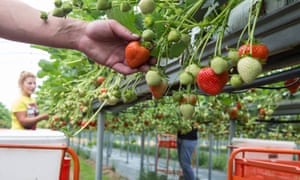
It’s a sign of labor shortages in U.K. agriculture that the English family farm which has fed Wimbledon tennis crowds with strawberries for more than 20 years translates job listings on its website into Romanian and Bulgarian. Set amid the rolling Kentish countryside known as the garden of England, Hugh Lowe Farms brings in workers from central and eastern Europe to produce the 28 metric tons of strawberries eaten every summer at the British tennis championships. It isn’t alone.

“We do rely on non-U.K. nationals, generally from countries which have higher rates of unemployment and lower wage” rates, said Nicholas Marston at Tonbridge, Kent-based Berry Gardens, a marketing cooperative that counts Hugh Lowe Farms as a founding member. About half the jobs in the 600 million-pound ($800 million) berry industry are seasonal and “not attractive to U.K. nationals,” he said.

Farm workers’ average hourly wages including those of managers were two-thirds the level for all U.K. industries, a survey published by Farmers Weekly in 2014 showed. In addition, much manual work is temporary, based on growing seasons. In 2013, the U.K. scrapped the Agricultural Wages Board for England and Wales that had regulated minimum pay rates and overtime.


Perhaps, then, it is a question of raising wages to attract local labour, as the Express suggests: 

BREXITEER Alp Mehmet tore apart James McGrory's argument in favour of remaining in the EU single market to safeguard British jobs given to EU nationals, pointing out five million Britons would be ready to take their place post-Brexit.

PUBLISHED: 09:17, Sat, May 26, 2018 

Speaking on TalkRadio, James McGrory, Executive Director of Open Britain, argued leaving the single market post-Brexit would create an employment vacuum in key low-paid British industries like farming and hospitality.

Mr McGrory said: “We have a lot of unskilled jobs in this country that need doing. “Talk to anybody in the agricultural industry, in the hospitality industry, these aren’t hugely paid jobs but they need doing. The farming industry is a cracking example in that we want to grow food in this country, we want to pick it and we want to eat it on our dinner table.

BBC Brexit news: Alp Mehmet tears apart James McGrory's argument in favour of freedom of movement

“Now, I’m afraid the vast, vast majority of that work is done by migrants from countries like Romania.”

Asked whether such jobs should be paid more to encourage British people to do them, he replied: “That’s always the argument put forward but if you do that you increase the price of food on people’s plates. Do people want to pay more for their food?”

But Former British Ambassador Alp Mehmet hit back at the young Remainer claiming a lot of unemployed Britons could easily fill the gap.

He said: “James, I’m very sorry, but that’s absolutely no excuse for mass immigration. Are you saying to me that if you want a bowl of strawberries on your table you’ve got to go to Romania or wherever to get the labour to come here and lie here and live their lives here forevermore?

“In order to provide you with those strawberries? That is absolute nonsense.
”

“If you pay enough, and the Migration Advisory Committee itself said, if you pay enough you will get the workers. There’s plenty of spare capacity. I know we’ve got, in theory, full employment, but there’s anything up to five million people frankly who could work more if the jobs were there. But where employers can bring in people at cheaper rates, lower rates, they’re going to continue to do so.”


Brexit news: Ex-British diplomat trashes Remoaner's argument in favour of key EU freedom | UK | News | Express.co.uk

The Observer also looks at the bigger picture: 

Red alert: UK farmers warn of soft fruit shortage

Growers fear strawberries will be left to rot as Europe’s migrant workers stay away – but it’s not just a Brexit issue

Jamie Doward and Valentine Baldassari

Sun 27 May 2018 08.00 BST
Comments2,851

The good news is that, despite the terrible spring weather, there should be a bumper harvest this summer. A nation breathes a collective sigh of relief. “The crop’s looking very good,” said Nicholas Marston, chairman of British Summer Fruits. “It’s a little later than last year, which, seeing that Wimbledon is a little late, is not a bad thing.”

But the bigger picture in the strawberry fields of Britain this year is far from rosy. Whether growers will have anyone to pick the ripe berries is now a critical issue, one that has profound implications for the UK’s food security, the health of its population and the sustainability of its countryside economy.

“Normally we have 10 people being interviewed by our agency for every job,” said Stephanie Maurel, the chief executive of Concordia which supplies around 10,000 foreign workers to 200 farms in the UK each year.

“As of a month ago we are putting three or four job offers in front of each seasonal worker from Bulgaria and Romania. They are picking and choosing the ones they will come to. There has been a total switch around in 12 months. We’ve never had this before.”
The temptation is to link the shortage of workers to Brexit. And, certainly, the UK’s decision to leave has not helped matters. “The morning after the vote, we had a pretty depressed workforce,” said Alastair Brooks who grows strawberries and raspberries near Faversham in Kent for supermarkets and employs around 200 Bulgarian and Romanian workers. “There were a few nasty incidents in town. People saying ‘you’ll have to go home now’. It brought out the worst in being British.”
...
But other factors are at play. “The big problem isn’t so much the referendum as the fact that unemployment in countries like Romania is falling very rapidly,” Marston said. “Clearly, a full-time job in your own country is more attractive than a seasonal job in another country, so the whole pool of seasonal labour within the European Union is reducing annually.”

So, just how acute is the problem?

Evidence submitted by English Apples and Pears Limited to the Department for Food and Rural Affairs (Defra) select committee suggests that almost a third of its members are scaling back as a result of the shortage. Some said they would be removing orchards, a troubling scenario given that more than 60% of the country’s traditional orchards are estimated to have disappeared since the 1950s.

“Urgent action is needed now to avoid crops being left unpicked, food wastage, food inflation and displacement by imported foods,” the submission stated.

The Association of Labour Providers was equally gloomy. It said 49% of labour providers do not expect to be able to source and supply sufficient seasonal agricultural workers this year and added: “Currently an average of 60% of agriculture and horticulture businesses are experiencing shortages in low and unskilled roles, with one in eight in crisis.”

...

The labour shortage saw labour costs rise by between 9 and 12% last year. A similar rise is predicted this year. “If this continues we will see businesses start to disinvest,” Capper said. “It’s really bad news because fruit and veg is the success story of British agriculture. If we can produce it here it’s going to be of better, nutritional value. Why would we want to diminish our investment in our food chain that delivers the greatest benefit in health terms?”

The roots of the crisis can be traced back to the government’s decision in 2013 to end the Seasonal Agricultural Workers Scheme. Set up after the second world war to help Czech and Polish soldiers who had fought for Britain find work in the country, it has mutated down the years to allow workers from countries such as Belarus, Ukraine and Russia to come to the UK on seasonal visas. At its end, it was confined to Romanian and Bulgarian workers.

Taking the decision to scrap it, the government argued that with Romania and Bulgaria joining the EU there would be no shortage of migrant labour to work on the UK’s farms. Indeed, figures released last week show that there are 2.3 million EU nationals now working in the UK, 2.4% more than there were in the immediate pre-referendum period. More than 400,000 of these are Romanian.

“But we didn’t forsee that the whole of Europe would now be short of people to do this work,” said Brooks whose employees earn in one week what they earn in four back home.

Many of the young, educated, English-speaking workers from eastern Europe have moved on to jobs in other sectors which offer full-time work or to countries such as Germany which are closer to home. In Britain’s fields today seasonal workers from eastern Europe are now more likely to be in their forties, to speak little English and to find picking physically tougher than their younger predecessors.

The situation has become so bad that Concordia is currently recruiting workers from Moldova where a third of the population have Romanian or Bulgarian passports.

Other European countries are bringing in workers from outside the EU. Brooks said Poland was using workers from North Korea while Portugal was relying on migrant labour from Thailand. “Here’s the irony,” Brooks said. “We are the only country in Europe that has a European worker only policy. Everywhere else is recruiting from outside the EU.”

Sunder Katwala, director of the thinktank British Future, said the majority of people accepted that Britain needed to bring in migrant labour if its food supply was to be maintained. “The public recognises that we need to find people to do these jobs if we want our strawberries to be picked,” he said.

“The Seasonal Agricultural Workers Scheme helped fill these vacancies until it was scrapped in 2013. It did the job well and we may need something similar again – a well-managed scheme that brings in the workers we need and makes employers take responsibility for the local impacts of migration, such as on housing.”

But the government appears to be in denial over the issue. In early 2017 it told the Defra committee that foreign labour shortage reports were anecdotal. Then, this February, Defra secretary Michael Gove seemed to signal a volte face, telling an NFU conference a scheme would be announced “shortly”.

The previous home secretary, Amber Rudd, dropped a similar hint, but No 10 is said to be against the plan, perhaps fearing the headlines if it starts issuing visas to non-EU nationals. The fact that prime minister Theresa May was home secretary when the original scheme was scrapped may also be a reason, some growers believe. Few in the horticultural sector now expect anything to happen before the autumn when a government-commissioned report is published and the potential to offer temporary visas to overseas workers can be used as a bargaining chip in Brexit negotiations.

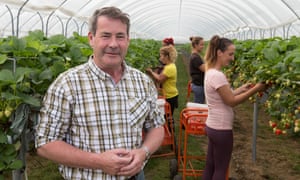
Soft fruit farmer Alistair Brooks, owner of Langdon Manor farm, fears the shortage of workers could be ‘catastrophic’ for his industry. Photograph: Andy Hall for the Observer

A Home Office spokesman defended its position. “The government places great value on the UK’s food and farming industries, both as crucial components of the UK economy and of the fabric of rural Britain. Up until the end of the implementation period in December 2020, employers in these sectors will be free to recruit EU citizens to fill vacancies and those arriving to work will be able to stay in the UK afterwards.”

Capper accused the government of allowing the issue of seasonal workers “to get tied up in the politics of immigration”. “A scheme that brings workers in to pick and pack fruit and veg and them sends them home again has got nothing to do with immigration,” she said.

Maurel said her organisation had been contacted twice last week by Border Force officials asking questions about the workers it was bringing into the UK – “the first time this had happened”.

Brooks said similar questions had been asked of his employees. “We haven’t had this sort of thing in 20 years. You do feel uneasy now as to where we are heading as a nation. We were all deeply shocked and embarrassed by the Windrush scandal but maybe that’s indicative of where the Home Office is.

“If that’s truly the case then that’s a big problem for the UK economy.”

And this is before the UK actually leaves Europe. Some 90,000 workers are needed this summer on UK farms. Of these, 35,000 are on seasonal contracts. “As we get closer to a cliff edge the government say we’re going to have a transition deal but we don’t know that,” Capper said. “If we do crash out of Europe next year I won’t have access to EU workers.”

“That would be a calamity,” said Brooks who is proud of the fact that, during the summer, 99% of Britain’s strawberries and raspberries come from within its shores.

Could UK workers plug the gap? Unlikely. Attempts to recruit them have been “an unmitigated disaster”, Maurel suggested.

“There is no appetite. We ring a bell in the office when a UK worker applies. We put jobs on Jobcentre Plus. Absolutely nothing happens. We’ve had two applications this year in five months.”|

...

Last Friday evening, as she finished her shift picking strawberries at Brooks’s farm in Kent, 27-year-old Afize Yuseinova, was one Bulgarian worker who pledged to continue working here. “I like England,” she said. “There are no jobs for me back home.”

But in the fields of Britain, Yuseinova is becoming an endangered species. Too many countries and industries now want her.

Brooks inspected a strawberry plant and found an ant. He explained that the insect was looking for aphids to milk for their honeydew. But the ant was out of luck as there were no aphids to be found.

“I love Bulgarian workers,” he said. “The problem is there’s only five million of them.”


Red alert: UK farmers warn of soft fruit shortage | Business | The Guardian

See also:
Brexit and the coming food crisis: ‘If you can’t feed a country, you haven’t got a country’ | Business | The Guardian

And:
Futures Forum: Brexit: and the West Country's Brend Hotel group's concerns about attracting staff from the EU
Futures Forum: Brexit: and 'What will you eat when the food runs out?'
.
.
.