Andfjorden, Norway. An eager humpback whale flicks its tail across the water’s surface as it dives down into a ball of herring. Humpback whales were hunted to the verge of extinction, but years of protection have allowed their populations to rebound significantly. The introduction of oil exploration in Norwegian waters could not only affect the humpbacks but every other living marine organism in this high productivity area. (Photo: Paul Nicklen/SeaLegacy)
It is impossible to understate the role of photography in sparking activism for a cause. A glance back at some of the most iconic photos in history have made it clear that a single photograph can open hearts, change minds, create shifts in culture and even inspire new laws.
This simple fact is the driving force behind conservation photography, a genre of nature photography whose purpose is to show people what this planet has to offer, and the ways in which it is at risk. It is also the driving force behind SeaLegacy, an organization dedicated to marine conservation, founded by two of the most influential conservation photographers of our time.
Cristina Mittermeier is an award-winning photographer who documents indigenous cultures around the world, many of which are under as much risk of disappearing as the most famous of endangered species. She founded the International League of Conservation Photographers, which helped turn conservation photography from a nebulous idea, or side-effect of nature photography, into a serious and respected genre of its own. Paul Nicklen is a renowned National Geographic photographer who focuses on the polar regions of our melting planet, and has produced over 20 stories for the famous magazine. This duo knows first hand the power of photography to ignite change, and is using that power to bring attention to the plight of our planet's oceans.
“Organizations dedicated to marine conservation have lots of valuable data but often lack the communications skills and visual assets to engage the media, governments and the public at large,” says Mittermeier. “By making high-quality visual materials available to organizations so that they can energize their campaigns, we will be more successful.”
The team has a specific way of measuring success, too. Currently only around 2 percent of the ocean is protected. SeaLegacy has a goal of seeing 20 percent of the ocean protected by 2020.
The new conservation organization is officially launching this week in Monaco at the opening of the BLUE Ocean Film Festival & Conservation Summit, and the launch includes an incredible photographic exhibition called "The Thin Blue Line." This gorgeous short video highlights images, and brings to the forefront why the world's oceans must be protected:
“The world needs to wake up to the dire situation facing our oceans and all its creatures,” says Nicklen. “Through a team of the most skilled photographers and filmmakers in the world, we will make sure the public at large, and especially politicians, are aware of the imperative to act swiftly and boldly if we want to maintain the ecological integrity of our oceans."
SeaLegacy is launching three weeks in advance of COP21, held Nov. 30 to Dec. 11 in Paris. As world leaders meet to discuss solutions to our planet's most pressing environmental problems — including the state of our oceans — the team for SeaLegacy will be working to tell the stories of these problems visually, because as the team says, "Producing powerful imagery that inspires people to care is imperative. Hope is empowerment. Hope is a solution. Hope is a game changer."
“Enoughness” Morondava, Madagascar The Vezo people are a semi-nomadic coastal people who make a living off the marine and coastal resources of southwestern Madagascar. Although they lack much in terms of material possessions, the bounty of the sea provides enough food to maintain their existence. For most of us, eating fish is commonplace, however, for 1 billion of the poorest people in the world, it is their only source of protein. This is yet another important reason to work towards healthy oceans. (Photo: Cristina Mittermeier/ SeaLegacy)
The surprise discovery this month that climate change has decimated key North Sea fish populations means fishing quotas must be reconfigured to take account of global warming, experts say. A groundbreaking study has found that the North Sea is being hit much harder by climate change than any other major fishery in the world. It found that seven major North Sea species, including cod and haddock, have collectively tumbled by 34.6 per cent since 1930, soley as a result of ocean warming. When other factors such as overfishing are included the over declines are much higher still.
Role of climate change largely unnoticed
But while the crisis facing our seas has been long been blamed on overfishing, climate-change induced ocean warming has been playing a considerable – but largely-unnoticed – role in declining fish populations, the study finds.
This discovery suggests that, even if quotas were strict and successfully enforced, fish stocks face the threat of further major declines in the future as the oceans continue to warm. As such, the institutions responsible for setting quotas – which in the case of UK fishing waters is the EU – should explicitly factor in the impact of climate change in their calculations, according to environmental law firm ClientEarth.
“We are alarmed by reports that climate change is impacting North Sea fish stocks and particularly concerned about the additional strain this puts on vulnerable stocks that are already struggling due to overfishing,” said Jennifer Reeves, fisheries lawyer at environmental law firm ClientEarth. “EU decision-makers must start considering how climate change will impact fish stocks when setting quotas and fisheries management policies,” she said.
Non-fishing factors like climate change need to be taken into account when deciding how much fishing can take place, to ensure the overall cumulative impact is not unsustainable. Otherwise at some point quotas will no longer reflect the reality of species distribution across the EU, she said. After Brexit
If the UK leaves the EU with no deal, responsibility for quotas would switch to the UK government whereas if it leaves with a deal it is likely the UK would be subject to EU quotas for at least two years, experts say.
Chris Free, the University of California Santa Barbara researcher who led the study, is calling on fisheries managers all over the world to “account for climate change” in their management decisions. His research, conducted while he was at Rutgers university, separated out the effects of warming water from overfishing and other factors.
It found that North Sea fish stocks declined by almost twice the level seen on the Iberian Coast, the next biggest casualty of climate change of the world’s fisheries – which saw stocks decline by 19.2 per cent between 1930 and 2010.
Major fish stocks suffer
Over that period, the volume of cod, haddock, whiting, herring that can be sustainably fished in the North Sea every year has fallen by about a quarter as the warming water kills off huge volumes of plankton, the tiny organisms that lie at the base of the marine food chain, the study found. This has drastically reduced food supplies for fish – some of which eat the plankton and others which eat other marine organisms that rely on them for their food.
The North Sea has been hit particularly hard because, due to the quirks of global warming, temperature rises are distributed unevenly around the globe – and the North Sea has risen considerably more than most other seas. It has increased by 0.8C from an average of 9.8C in 1930 to 10.6C in 2010.
Sandeels also being hit
North Sea Sandeels are also suffering, with climate change dragging down populations by around 30 per cent over the period.
Euan Dunn, the RSPB’s Principal Policy Officer said, “There is now compelling scientific evidence that rising sea temperatures are reducing the abundance of sandeels on which so many of our seabird species rely to feed themselves and raise young. This is likely to be a key reason behind the major recent declines in seabird populations such as the kittiwake and puffin.”
The 34.6 per cent decline in fish stocks recorded in the North Sea as a result of climate change compared to a 5.3 per cent drop in the South Atlantic Ocean and a 4.7 per cent drop in the North Atlantic Ocean. Only the tiny Sea of Japan, situated within the Japanese archipelago, was higher, at 34.7 per cent
Overall, fish stocks around the world fell by 4.1 per cent between 1910 and 2010 as a result of ocean warming, according to the first study to comprehensively quantify the effect of climate change on fish stocks worldwide.
Experts say the study is groundbreaking because it finds the effects of climate change are already upon us.
“We were stunned to find that fish around the world have already responded to ocean warming. These aren’t hypothetical changes sometime in the future,” said Malin Pinsky, of Rutgers’ University.
The study
The research examined 235 fish populations made up of 124 species in 38 regions of the world. It used a standard measure of fish stocks calculated by determining the number that could be sustainably fished each year if the fishery was perfectly managed – meaning no overfishing, no disease, oil spills or other negative factors.
Known as the maximum sustainable yield (MSY), any changes in this level is soley governed by ocean warming.
In reality, despite widespread efforts to use quotas to put a lid on it, overfishing does occur – putting further pressure on fish populations, many of which are already under siege from climate change.
A fisherman’s tale:
Graham Doswell, a small-boat fisherman based in Eastbourne, has definitely noticed a change in fish distribution in his decades as a fisherman in the English channel and thinks global warming is likely to be a major factor.
“There are lots of difference, for sure. Three or four years ago there was tons and tons of cod in channel and this year its been very scarce, almost non existant,” he said. “Meanwhile, the herring are changing their patterns. They come out of the North Sea and round into the channel – but they seems to be a month later than it used to be,” Mr Doswell added.
Bass moved into North Sea
“The bass have moved further up into the North Sea – whereas you didn’t use to catch bass in the north sea.”
Mr Doswell said there is no doubt that the sea is getting warmer. “When I was fishing with my father, we used to measure the water temperature – and in the winter used to be far, far cooler than it is now,” said Mr Doswell, whose boat is 9.8 metres long – classing it as small.
“I am concerned about global warming. Being a small boat fisherman, we haven’t got the capacity to say ‘Oh the fish have moved up into the North Sea, we can follow them round’. We’re stuck with what we’ve got here and if it carries on changing it could be a problem,” he said.
How North Sea compares to others
To put the climate change effect into perspective, the North Sea haddock population fell by 59.9 per cent overall between 1990 and 2010 as a result of overfishing and other factors – as well as ocean warming. North Sea Whiting declined by 39.8 per cent, cod by 39.2 per cent and sole by 38.9 per cent over the same period.
“Overfishing provides a one-two punch to fisheries facing warming waters. It not only makes fisheries more vulnerable to ocean warming, but continued warming will also hinder efforts to rebuild overfished populations,” said Dr Free.
Debbie Crockard, senior fisheries policy advocate at the Marine Conservation Society, said: “The combination of climate change and overfishing is problematic as the cumulative impacts are often much more severe than individual ones.”
The oceans that have benefitted from global warming
While most fish species in most seas are suffering from ocean warming some are benefitting. The Mediterranean Sea and the Norwegian Sea, saw increases of 0.6 per cent and 1.1 per cent, in major fish stocks respectively, between 1930 and 2010, as they benefitted from warming waters. Meanwhile, the South Pacific saw a 4.2 per cent rise and the Baltic Sea an 11.2 per cent jump.
The winning fish
Likewise, while some fish are suffering at the hands of global warming, others were flourishing. The Greenland Halibut, living in the Gulf of St Lawrence between the US and Canada, for example, have seen their stocks rise by 53.6 per cent in 80 years as a result of climate change.
In the same waters, the Atlantic Cod is up by 45.9 per cent while the Atlantic Herring of the Bothnian Sea, between Sweden and Finland, have increased by 30.6 per cent.
Experts suggested any benefits due to climate change could be relatively short lived, however. “Fish populations can only tolerate so much warming. Many of the species that have benefited from warming so far are likely to start declining as temperatures continue to rise,” said Olaf Jensen, also of Rutgers.
Senior Norwegian politicians and business figures have rejected Norway-plus, the increasingly touted British cross-party plan for the UK to leave the EU but join Norway in a free trade trade area inside the EU single market.
They attacked the idea as “neither in Norway nor the UK’s interest”. The UK would need Norway’s permission to join its Efta club.
The rejection is a blow to an influential cross-party group led by the Tory MP Nick Boles, with private cabinet support, that is looking for a plan B if, as expected, MPs reject Theresa May’s deal next Tuesday.
The former Labour foreign secretary David Miliband and the Tory former universities minister Jo Johnson also condemned Norway-plus as throwing away a key advantage of current membership “in the form of our vote, voice and veto around the table”.
The former ministers’ joint assault on Norway-plus, in a pamphlet written by the People’s Vote campaign, is in some senses confirmation that the Boles plan could become a credible rival to a second referendum as a MPs search for a way out of a potential Commons deadlock.
The two men insist Norway-plus “would not be easy to negotiate, would not mean reduced payments to the EU and would not allow the UK to end freedom of movement for migrants from the EU”.
Speaking on BBC Radio 4’s Today programme, Johnson said: “Norway-plus does not deliver on the referendum since it would reduce the UK to a nation of lobbyists camped outside the European parliament in Brussels.” Describing such an outcome as undignified and the worst of all worlds, he said it would only add to a sense of deceit for voters who had backed Brexit.
People’s Vote claims that at a time when trust in politics is at low point, it is better to confront voters with the true choices on offer, rather than “repeating the deeply misleading promises made for Brexit two years ago”, Johnson said.
But Stephen Kinnock, one of the Labour advocates for Norway-plus, said the Efta court could diverge from the European court of justice, and that the Efta treaty allowed for an emergency brake on migration in exceptional circumstances. He claimed as many as 10 cabinet ministers backed a pivot to Norway-plus after the expected Commons defeat next week, and urged May to take up this option.
Any attempt to push through May’s deal or a second referendum was deeply risky, he said.
Quick guide
What is the Norway-plus Brexit option?
Norway-plus, the softest form of Brexit, requires the UK to seek to apply to join the European Free Trade Area grouping, consisting of Norway, Iceland and Liechtenstein. The scheme, as revised by Boles, would require the UK also to remain in the EU customs union indefinitely, or at least until a solution to the border in Ireland could be found.
But the plan was rejected by Heidi Nordby Lunde, an MP in Norway’s governing Conservative party, and leader of Norway’s European movement. She said her views reflected those of the governing party even though the Norwegian prime minister, Erna Solberg, has been more diplomatic by saying Norway would examine a UK application.
Lunde told the Guardian: “Really, the Norwegian option is not an option. We have been telling you this for one and a half years since the referendum and how this works, so I am surprised that after all these years it is still part of the grown-up debate in the UK. You just expect us to give you an invitation rather than consider whether Norway would want to give you such an invitation. It might be in your interest to use our agreement, but it would not be in our interest.”
Explaining Norway’s fear of the UK joining the Efta club, she said: “The three countries in Efta have to agree on all the regulations coming from the EU, so if one country vetoes something we all have to veto, which means that if the UK enters the Efta platform and starts to veto regulations that we want, this will affect not just the UK but also us as well. Part of the success we have had with this EEA agreement is for the last 25 years is that we do accept the rules and regulations that do come out of the EU, mostly because it is in our interest.
“If, as I understand, UK politicians do not want to be ruled by regulations coming from other countries, why would they accept a country with 38,000 citizens like Liechtenstein being able to veto regulations that the UK wants. That would be the reality.”
A member of the parliament’s economic affairs committee, she said “it is not in my country’s interests to have the UK aboard, and I cannot see how possibly an EEA/Efta agreement could be in the interests of the UK”.
“As part of the agreement with the EU we accept migration and free movement, we have our own body of justice, but it is compliant with the European court of justice. We accept the rules and regulations of the single market.”
She added: “It is not an option for the UK to stay inside the customs union, as the UK proposes to solve the Northern Ireland border issue, if you are part of the Efta platform, since Efta is its own free trade bloc. We have 29 trade agreements with 39 countries outside the EU that the UK would need to be able to accept. I do not understand why it would be in the UK interests to enter into trade agreements on the basis of agreements that have been negotiated in our interests and not the UK’s.”
She said the only politicians in Norway who wanted the UK to join Efta were the Eurosceptic party that wanted to destroy Norway’s relationship with the EU.
Her fears have been echoed by Ole Erik Almlid, of the Confederation of Norwegian Enterprise business association, who has also questioned whether the UK would be willing to go from rule maker to rule taker. He said Norway would suffer and parts of the Efta agreement with the EU would have to be suspended if an Efta member such as the UK refused to abide by the obligations in the agreement.
The fishing industry has found itself at the heart of the debate over Brexit and the prime minister's draft deal. But how did a sector which accounts for about 0.1% of the UK's economy become such a big issue?
Whale or minnow?
Image copyrightGETTY IMAGESImage captionLess than 0.1% of workers are employed in the fishing indusrty
A Commons research library briefing reckons the UK's fishing and fish processing industries employ a total of 24,000 people, and contribute £1.4bn to the UK economy. Yes, that's a lot of jobs and a lot of money. But it's a drop in the ocean when you consider that it's 0.12% of the overall economy, and less than 0.1% of the 33 million strong national workforce.
In terms of economic impact (measured by gross value added, or GVA), the timber industry has similar heft. Indeed, looking at the lateststatistics for GVA by industry, almost all of them are bigger than fishing.
The leather goods industry is slightly larger - and given its reliance on European markets, could be as significantly affected by Brexit as fishing. Equally the travel agency industry is also watching political proceedings with interest, and is worth significantly more in GVA.
And yet, we don't hear backbench MPs fretting about the future of woodworking, or writing to the prime minister to demand a good deal for tanners. We don't even hear as regularly about the financial services industry, which is worth £119bn(or 6.5% of economic output).
So why does fishing have so much pull?
Local significance
Image copyrightGETTY IMAGESImage captionThe fishing industry is worth more than a billion pounds - but is still dwarfed by many others
The difference between fishing and industries like wood processing can be found in their histories and its geographical concentrations. By and large, if you're going to go fishing, you need access to the sea. So the actual fish-catching infrastructure is packed into a few small areas - particularly in Scotland, which has 53% of the entire UK industry.
While it might make up a small sliver of the national workforce, the industry dominates some coastal communities in places like Peterhead. This means any changes in its fortunes have a very noticeable impact - similar to the way the downturn in the oil industry was particularly stark in Aberdeen.
The history of the fishing industry also gives it a firm hold on the heartstrings of a nation which up until quite recently claimed with some justification to "rule the waves".
On top of this, the industry has a powerful lobbying presence - Scottish Fishing Federation chief Bertie Armstrong has a keen eye for a media opportunity, and has become a more prominent figure in the current political debate than quite a few cabinet ministers.
Brexit will not take back control of fishing industry, says Labour group
Blame successive UK governments, not the EU, for fact that one Dutch ship has a larger UK quota than entire Cornish fishing fleet, say South East Cornwall Labour group
By
Max Channon
21:28, 2 DEC 2018
A flotilla of fishing boats sailed out of Newlyn this evening to show their support for the Vote Leave campaign.(Image: Greg Martin) One Dutch factory ship has a larger UK quota than entire Cornish fishing fleet - but this is not the fault of the EU - South East Cornwall Labour group has said.
In a statement released to the press today, the group's Energy and Environment Co-ordinator, Dr Patrick O'Sullivan has also cliamed Brexit will not enable the UK to 'take back control' of the fishing inudstry.
"With all the talk of ‘take back control’, ministers have the power to distribute UK quota now and put the under-ten fleet first. This does not need EU agreement, or exit from the Common Fisheries Policy. It could be done today," said Dr O'Sullivan.
"As Britain exports the majority of the fish that it catches and imports most of the fish that it eats, closing down UK waters to foreign boats may not be a simple matter, as access may well be used by the EU as a condition of any final Brexit negotiations.
"It is not so much the EU which is directly responsible for many of the foreign boats fishing in UK waters, but successive UK governments’ own policies of auctioning off leases for fishing quotas to the highest bidder.
"The real issue is that a greater proportion of UK fishing quota is owned by foreign businesses than of any other EU member state. Three companies (Andrew Marr Inc., Interfish, and the Cornelius Vrolijk, a Dutch factory ship) own over 66%. The Cornelius Vrolijk itself owns 23% of the English fishing quota – more than the entire Cornish fishing fleet. Since ‘under ten’ boats contribute 78% of the UK fishing workforce, it seems grossly unfair that they receive only 2-6% of the UK national fishing quota.
"Labour’s new environmental policy has been welcomed by local campaigners. The Green Transformation, announced at national conference in September, states that we will reconfigure funds for farming and fishing to support sustainable practices, smaller traders, local economies and community benefits, and establish a science innovation fund to promote the most sustainable forms of farming and fishing, with support for our small-scale fishing fleet.
"We will also review allocation of UK fishing quotas to promote the most sustainable fishing practices, to the benefit of coastal communities and the small-scale fishing fleet. This clearly demonstrates that Labour is not just a metropolitan party, and that we care for ‘the many’ small, coastal and other rural communities, not just for the urban ‘few’.
"Research by the New Economics Foundation has shown that thousands of new jobs could be created if UK fisheries policies were reformed in the way Labour suggests. Limiting catches to follow scientific advice would increase landings by 45%, translating into an additional Gross Value Added (GVA) of £150 million around the UK coastline. This would support an additional 5,390 full-time equivalent jobs in fishing and its allied and ancillary trades, and in the wider community."
The fishing industry constitutes a small but powerful voice when it comes to Brexit negotiations. Who gets to fish in UK waters and how much they get to fish, as well as the UK fishing industry’s access to EU markets, have been front and centre of debates over the UK’s future relationship with the EU.
It’s widely recognised that the UK fishing industry voted for Brexit. The Common Fisheries Policy (CFP), which regulates fishing rights in the EU, is seen as a huge source of discontent among UK fishermen. But having interviewed key people in northeast Scotland’s fishing industry this summer, our conversations revealed a much more nuanced position on Brexit than is often portrayed in the media.
Perhaps most notably, some fishermen suggested that Brexit is not entirely about reversing the CFP, in the sense that foreign vessels should be banned from accessing UK fish stocks in UK waters. Rather, it is about the UK managing its own waters after Brexit more fairly than is possible within the CFP. There is an awareness that most UK fish exports are destined for EU markets and so maintaining a good working relationship is important. For example, one fisherman said:
I’m not also advocating that no foreign boat should be allowed in the UK, that would be wrong in my opinion. They have historical rights as well fishing our waters, it’s just the allocation of it.
Fair fishing for all
In fact, the CFP is credited with some positives, such as bringing in management rules that helped the industry survive. But most agree that the CFP is now a burden to the industry that imposes impractical rules like the discard ban and gives away a UK resource at the cost of the UK fishing industry. As one fisherman put it:
To me the Common Fisheries Policy has been a disastrous policy for the fishing industry round the UK. Okay, it’s conserved the stocks but it’s decimated the fishing communities round about the UK.
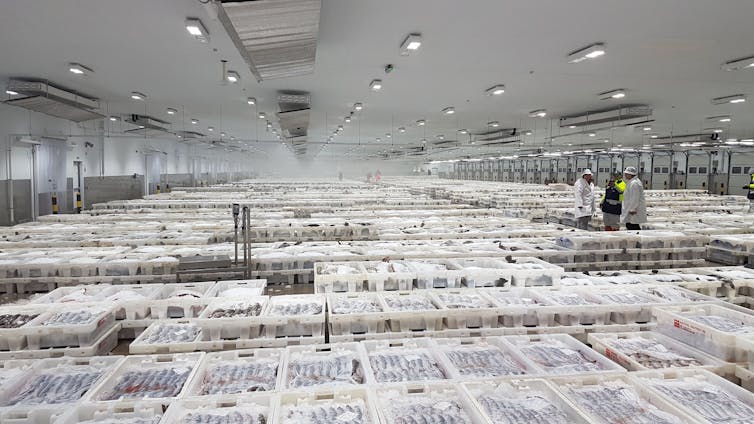
Peterhead fish market in northeast Scotland at auction time.Andy Forse
There is also an awareness of the possibility that the fishing industry ends up in a worse position, if negotiations with the EU go badly. What they want is for the UK government to provide a plan that ensures the future of their industry and their communities, while dealing fairly with fishermen from the EU, where a significant part of their business plan relies on access to UK waters.
This understanding of the potential plight of their fellow fishermen from Europe, were the UK waters to be closed to foreign vessels, is reflected in one person’s comments:
I do not think it is fair that on a vote of the UK that a man who has built up a business in Denmark, Holland, France all of a sudden loses out overnight. I think we should be man enough to say we’re changing the rules and we’re going to do it over a ten to 15-year period.
There is also concern that the current Brexit transition period leaves the fishing industry within the CFP while the UK has no say in its operation. But this is minor compared to the fear that the UK will leave the EU and remain in the CFP.
Little confidence in negotiations
Interviewees recognise that the fishing industry is of low economic importance to the UK and have little confidence in the negotiation. The largest concern is that, as part of the negotiations to withdraw from the EU, the fishing industry is used as leverage in wider trade negotiations and ends up in the same or a worse position. One person said:
It will just be a bargaining chip, the industry is nothing to the GDP in the UK, it’s less than 1%. Well, if you go to Denmark, you go to Holland, they all fight for their fishermen. France, Spain, you take the financial market in London, they’ll sacrifice the fishing industry to keep it.
The industry also cares about a future EU-UK trade deal, as the majority of fish products exported from the UK go to the EU. Currently, there are no tariffs or customs checks on these products. But there are concerns that tariffs on seafood exports would increase the price of their products which could reduce sales. Plus, any delays from customs checks would reduce the quality of the fresh produce as it increases the time between catching and arriving at supermarkets and restaurants on the continent. One fisherman summed up his concerns on trade and markets:
I think the main risk is our markets in Europe. I have a fear that there’s a closed-door there and we have a perishable commodity and we have lorries backing up at the channel and fish decreasing in quality, you know, that can hit the price in the market for us.
Clearly, there are fears over how things will pan out. The fishing industry voted for Brexit to escape the rules and regulations of the CFP, many of which are seen as troublesome at best. But the ongoing Brexit negotiations have provided no certainty or clarity to the fishing industry, which both fears its decline and hopes for an outcome that enables a renaissance in the UK’s coastal communities.