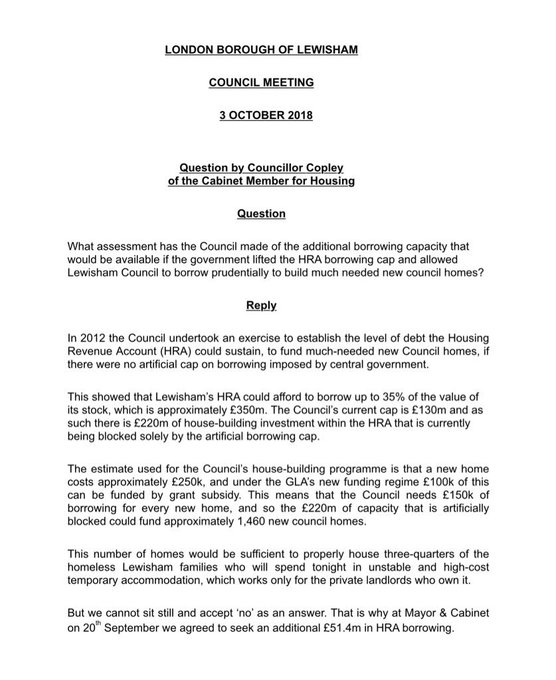
Futures Forum: Ending austerity > and allowing councils to borrow more to build more housing
Her Housing Minister was complaining about the quality of housing:
Minister accuses housebuilders of pushing ‘soulless’ housing | News | Building
With a piece from the editor of the Housing magazine:
Leader: The Tories put housing in the spotlight
By Chloë McCulloch
5 October 2018
The PM surprised conference with a welcome boost to council house building, but elsewhere private housebuilders got a bit of a kicking
Party conference season is all about style over substance – we expect rhetoric rather than detail, right? The Tories, just like Labour, have been busy tearing themselves up over Brexit, but they have also been keen to focus on some vote-winning policy areas, and so housing has had a particularly good airing.
The Conservatives were in for a surprise when the prime ministers closed their conference by announcing she was scrapping the cap on councils’ borrowing to build homes. In a speech where she pledged to end austerity she also singled housing out as “the biggest domestic policy challenge of our generation”. She did not say when the cap would be lifted, although the housing department has since indicated it will be “soon” and that the move could mean an additional 10,000 homes a year. So we can assume more details about exactly when and how that can be achieved will emerge in the Budget later this month.
The other obvious headline grabber has been the much-trailed ban on combustible materials in the walls of buildings over 18m. A popular move by housing secretary James Brokenshire, but not accompanied by any documents detailing what this means for construction professionals specifying building components. Does the ban cover cross-laminated timber, for example? Or other elements on the exterior of a building such as gaskets, seals and vapour membranes? Does it mean an end to full-scale testing of cladding systems as one way to comply with building regs? We won’t know until some unspecified date in the autumn.
Meanwhile, at a fringe meeting housing minister Kit Malthouse stuck his oar in telling his audience that buyers of new homes do so holding their noses: the most important purchase of their lives is made despite “misgivings about design and quality”. The minister clearly has the major housebuilders in his sights, blaming their dominance for a lack of competition and design innovation. He wants to disrupt the market and find the new “Dyson” among housebuilders.
This is a message aimed squarely at the Conservative party base – homeowners in the shires – often labelled as the nation’s staunchest nimbys – who will not be won over easily to the idea of large-scale homebuilding on their doorstep.
How do ministers square the circle of achieving a target of 300,000 new homes a year by the mid-2020s, while not alienating their heartlands? One way is to focus the debate not on the numbers but on the idea of quality and design. It’s a tactic we saw back in July with the launch of the revised planning rules in the National Planning Policy Framework (NPPF). The press release at the time flagged the framework as the “government’s new planning rulebook to deliver more quality, well-designed homes” – no room for doubt there.
But is the attack on the big names in housing deserved? Certainly the likes of Persimmon and Bovis have been in the firing line over defects, and in Bovis’ case it set aside £7m to deal with customer complaints. But the issue of design goes beyond homes with snagging problems or faults. What Malthouse is talking about is new housing estates that are soulless and with no sense of neighbourhood or place, those cul de sacs on the edge of towns and villages with row upon row of identical boxy homes.
Clearly this charge cannot be laid at all housebuilders – Barratt and Berkeley are just two with a reputation for more variety and for trying to respond to local contexts with better place-making. Barratt London, for example, does not use house types, its developments are bespoke for the particular site.
Moreover the Home Builders Federation, which conducts a home purchasers survey, would argue that the vast majority of customers are happy with their new homes. Those suburban boxes that city-centric architects so hate are what people around the country want. Modernist designs, the argument goes, might have a market in the cities but elsewhere people pay for a traditional house. Far out designs simply don’t get the sales rates, which is a fair point.
Of course, good design does not have to be about “out there” design; it can be about creating better street scenes, finding practical solutions to get cars off the streets or planning a new neighbourhood around local facilities. And the changes to the NPPF make clear that the government intends this focus on design to be embedded in the planning system and that proposals should be in line with what communities want. Fine in theory, harder in practice – as the leader of Buckinghamshire county council attests, it’s not easy for planning departments to challenge developers over their designs. If councillors turn down a proposal on design grounds, the likelihood is that the planning inspector will overturn that decision on appeal.
Malthouse indicated that good design could be fast-tracked through the planning system, but a conference platform is never the place where the finer points of a new policy push are nailed down. By contrast, it is perfect for a bit of housebuilder bashing. Insiders blame Persimmon’s excessive bonus payments for poisoning ministers’ views of the whole sector, but the government has also taken a dim view of the leasehold scandal and slow build out rates on big sites.
So, no surprise Malthouse’s boss, James Brokenshire, told the Sunday Telegraph he is “reflecting carefully” on the future of Help to Buy. The government committed another £10bn to the scheme a year ago and extended it to 2021, but critics who say it simply lines the pockets of housing bosses are lobbying for it to be scrapped. Housebuilders will be hoping it will be reformed rather than cancelled completely. But they’ll be only too aware that their unpopularity these days makes them an easy target.
The PM surprised conference with a welcome boost to council house building, but elsewhere private housebuilders got a bit of a kicking
Party conference season is all about style over substance – we expect rhetoric rather than detail, right? The Tories, just like Labour, have been busy tearing themselves up over Brexit, but they have also been keen to focus on some vote-winning policy areas, and so housing has had a particularly good airing.
The Conservatives were in for a surprise when the prime ministers closed their conference by announcing she was scrapping the cap on councils’ borrowing to build homes. In a speech where she pledged to end austerity she also singled housing out as “the biggest domestic policy challenge of our generation”. She did not say when the cap would be lifted, although the housing department has since indicated it will be “soon” and that the move could mean an additional 10,000 homes a year. So we can assume more details about exactly when and how that can be achieved will emerge in the Budget later this month.
The other obvious headline grabber has been the much-trailed ban on combustible materials in the walls of buildings over 18m. A popular move by housing secretary James Brokenshire, but not accompanied by any documents detailing what this means for construction professionals specifying building components. Does the ban cover cross-laminated timber, for example? Or other elements on the exterior of a building such as gaskets, seals and vapour membranes? Does it mean an end to full-scale testing of cladding systems as one way to comply with building regs? We won’t know until some unspecified date in the autumn.
Meanwhile, at a fringe meeting housing minister Kit Malthouse stuck his oar in telling his audience that buyers of new homes do so holding their noses: the most important purchase of their lives is made despite “misgivings about design and quality”. The minister clearly has the major housebuilders in his sights, blaming their dominance for a lack of competition and design innovation. He wants to disrupt the market and find the new “Dyson” among housebuilders.
This is a message aimed squarely at the Conservative party base – homeowners in the shires – often labelled as the nation’s staunchest nimbys – who will not be won over easily to the idea of large-scale homebuilding on their doorstep.
How do ministers square the circle of achieving a target of 300,000 new homes a year by the mid-2020s, while not alienating their heartlands? One way is to focus the debate not on the numbers but on the idea of quality and design. It’s a tactic we saw back in July with the launch of the revised planning rules in the National Planning Policy Framework (NPPF). The press release at the time flagged the framework as the “government’s new planning rulebook to deliver more quality, well-designed homes” – no room for doubt there.
But is the attack on the big names in housing deserved? Certainly the likes of Persimmon and Bovis have been in the firing line over defects, and in Bovis’ case it set aside £7m to deal with customer complaints. But the issue of design goes beyond homes with snagging problems or faults. What Malthouse is talking about is new housing estates that are soulless and with no sense of neighbourhood or place, those cul de sacs on the edge of towns and villages with row upon row of identical boxy homes.
Clearly this charge cannot be laid at all housebuilders – Barratt and Berkeley are just two with a reputation for more variety and for trying to respond to local contexts with better place-making. Barratt London, for example, does not use house types, its developments are bespoke for the particular site.
Moreover the Home Builders Federation, which conducts a home purchasers survey, would argue that the vast majority of customers are happy with their new homes. Those suburban boxes that city-centric architects so hate are what people around the country want. Modernist designs, the argument goes, might have a market in the cities but elsewhere people pay for a traditional house. Far out designs simply don’t get the sales rates, which is a fair point.
Of course, good design does not have to be about “out there” design; it can be about creating better street scenes, finding practical solutions to get cars off the streets or planning a new neighbourhood around local facilities. And the changes to the NPPF make clear that the government intends this focus on design to be embedded in the planning system and that proposals should be in line with what communities want. Fine in theory, harder in practice – as the leader of Buckinghamshire county council attests, it’s not easy for planning departments to challenge developers over their designs. If councillors turn down a proposal on design grounds, the likelihood is that the planning inspector will overturn that decision on appeal.
Malthouse indicated that good design could be fast-tracked through the planning system, but a conference platform is never the place where the finer points of a new policy push are nailed down. By contrast, it is perfect for a bit of housebuilder bashing. Insiders blame Persimmon’s excessive bonus payments for poisoning ministers’ views of the whole sector, but the government has also taken a dim view of the leasehold scandal and slow build out rates on big sites.
So, no surprise Malthouse’s boss, James Brokenshire, told the Sunday Telegraph he is “reflecting carefully” on the future of Help to Buy. The government committed another £10bn to the scheme a year ago and extended it to 2021, but critics who say it simply lines the pockets of housing bosses are lobbying for it to be scrapped. Housebuilders will be hoping it will be reformed rather than cancelled completely. But they’ll be only too aware that their unpopularity these days makes them an easy target.
Chloë McCulloch is acting editor of Building
Leader: The Tories put housing in the spotlight | Comment | Building
See also countless East Devon Watch blog postings which make the same points, just from the last couple of months...
- about bad quality:
“Housebuilder Barratt shrugs off market worries to post record profits” | East Devon Watch
Barclays refuses mortgages on controversial Taylor Wimpey new homes – and Taylor Wimpey share price INCREASES! | East Devon Watch
New homes: extra small and privacy only in the toilet | East Devon Watch
Do you have a Taylor Wimpey house? Check your mirrors! | East Devon Watch
- and about help to buy:
“Builders in a panic over Help to Buy” | East Devon Watch
“First-time buyers: average salary requirement rises 18% in UK cities” | East Devon Watch
“Help to buy” – or help to rip off? | East Devon Watch
“Persimmon profits rise 13% after help-to-buy boost” | East Devon Watch
“Are developers inflating the prices of homes through Help To Buy? “ | East Devon Watch
“Help to Buy mess as taxpayers subsidise thousands of homes for couples earning more than £100,000” | East Devon Watch
.
.
.